Space and the Paradox of Multi-Space. Baudrillard and Heidegger in Conversation
by Dr. Shing-Shang Lin
Abstract
Traditionally, metaphysics has understood space either as a neutral container encompassing all entities or as a formal condition of subjectivity. In contrast, the conceptions of space proposed by Baudrillard and Heidegger depart from this classical paradigm by reorienting attention to human existence, the lifeworld, and the human being as the locus of spatial intelligibility. Their views of space are distinctly thing-oriented, yet characterized by multiplicity and involve language in an expansive sense. Furthermore, their accounts of space are deeply entangled with the question of technology — though each in a markedly different modality and conceptual register.
Keywords: Baudrillard, Heidegger, Simulation, Space, Hyperreality
Like time, space has traditionally been conceived both as a form and as a condition of human existence. In classical metaphysics, space is regarded as unique, eternal, and unproduced — that is, as an independent and immutable backdrop to being (das Sein). However, for Heidegger — and to a certain extent, also for Baudrillard — the question of space arises not within metaphysics (at least not in its traditional form), nor within physics, but within the horizon of human existence itself.
Their conceptions of space are constituted through relational structures rooted in existential activity, giving rise to a multiplicity of spaces rather than a singular, fixed spatial order — even though their orientations diverge. Baudrillard approaches space through the lens of political-economic systems, whereas Heidegger engages it ontologically, initially through the framework of fundamental ontology, and subsequently by way of the concepts of Ereignis (enowning) and also through “the presencing (wesende) relation to being as being” [1].
Thus, while both thinkers address the reality of space, they do so through divergent perspectives and methodologies.
Despite their methodological differences — most notably Baudrillard’s avoidance of a “phenomenological reading” [2], his descriptions often take on Heidegger’s phenomenological tone, particularly through what he terms “semiological reduction” [3], a move that echoes phenomenological reduction and destruction of Heidegger’s phenomenology [4]. Both thinkers employ etymology as a method for uncovering the obscured origins and intrinsic ambiguities of concepts. Furthermore, Baudrillard’s processes of deconstruction and reconstruction are, to varying degrees, influenced or inspired by Heidegger’s phenomenology and hermeneutics. Although their respective conceptions of space emerge from distinct philosophical frameworks — Heidegger’s ontology and Baudrillard’s semiology — they converge in a crucial respect: for both, space is not fundamentally physical.
Further parallels can be found in their spatial thinking: each adopts a thing-centered, relational understanding of space characterized by multiplicity. These shared elements form a conceptual bridge, enabling a productive dialogue between their otherwise divergent approaches to spatiality.
Since space, for both Heidegger and Baudrillard, is neither eternal nor independent — as it is in traditional metaphysics — it must, in some sense, be created or produced. This provokes an unavoidable question: What creates space, and by what means? Given the accelerating transformations brought about by modern technology, a second, equally urgent question arises: How is space being produced today, and under what conditions? How do Heidegger and Baudrillard conceive of space and its properties within this ongoing technological transformation? Ultimately, we are compelled to ask: What kind of space do we now inhabit? And more intimately still: What kind of space do we live in today, as human beings both shaped by and actively shaping these conditions?
1. SPACE MAKING
For both Baudrillard and Heidegger, space is constituted through diverse processes, resulting in a plurality of spaces. Each of these spatial forms may refer not only to truth or reality, but also to modalities of untruth or irreality. In Baudrillard’s account of consumer society, space is phenomenally produced by objects — not as isolated entities, but through the intricate dynamic networks of relations they establish among themselves. More fundamentally, this spatial production is semiologically grounded, operating as a semiological hyperspace. Such a hyperspace is generated by signs and codes through ongoing processes of deconstruction and reconstruction within the regimes of simulation and symbolic exchange.
In contrast, Heidegger’s understanding of space is rooted in ontology, and more specifically, in fundamental ontology. His early thinking about space-making — explorations through phenomenology and hermeneutics — differs markedly from the approached developed in his later philosophy. In the 1920s, Heidegger argues that space is constituted only insofar as the human being, as Dasein, factically exists. Through this process of Dasein’s “making space by itself (Sicheinräumen)” [5], space is actively generated by Dasein’s own activity. This implies that space is constituted and centered through human beings as Dasein; however, Heidegger categorically rejects any reading of his thinking ground in anthropocentrism. Given his foundational thesis that the being of Dasein is care (Sorge), he would argue that it is care, not the human being per se, that occupies the center of existence or a privileged position within space. For Heidegger, it is not its status as subject in the central position that defines Dasein, but its disclosing or closing openness to being.
While Heidegger makes clear that his inquiry into being, time, and space does not proceed on a psychological level, Being and Time (1927) nonetheless reveals a primordial motivation underlying human activity. This motivation is not grounded in will or a will-to-power, but in care. Since care always involves a relation to something — something cared for — Heidegger locates the source of human activity within the very structure of Dasein. Accordingly, such activity serves to cultivate and reinforce a particular form of human subjectivity. While the specific motivations of action may shift with historical or environmental contexts, Dasein retains a privileged role in the constitution and articulation of space in the analytic of Being and Time. In contrast, for Baudrillard in The Consumer Society (1970), space is primarily produced through the interplay of objects and signs.
The space in which we exist today has been fundamentally transformed: we are increasingly surrounded by things, and our connections to others are mediated — indeed structured by things as objects, precisely a set or a series of objects. For Baudrillard, the motivation of human as consumer is also affected by a serial object, and even by the complex “super-object” so that the consumer is drawn into “a series of more complex motivations” [6]. In this way, “the center of the world is no longer the desire of the subject, but the fate of the object” [7]. Anyhow, the space making by both of them is in some way connected with relationships.
In Heidegger’s early philosophy, this relation, grounded in care, is existentially constituted through involvement (Bewandtnis), initially via the referential or formal indication of things as instruments encountered by the human being [8]. In this way, the pure “where-in” (Worin) and the dynamic “where-upon-to” (Woraufhin) are revealed as ontological structures of primordial spatiality — structures more fundamental than the mere multiplicity of the three physical dimensions.
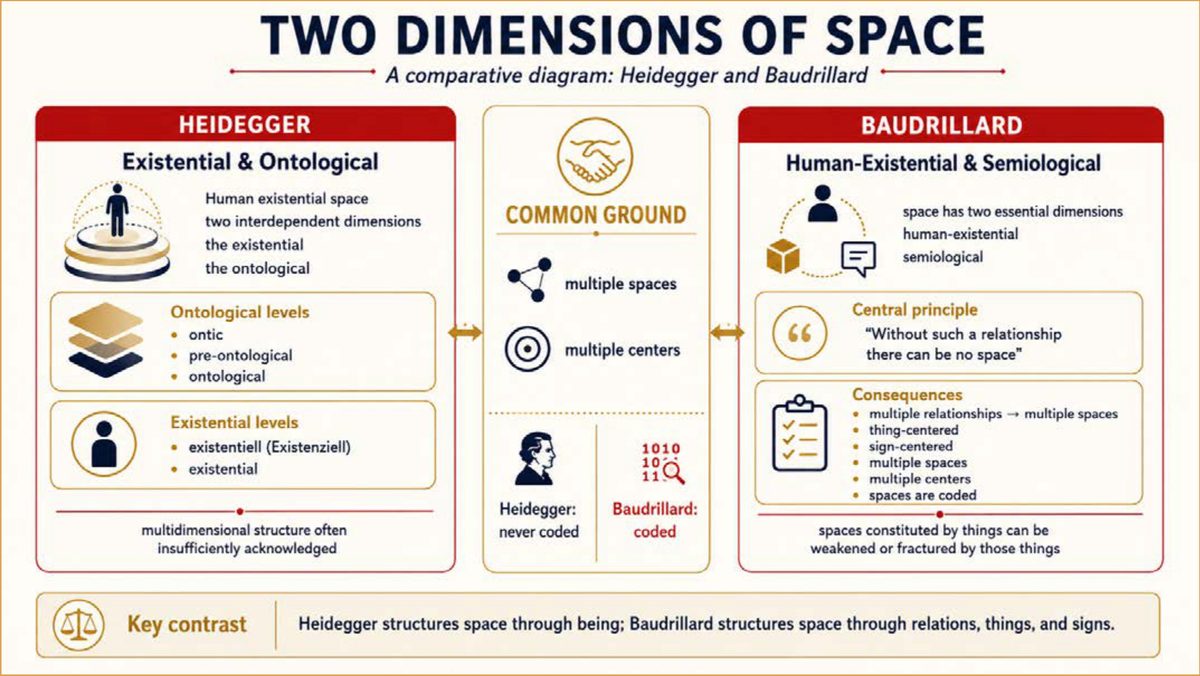
In Heidegger’s early philosophy, the space-making of Dasein occurs in both an ontological and an existential sense. Consequently, human existential space can be understood as comprising two interdependent and mutually involved dimensions: the existential and the ontological. According to fundamental ontology, the structure of space encompasses three ontological levels: the ontic, the pre-ontological, and the ontological — or two existential levels: the existentiell (Existenziell) and the existential. However, due to what Heidegger terms the forgetting of being, the proposition that space possesses such a multidimensional structure has, in his view, remained insufficiently acknowledged within philosophical discourse.
Baudrillard conceives space as having two essential dimensions: the human-existential and the semiological. Central to his understanding of space-making is the fundamental role of relations. “Without such a relationship there can be no space.” [9] Thus, when multiple relationships coexist simultaneously, multiple spaces are consequently formed. And the consumption is regarded as “an active form of relationship (not only to objects, but also to society and to the world), a mode of systematic activity and global response which founds our entire cultural system” [10]. Things as objects not only mediate relationships between people and connect consumers to the political-economic system, but they can also weaken or disrupt these very relationships. This means that spaces constituted by things are themselves vulnerable to being weakened or fractured by those things. Since each space formed through relationships is initiated and structured around objects, each space possesses a core object as its center. Thus, phenomenologically, the space of consumer society reveals itself as obviously thing-centered. But the object is grasped rather “in its total signification” [11], thus the space of the consumer society is fundamentally the sign-centered one. Thus, according to Baudrillard, multiple spaces exist, each with its own multiple centers. Heidegger also acknowledges the existence of multiple spaces with multiple centers, but these spaces are never coded.
Insofar as the ontological difference is acknowledged by Heidegger, space can be understood as possessing two kinds of attributes. The first is space as a whole in the ontological sense; the second, emphasized primarily in Heidegger’s later philosophy, comprises the ontical-ontological spaces arising from the spatialization of things and simultaneously the process of enowning by itself (Sich-ereignen). These two dimensions stand in a whole-part relationship. In this regard, Heidegger’s thought is, to some extent, influenced by Kant [12].
While Heidegger retains the traditional metaphysical notion of space as a totality, it does not constitute the core of his spatial conception. Rather, he centers his inquiry on the ontical-ontological spaces, most notably the space of the world or of the fourfold (Geviert), which constitute the ground of Heidegger’s onto-topology. Here, we adopt the prefix onto- (ὄντο) to reflect the dual meaning inherent in the Greek on (ὄν) and to on (τὸ ὄν), denoting both beings (das Seiende) and being (das Sein) in a single gesture. Although he refers to the “topology of beyng (Seyns)” in 1947 [13], his late philosophy clearly understands space not only as the topology of being/beyng, but as fundamentally bound up with beings. Thus, the here newly proposed concept of onto-topology can be understood as a topology of both being and beings, insofar as “being withdraws by concealing (ent-birgt) itself in beings.” [14]. The ontical-ontological spaces in onto-topology represent the conjunction of being and beings by late Heidegger.
As one of the four, the human being as mortal accomplishes its own being through an ontical-ontological relation with the other three of the fourfold. In this context, the human is no longer the center of the world. Yet the fourfold is not the only expression of worldhood in Heidegger’s later philosophy. Spatiality and world are opened through the enowning (Ereignis) of the fourfold and through the saying (Sage) of being, which he considers the essence of language. The saying of being plays a distinctive role: it paves the way both for the opening of the world and for those who can hear and receive this Saying to take part in its emergence. Fundamentally, language as gathering and letting-presence (anwesen lassen) establishes relation. Thus, language is described as “the relation of all relations.” [15]
As Baudrillard insightfully puts it, “Without relation, there is no space (Sans relation, pas d’espace)” [16]. Accordingly, in Heidegger’s later thought, language — or logos— grounds space-making in both the ontological and ontical-ontological dimensions.
2. DECENTERED MULTI-CENTERED SPACE
Though Baudrillard analyzes familiar spatial forms in consumer society, like the living room, shopping mall and drugstore, he does not conceive of space as composed of discrete, isolable parts.
Unlike Baudrillard, Heidegger, particularly in his early philosophy, distinguishes various spatial components and categories. He adopts general or everyday spatial terms such as place, region, location, and distance, and reinterprets them phenomenologically to reveal their primordial structures. Although he explains that space as region (Gegend) is constituted through directing (Ausrichten) and that distance arises through de-severing (Ent-fernung), the center of this space is neither the act of directing nor that of de-severing, but the human being as such. Since directing and de-severing arise from the existential constitution of human being, region and distance as fundamental structures of spatiality are primordially disclosed through human existential activity in the world.
Different human activities give rise to different relations, each relating to distinct spatial regions, for instance, an instrumental space for manufacturing or a contemplative space for learning. These relations center upon configurations determined by the human activities from which they arise. Accordingly, human existential spaces and their constituents are constructed through everyday life, yet remain open to the possibility of transformation or deconstruction as relational structures shift. These spaces are thus multi-centered, yet also subject to decentering as relational patterns shift. By Heidegger, this implies that a space or place is not strictly both centered and decentered at once. Rather, due to the multiplicity of centers, human existential space becomes decentered in the sense that the notion of a single, fixed center is dissolved.
In the 1980s, Baudrillard indicates that the hyperspace is mobile and decentered [17]. But we find that his claim ultimately contradicts itself. His concept of hyperspace not only gives rise to paradoxes, but also reveals an internal inconsistency within its own structure. While he asserts that “the geometry of the code, however, remains fixed and centralized” [18], he simultaneously describes hyperspace, a space constructed through code, as decentered, where hyperreality is produced. This reveals a contradiction: hyperspace is not merely decentered but also centered, and therefore cannot properly belong to the domain of the real or the true [19]. Within hyperspace, the real, the virtual, and even the irreal become indistinguishable.
By Baudrillard, hyperspace is inherently multiple, and its most prominent form appears in the hyperspace of the screen, a space composed of two distinct layers. The first is on the screen: a surface characterized by curvature, which is neither flat nor strictly geometric. The second is within the screen: a space constructed by code and made visible through digital display. Both of these layers are part of a space of direct manipulation and belong to the same homogeneous space, thus creating a site marked by the absence of depth. Baudrillard’s hyperspace is riddled with spatial paradoxes. Most notably, while it opens up multiple spaces and virtual worlds on its surface, it simultaneously closes off the real world by folding it back into itself or “closes this world on itself” [20]. Second, hyperspace is a space that simultaneously expands and contracts — offering the illusion of boundless access, yet remaining confined within the limits of the screen. Third, all spatial dimensions within the hyperspace of the screen are simultaneously absorbed into and fragmented by the screen itself. In this sense, hyperspace becomes a site of irreconcilable contradictions. Consequently, human existence within hyperspace is itself paradoxical — immersed in a space that is at once open and closed, multiple and flattened, infinite and depthless.
The kind of space constructed through object-related relationships in consumer society reveals a paradoxical duality. On the one hand, it is spatially and materially limited, both by the finite lifespan of manufactured objects and by the constraints and manipulations of the political-economic system; on the other, for Baudrillard, the true construction of objects is symbolic: constituted through signs and codes. Grounded in symbolic exchange, this coded space can transcend temporal limitations and thus possesses a kind of virtual infinity. Yet this very infinity remains constrained by the economic system, resulting in what may be called a paradoxical limited infinity.
The object-constructed space also contains a fundamental paradox. Its premise lies in the fact that relationships are constituted through objects. Yet this requires that the functional roles of objects be transcended. Only then can space be, as Baudrillard puts it, “opened up, animated, invested with rhythm, and expanded by a correlation between objects.” [21]. In this sense, space is, for Baudrillard, primarily a relation and also a “between”. Space emerges from the interplay between objects and, in turn, becomes “the universal function” of the relationships between objects and their values. This implies that: the more space is occupied by objects, the less free space remains [22].
Baudrillard thus distinguishes between two kinds of spatial freedom. The first is formal freedom: a space that plays freely between objects and is immediately perceptible. The second is true freedom, which resides in signification and arises only when the functional logic of objects is transcended. However, in consumer society, no product can exist without function. Yet crucially, function is no longer the decisive factor in consumption; instead, it is simulation and symbolic exchange that govern consumer behavior. As such, no one within consumer society is immune from the limitations and manipulations of the political-economic system.
The space constituted by objects/ things by Baudrillard and also by Heidegger is inherently multiple, defined by a plurality of centers. In the contemporary age, technology continues to enhance the functional value of things as products, solidifying the enclosure and constraints of space, while simultaneously rendering these constraints less perceptible. On the surface, according to Baudrillard, space appears to open and expand, animated by a dynamic and seemingly free-flowing rhythm. Yet, as McLuhan observes, technology “tends to restrict and enclose space” [23]. In truth, this space is circumscribed and structured within the boundaries and realities shaped by serial objects, by the passive constraints embedded in their functions, and by the manipulative logic of the politico-economic system. The object-centered spatiality of the consumer-technological society thus constitutes a pseudo-open space: one that simulates openness while subtly enforcing control. Its limitations and mechanisms of manipulation often go unrecognized, concealed beneath the surface of spatial freedom — and even more so under the ideological guise of democracy.
In particular, according to Baudrillard, the politico-economic system grants consumers, and indeed all individuals, the “freedom” to choose, thereby allowing them to be “recognized as enjoying sovereignty” [24]. Yet the paradox of space, along with its pseudo-openness, remains difficult to discern, precisely because it is veiled by the illusion of so-called unlimited expansion: the boundless realms of the internet, the infinite links, and the ceaseless surfing. Both the internet and modern transportation technologies reveal another paradox inherent to human spatial existence — one that profoundly shapes our how-to-be-in-the- world. Enabled by technological mobility, object-constituted space appears to move freely, animated by rhythm and acceleration. Yet paradoxically, we human beings find ourselves increasingly fixed and stationary before the glowing point of a screen or enclosed within the capsule of a vehicle. In the name of movement, we become immobile [25].
The hyperreal by Baudrillard is, in itself, a concept grounded in paradox: it is, as Baudrillard defines, “a real without origin or reality” [26]. Hyperspace, as constructed through symbolic exchange and simulation, the system of signs standing in for the real, operates within the logic of simulation, wherein the real is infinitely reproducible, and yet simultaneously irrelevant. In such a space, difference vanishes. Thus, simulation “threatens the difference between the ‘true’ and the ‘false’, the ‘real’ and the ‘imaginary’”, undermining representation and eluding the principle of truth. Yet this does not imply that simulation is simply false. Rather, it constitutes a zone of transition: from the reflection of a profound reality, to the point where there is “no relation to any reality” at all [27]. Like the Möbius strip, simulation can continue indefinitely in a kind of implosion, an implosion of meaning, characterized by “the absorption of causality and of the differential mode of determination” [28]. In this way, simulation gives rise to a fractal space that is both self-signifying and self-alienating. Simulation is not merely a conceptual structure; it is a strategy, a force relation, a site of struggle or “a stake”, and “the object of a social ‘demand’”. It constitutes a system, and, at the same time, a space: one of “absolute manipulation”, but also of the “indifferentiation between the active and the passive” [29]. Built upon this regime of simulation, hyperspace where is the play of simulation stands at a pole radically opposed to Heidegger’s spatiality and time-play-space which are rooted in the tracing of the truth of being and of existence. The former is a space of infinite surface, circulation and fractal; the latter, a onto-topology of truth combined with temporal emergence and existential inscription.
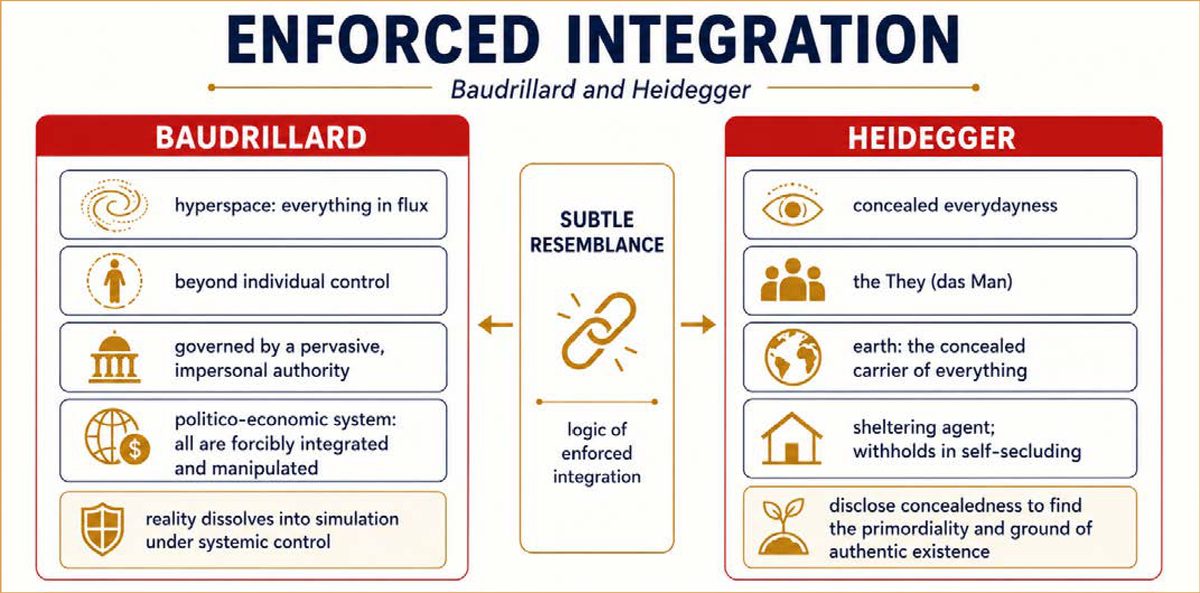
Although both of them, Baudrillard and Heidegger, gesture toward a kind of truth, they do so in radically opposite directions. Baudrillard focuses on the concrete collective phenomena of life and the actual conditions of human existence in the consumer society. He constructs, deconstructs, and ultimately reconstitutes these realities as hyperreal, and exposing how the real and the unreal, the true and the false, are interwoven, masked and reproduced in the fabric of contemporary life. Within the hyperspace he theorizes, nothing remains fixed; everything is in flux: constantly shifting, unstable, and beyond individual control. Yet paradoxically, this very instability is governed by a pervasive, impersonal authority. Baudrillard refers to this as the politico-economic system, an apparatus into which all are forcibly integrated and manipulated. This logic of enforced integration bears a subtle resemblance to what Heidegger describes in the 1920s as the concealed everydayness and the statement of the They (das Man), and later, in the 1930s, as the earth in the ontological sense: the concealed carrier of everything. The earth carries as sheltering agent and withholds in self-secluding, and in so doing, uncover its concealedness. Thus, while Baudrillard reveals how reality dissolves into simulation under systemic control, Heidegger seeks to disclose the concealedness, in order to find out the primordiality and ground of authentic existence.
In Heidegger’s thought, there are ultimately no paradoxes in issues of time and space, or between human existence and being, truth and untruth. Firstly, this is an analogous dialectic operates within these structures. “Truth is un-truth, insofar as there belongs to it the reservoir of the not-yet-uncovered, the un-uncovered, in the sense of concealment.” [30] Secondly, through the ontological difference, he distinguishes between two levels of reality: the ontological and the ontical.
Opposites, such as truth and un-truth, concealment and un-concealment, do not contradict each other but coexist on different planes. Thirdly, especially in his thinking of the 1930s, he emphasizes the primal conflict (Urstreit) between opposites such as the closed earth and the open world. This conflict is not to be resolved, but unified as an ontological dynamic and movement. Conflict, in his view, are not a problem to be eliminated but the necessary condition for the unfolding of being as such, namely the occurring of Being. “Truth is the primal conflict in which, always in some particular way.” [31] In Heidegger’s ontology, the opposites not only coexist but require each other; they are interdependent.
Their relation gives rise to the very movement of Being — it is the origin of its dynamism. More than that, this primal conflict constitutes the force that enables the occurring of the truth of being (enowning, Ereignen), and in this sense, it functions as the ontological dynamic that opens a clearing (Lichtung) where is the ontological spatiality and in where opening and concealing continue to fight each other.
For Baudrillard and also for late Heidegger, what occupies the center of space is neither a purely natural entity nor an essential thing-in-itself. Rather, the human being situates itself indirectly at the center through the production and presence of the artificial thing. Yet this does not imply that the individual human being exercises control over space. On the contrary, it suggests that the human’s relation to space is mediated and conditioned by the very things it produces. The artificial thing, far from simply serving human intention, becomes the structuring force of spatial experience itself, neither by Heidegger nor by Baudrillard. Their thoughts tend to be de-anthropocentric, but also tend to favor human collectivism and collective activities, like talking or mood in everyday life by early Heidegger, or like human collective activities of consumption by Baudrillard.
For Heidegger, the human being as Dasein is always, in some way, with others — even in solitude. This fundamental condition of being-with (Mitsein) or Dasein-with (Mitdasein) underlies all existence. For Baudrillard, however, human beings today find themselves surrounded by and relationally embedded within a world of things as objects that are circulated, consumed, and positioned within the politico-economic system. These things mediate human relations: they connect, but they also separate. In this sense, the human environment is no longer simply given or natural, but constructed and continually reconstructed through objects. The world of things not only shapes the conditions of human coexistence, but also determines the spatial and relational fabric in which that coexistence unfolds.
More importantly, for both thinkers, the thing that stands at the center of space is, in some essential way, bound up with language. For Baudrillard, the thing is tied to signification and embedded in systems of signs, codes, denotation, and connotation. The object is not simply present; it is encoded, circulating meaning within the politico-economic and semiotic structures of simulation. For Heidegger, by contrast, the thing is gathered into Saying (Sage) which is not regarded as representation, but as a letting-speak of being. Language, in this sense, is not a tool for talking about being, but a way of responding to and after-saying (Nach-sagen) of poet during the occurring of being, and equally, through philosophizing thinking which is not the indirect conceptual thinking or representing about being, but the thinking of being, namely the thinking directly lets the being and the truth of being occur.
In Heidegger’s late philosophy, enowning (Ereignis) is the authentic center of space, not in an ontic or merely phenomenal sense, but ontologically. While the thing appears to lie at the center of the fourfold (Geviert) which is the gathering sky and earth, mortals and divinities, this gathering is not initiated by the thing itself. Rather, it is made possible by enowning (Ereignis), or more precisely, by the ontological movement of to-enown (ereignen), which grants each being its own proper place, its ownness (Eigentum). It is through this occurrence, the event of the truth of being, that both the human being and the thing are brought into their proper essence. In this sense, spatiality is not primarily structured by objects or by human positioning, but by the clearing (Lichtung) that opens in the event of enowning. Here, being happens, not as presence, but as appropriation.
For both thinkers, Heidegger and Baudrillard, what occupies the center of space is not natural but produced, yet their interpretations diverge fundamentally. Baudrillard who argues that, within the context of consumer society, nature is expelled from the human world and reduced to a system of production and consumption. Heidegger, in contrast, reconsiders physis not as raw material but as a mode of bringing-forth (Her-vor-bringen)—a revealing of being. In this sense, production is ontological, not merely technical. Through this ontological lens, Heidegger preserves a space for the divine even after Nietzsche’s proclamation of the “death of God.” The divine is not restored as an entity, but as part of the event of being’s unfolding, the truth of being in sense of a-letheia. Within the fourfold, what is gathered is not beings per se, but four places or regions (sky, earth, mortals, divinities) where the presencing (Anwesen) of beings as a whole may occur. These are not categories in a metaphysical or epistemological sense, but ontical-ontological clearing, sites where being can occur and where truth can be disclosed. In this way, both the fourfold and the thing are ontical-ontological. The thing, as product of everyday life, such as a bridge, a building, a pitcher, does not merely occupy a space, but gathers space. With the decisive turn in Heidegger’s thinking in 1946, he redefines the relation between being and beings, declaring: “being withdraws by con-cealing (ent-birgt) itself in beings.” [32] Thus, the thing is no longer just in space; it makes space. It is itself a site (Stätte), a location (Ort) through which the fourfold is allowed to appear.
Yet the thing does not unite the four; it gathers them. Only in the thinging of the thing, when the thing becomes an activity, a process rather than an object, can it truly dwell. During enowning, the thing gathers the four into nearness, without dissolving their difference. In this gathering-together, the four enter into a relation of accord, not identity. Each reflects the others “in its own way, into its own, within the simplicity of the four.” [33] Through this reflective mirroring, the fourfold belongs together, not through force, but through letting-be. This kind of mirroring is neither a mode of thinking, nor a likeness, nor a simulation. It is not epistemological reflection, nor Platonic imitation. Rather, it is an ontological mirroring, that is a letting-appear of beings in their ownmost (eigenst) essence.
To a certain extent, Heidegger’s notion of mirroring reinterprets Plato’s image of production [34]. It produces, but not in the sense of generating phantoms or copies of substance, as in Platonic mimesis. Nor is it, as Baudrillard would claim, the mirror of production shaped by the “discourse of representation” [35], that is, the system of simulation in which signs refer only to other signs.
Heidegger’s mirroring is the play of enowning (Ereignis). It does not reduce the four (sky, earth, mortals, divinities) into a unified totality, nor dissolve them into equivalence. Rather, it lightens (makes visible) the proper being of each, allowing each to present itself from itself, entering into “a simple belonging to one another” [36]. In this ontological play, the four are not subsumed, but granted space to be. Each plays to the others, not competitively, but with brightness and harmony. None insists on its own dominance; rather, each is set free into its own, and in that freedom, each is bound into a shared simplicity that is a resonance of essential nearness. Without such mirroring, the relation of the four could not be established. It is mirroring that lets the fourfold come into presence, not as a metaphysical structure, but as a poetic gathering, an event of openness, where being as such gives space for belonging.
In Heidegger’s later philosophy, the relation between being and beings (once characterized by ontological difference) is no longer marked primarily by interruption or separation, but is mediated and gathered through the thing. This transformation is grounded in the recognition of two distinct yet interrelated layers of spatiality: the ontical and the ontological. Though they are distinct in level, they belong to one unified order: the onto-topological order. On the ontical and phenomenal level, the thing as a being can connect, relate, and gather; however, it cannot by itself bring forth the truth of being. Strictly speaking, it cannot establish an ontological relation without more. And yet, in the light of enowning, the thing is not merely a being, it harbors being within itself. In this way, it becomes capable of participating in the event of truth. During the occurrence of enowning, the thing appropriates itself to being, and in so doing, it gathers the ontological and ontical dimensions into a unified relational field.
It is precisely in this act that the thing becomes an authentic thing. It fulfills its essence when, as Heidegger says, “the thing things” [37]. But this is not automatic, but a prerequisite grounded in the event of being. Without enowning (Ereignis), the thing remains merely present-at- hand; only through this ontological appropriation does the thing truly come into its own.
Contrary to Baudrillard’s understanding of the relation between thing and language, Heidegger conceives the authentic meaning of the thing not in terms of sign or code, but as language itself. For Heidegger language is not any kind symbolic system of representation; rather, it is the originary event through which the thing becomes a thing. As he states: “The word conditions the thing to become a thing”, and “leaves the thing as present (anwesen)” [38]. That is, the thing only comes into its own being, namely its proper presence, where “the word is preserved.” [39] In this view, language is not an external medium for describing things, but the very space in which things come into presence. This ontological space is the clearing (Lichtung) that lets the thing appear as what it is. Thus, language is not about the thing. It is the dwelling of being that lets the thing thing.
This relation first constructs and determines the horizontal dimension of space, including the boundaries of the environment. This horizontal space is constituted not only by things but also by language; thus, space is centered not solely on things but equally on language. Secondly, the relation also constructs the vertical dimension of space, which transcends the ontical to the ontological level which space may be called the onto-topos [40]. Therefore, space is a layered phenomenon, simultaneously shaped by the interplay of things and language, bridging the concrete environment and the fundamental ground of being.
Baudrillard’s concept of space remains confined to the horizontal surface. Yet his thing-centered spatiality is, in a sense, more radical than Heidegger’s. He reveals how people are defined themselves through significations of their objects, namely how objects, as commodities, become categories that, in the most tyrannical fashion, define categories of people. For Baudrillard, space is not ontological but socio-economico-political. It emerges within consumer society and the realm of everyday life, structured through practices of consumption and dominated by the politico-economic system. More precisely, it is a space constructed and controlled by signs and codes as manipulated by that very system. In this way, Baudrillard’s spatial theory reveals the deep entanglement of identity, objecthood, and power, politico-economic power and also the power of unconsciousness, but without grounding these in the ontological unfolding of being, as Heidegger does.
For Baudrillard, the relational structure constituted by language is defined through the denotation of objects, signifying “correlation.” This correlation exists solely between things as objects, specifically, serial products, and both the relation and its corresponding space are deconstructed and reconstructed via the signification inherent in symbolic exchange and simulation. Within this process, “in the self-centered image or the code-centered message, the signifier becomes its own signified” [41]. Consequently, space is centered by the thing itself, where correlation serves as the necessary and sufficient condition for the formation of space, even within a sign-centric framework. Regarding the concept of space for both Baudrillard and Heidegger, authentic space is constituted and centered by language; however, for Baudrillard, this refers to the sign or code, whereas for Heidegger, it pertains to the Saying of being or the logos of being.
For Heidegger, In the logos-centric world, there are three layers of space: the saying of being, the saying of the poet, and human speaking. The poet and thinker serve as mediators between the other two layers, while both attend to hearing and responding to the stillness (Stille) emanating from the saying of being. Following this attentive listening, the poet speaks what comes after being’s saying, and the thinker philosophizes. In this sense, both types of human beings can be regarded as central within the logos-centric world. However, the ultimate authority is logos and the unfolding or truth of being, not humanity itself. Thus, the space within the logos-centric world is characterized by multiple centers, a human-centric logos-center. The space is not only logos-centered but also thing-centered, both containing a form of human-centeredness, with the poet and thinker positioned as intermediaries and, consequently, as centers themselves.
First, on the linguistic dimension, Heidegger’s notion of space is therefore multi-centered. Second, although the saying of being is the center of the enowning, the enowning as the unfolding of being or the truth of being is a philosophical event considered, a human act. Indirectly, this makes the human being a secondary center of space, coexisting simultaneously with the logos-center and the thing-center within the linguistic dimension. In this respect, Heidegger does not entirely abandon anthropocentrism in his later philosophy.
3. SPACED INTO AND OUT
Because logos “lets things lie together before us, concerns itself solely with the safety of that which lies before us in unconcealment” [42], the gathering appropriate to such laying is determined in advance by safekeeping. This logos-centered space is therefore ontological in nature and characterized by safety and safekeeping, by the illuminating openness of truth. It is a space into which the poet and the thinker may step as they partake in enowning, thereby opening a space centered on logos. Likewise, by Heidegger, the human being (especially poet, thinker and selfless and holy human beings) as one of the fourfold can dwell within the radiant, thing-centered space for they too participate in enowning and help bringing the thing-centered space of the fourfold into openness. This also means that Heidegger does not think that the harmonious time-space of enowning, occurring of truth of being, is universally accessible to everyone. He designates such a human being as a rare, solitary individual [43].
Apart from discussing the hypermarket as a hyperspace where space-time is conceived as “a whole operational simulation of social life” [44], or describing coded hyperspace as “a neutralized and homogenized time-space of indifference” [45], Baudrillard rarely addresses the interrelation between time and space, neither connecting them explicitly nor exploring their dynamic interaction. In contrast, Heidegger’s early philosophy roots space fundamentally in time. In his later thought, the mirroring and occurrence of being take on the character of an ontological play, a play of enowning of being, which is intrinsically linked to time. As such, space is reinterpreted as a time-play-space. A describes the enowning of being as a mirroring play (erreignende Spiegel-Spiel) or a circular dance (Reigen), in which time and space are united in a mutual relationship grounded in freedom and trust. “None of the four insists on its own separate particularity; rather, each is expropriated, within their mutual enowning, into its own being.” [46] In this way, time-space in Heidegger’s late philosophy is characterized by trust, freedom, and harmony, as well as by the unconcealment of truth. In contrast to the characteristics of Heidegger’s concept of time-space, where harmonizes with trust, freedom and the unconcealment of truth, Baudrillard’s notion of space, whether thing-centered or code-centered, is fundamentally shaped by competition. In the latter view, spatial relationships are primarily constructed through consumption activities in consumer society, where needs emerge “not from the growth of appetite, but from competition”. As he puts it, “the language of cities is competition itself” [47]. Within this framework, all things and relationships are socialized through consumption, not only one’s relations with others, but even one’s relation to oneself becomes a consumed relation [48]. Ultimately, grounded in competition, objects gather both consumers and systems. Their sign-function constructs consumer relationships which are produced and exchanged to signify and perform social class. Once the instrumental function of the object is canceled, the object as sign takes on a distinct social function: it circulates reputation, reinforces visibility, and delineates social stratification [49].
According to the value principle of symbolic exchange by Baudrillard, a thing in consumer society must first become a sign within the system. It then acquires two levels of meaning: denotation and connotation, “whereby the object is cathected, commercialized, and personalized, whereby it attains utility and enters into a cultural system” [50]. This transformation fundamentally alters human relations, reducing them to relations of consumption. In other words, the human relation itself becomes an act of consuming (se consommer) in a double sense.
First, the human relation is both consummated and abolished through the object that has become a sign in consumer society. As a result, the human relationship now merely signifies. It is thus arbitrary. The conversion of object into sign leads to a broader transformation: the human relationship becomes one of consuming and being consumed. This mode of consumption is grounded not only in the sign but also in scarcity. Need can be produced, and desire can be manipulated, through scarcity: people are made to feel they never have enough and must obey this unconscious imperative of new morality to keeping consuming. Consequently, both human relationships and the spaces constituted by them are consumed and impoverished. “We are witnessing the systematic reinjection of human relations— in the form of signs — into the social circuit, and the consumption of those relations and of that human warmth in signified form.” [51] Such coded warmth, however, has no temperature. Similarly, the space constituted by these signified relationships is cool, masked by its coded and signed simulation. Most people are unconsciously shaped by the politico-economic system and are inevitably drawn into this cool and competitive living space.
Secondly, the thing as object becomes the necessary mediator between human beings, and ultimately, the sign as the true object of consumption fully replaces direct human relations. In this way, whether we intend it or not, we now live simultaneously and primarily in two doubly coded hyperspaces. As Baudrillard asserts, the site of consumption is everyday life itself; consumption thus becomes a double-coded experience which is a real and a hyperreal living space. One is the material, physical space of daily life; the other is cyberspace, located on and within the screen of digital devices. These two spaces are encoded differently but interact constantly through interacting processes of simulation and consumption. In the era of mass communication, daily interaction revolves not around immediate material use, but rather around “the reception and manipulation of goods and messages” [52].
To be consumable, goods must first be deconstructed into indifferent and neutralized codes. But unlike Heidegger’s logos-centered space, which opens for the truth of being and moves toward language and unconcealment; according to Baudrillard, this coded space does not orient itself toward truth or reality. Instead, it leads to a system of differentiated categories designed solely for transaction and symbolic exchange.
As such, no one can truly escape the coded hyperspace shaped by simulation and symbolic exchange, even those who abstain from television or digital screens. The moment one consumes, one enters this space. As long as humans are compelled to consume, they inhabit the cool, coded hyperspace of postmodern life.
The pervasive reach of contemporary communication and consumption enables global interaction at any moment, yet paradoxically creates a shared lived environment while simultaneously reinforcing individual disjunction. This pervasive connectivity, therefore, fundamentally constitutes and reconfigures the subjects who inhabit it. Consequently, digital imprints, conceptualized here as digital tattoos, inscribe the emergent hyperspace of domesticity and urbanity, while the very practice of digital nomadism actively re-forms the human experience within this new spatial paradigm.
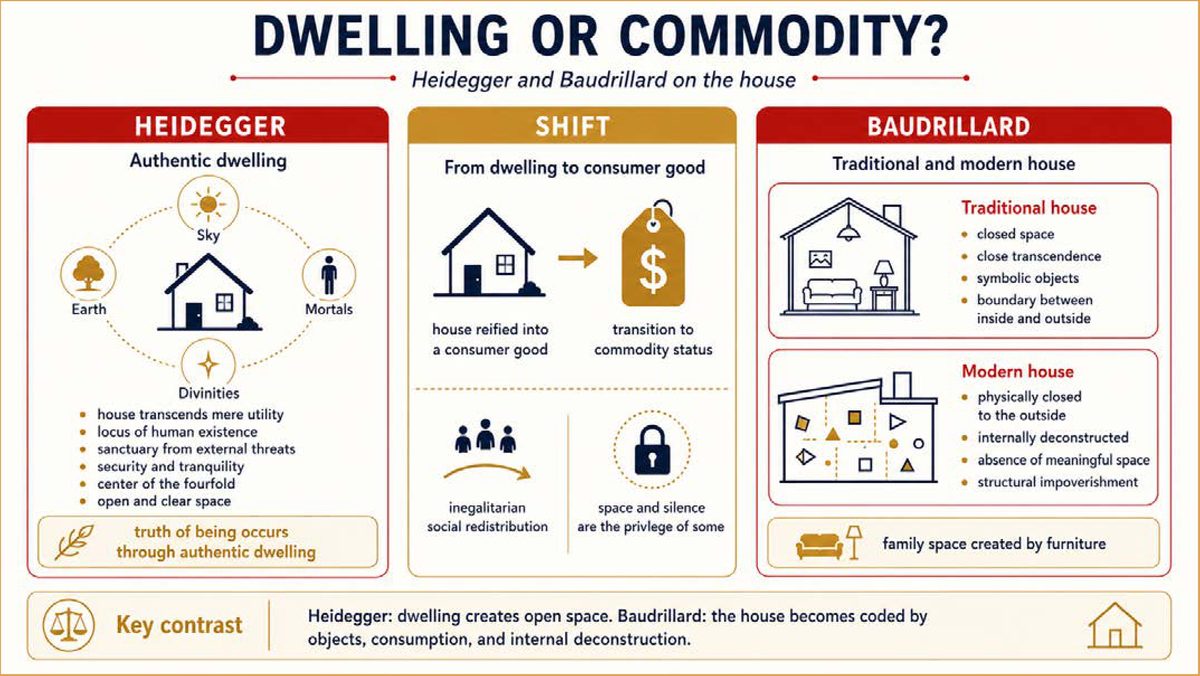
Despite their distinct philosophical frameworks, both Heidegger and Baudrillard converge on the critical assertion that the dwelling ought not to be commodified. For Heidegger, the house transcends mere utility, standing as the very locus and location of human existence, providing essential sanctuary from external threats and thus establishing a domain of profound security and tranquility. Moreover, as a thing, the house can gather the fourfold and be the center of this open-space. Yet, echoing Baudrillard’s astute observations on the American housing boom of the 1960s, contemporary trends demonstrate the insidious reification of the house into a consumer good. He incisively captured this shift, stating: “There is no right to space until there no longer is space for everyone, and until space and silence are the privilege of some at the expense of others”, and that means that “its transition to commodity status and its inegalitarian social redistribution” [53]. He further elucidated that once dwellings are subsumed by the logic of differential connotation, their transformation into consumer goods becomes inexorable [54].
For Heidegger, when the house functions as an authentic dwelling, it not only creates space but also becomes the center of the fourfold — an open and clear space where the truth of being occurs precisely because of this authentic dwelling. In contrast to Heidegger, Baudrillard conceptualizes the traditional house as a “closed space”. He differentiates between the traditional and modern house. The former represents a “a close transcendence” due to its intricate interiority and the symbolic objects within it, which serve as “boundary markers of the symbolic configuration” and define its clear “boundary between inside and outside, and their formal opposition” [55].
When Baudrillard considers space defined by a set of objects, he specifically refers to the family space created by furniture — the set of furniture. Consequently, the modern house, in his view, descends into an absence of meaningful space and a spatial paradox: while physically closed to the outside, it is internally deconstructed. He asserts that this deconstruction affects only the internal organization, not the physical enclosure. Thus, this spatial paradox does not inherently create problems for family space; rather, the internal deconstruction leads to structural impoverishment.
Paradoxically, Baudrillard argues that consumer society is characterized by both profusion and simultaneous scarcity. Consumption constitutes “an active form of relationship (not only to objects, but also to society and to the world), a mode of systematic activity and global response which founds our entire cultural system” [56]. Since consumption fundamentally functions as “the simple structural play of competition” [57], the relationships and spaces constructed through these relations can be nothing other than competitive. This pervasive competition, fueled by consumption, is not established through overt conflict or direct physical violence; on the contrary, it is paradoxically fostered by passion and encouragement. Baudrillard, for instance, highlights advertising as “the most remarkable mass medium of our age” [58]. The advertising is everywhere, constructing a coded hyperspace where is filled with the happiness-signs in daily life. But in truth, it passionately or cheerfully stimulates the desire and consumption through social comparison and rivalry. The profound consequences of the market economy and its pervasive competition are insufficiency and a radical, catastrophic anxiety, which are only exacerbated by technological advancements, but human stress and anxiety are deepening unconsciously. Evidently, Baudrillard rejects Heidegger’s notion of technology and his soteriology, aligning instead with McLuhan’s concepts of implosion and immediacy generated by electronic technology, which compels immediate commitment, participation, and (re-)action from everyone. While McLuhan presciently predicted that today we all have entered an age of “anxiety” [59], Baudrillard would claim that we are collectively struggling in an age of unconsciousness that leaves us adrift in the coded hyperspace.
Literature
Baudrillard, Jean (1968/2007): Das System der Dinge. Über unser Verhältnis zu den alltäglichen Gegenständen. Aus dem Französischen von J. Garzulz. Mit einem aktuellen Nachwort von F. Rötzer. Frankfurt/N.Y.: Campus.
— (1968/1996): The System of Objects. Translated by James Benedict. London/ NY: Verso.
— 1968/2014): Le système des objets. Paris: Gallimard.
— (1970/1998): The Consumer Society. Myths and structures. London: Sage.
—(1970/2007): La société de consommation. Ses mythes ses structures. Paris: Gallimard.
— (1972/2007): Pour une critique de l’économie politique du sign. Paris: Gallimard.
— (1972/1981): For a Critique of the Political Econom of the Sign. Translated and Introduction by Ch. Levin. St. Louis: Telos Press.
— (1975): The Mirror of Production. Translated by Mark Poster. N. Y.: Telos Press.
—(1978): Kool Killer oder der Aufstand der Zeichen. Berlin: Merve.
— (1981/1994): Simulacra and Simulation. Translated by Sheila F. Glaser. Michigan: The University of Michigan Press.
— (1987/1994): Das Andere selbst. Habilitation. Aus dem Französischen übersetzt von Monika Buchgeister und Hans-Walter Schmidt. Hrsg. von Peter Engelmann. Wien: Passagen.
Heidegger, Martin (1927/1993): Sein und Zeit. Tübingen: Max Niemeyer.
— (1935–1946/2003): Holzwege. In: GA 5. Frankfurt: Vittorio Klostermann.
— (1936–1954/2000): Vorträge und Aufsätze. GA 7. Frankfurt a. M.: V. Klostermann.
— (1950–1959/1985): Unterwegs zur Sprache. In: GA 12. Frankfurt: Vittorio Klostermann.
— (1910–1976/1983): Aus der Erfahrung des Denkens. In: GA 13. Frankfurt: Vittorio Klostermann.
— (1927/1989): Die Grundprobleme der Phänomenologie. In: GA 24. Frankfurt: Vittorio Klostermann.
— (1936/1994): Beiträge zur Philosophie. (Vom Ereignis). In: GA 65. Frankfurt: Vittorio Klostermann.
Kant, I. (1781/1987/1998): Kritik der reinen Vernunft. Hrsg. von J. Timmermann. Hamburg: Meiner.
Lin, Shing-Shang (2011): Von den modernen zu den postmodernen Zeitvorstellungen. Kant, Heidegger, Virilio, Baudrillard. Essen: Die Blaue Eule.
McLuhan, Marshall (1964/2002): Understanding Media. The extensions of man. London and NY: Routledge.
Plato (1998): Der Staat. Übersetzt von Otto Apelt. In: Platon Sämliche Dialoge. Band V. Hamburg: Felix Mein
[1] Martin Heidegger (1950/2000): Das Ding, in GA 7: 180.
[2] Jean Baudrillard (1972/2007): Pour une critique de l’économie politique du signe, p. 20.
[3] Ibid., p. 95ff.
[4] Ref. Martin Heidegger (1927/1989): Die Grundprobleme der Phänomenologie. In GA 24: 28ff.
[5] Heidegger (1927/1993): Sein und Zeit (later marked as “SZ”) S. 368.
[6] Jean Baudrillard (1970): The Consumer Society. Myths and structures (later marked as “CS”). P. 27.
[7] Jean Baudrillard (1987/1994): Das Andere selbst. Habilitation. S. 63.
[8] Such relational involvement constitutes nothing less than the form of human existent space, simultaneously determining its boundaries and movement. In this sense, the “How-to-be” and “How-to-care” in everyday life can be considered the contents of human existent space, thereby attuning its quality.
[9] Jean Baudrillard (1968/1996): The System of Objects, p. 18.
[10] Ibid., p. 199.
[11] Baudrillard (1970): CS 27.
[12] Ref. Kant, I. (1781/1987/1998): Kritik der reinen Vernunft, A 25f/39f.
[13] Martin Heidegger (1935–1936/2003): Der Ursprung des Kunstwerks, in GA 5: 337. (later marked only GA 5) Heidegger (1947/1983): Aus der Erfahrung des Denkens. In: GA 13: 84.
[14] Heidegger, GA 5: 337.
[15] Nartin Heidegger (1957/58/1985) : Das Wesen der Sprache, in GA 12: 202, 203. (later marked only GA 12)
[16] Jean Baudrillard (1968/2014): Le système des objets, p. 26.
[17] Baudrillard (1981/1994): Simulacra and Simulation, p. 76.
[18] Jean Baudrillard (1978): Kool Killer oder der Aufstand der Zeichen, S. 22.
[19] Baudrillard (1981/1994): Simulacra and Simulation, P. 2.
[20] Ibid., p. 75f.
[21] Baudrillard (1968/1996): The System of Objects, p. 18.
[22] Ibid., p. 21.
[23] Marshall McLuhan (1964): Understanding Media: The Extensions of Man, p. 134.
[24] Baudrillard (1970): CS 86.
[25] Ref. Shing-Shang Lin (2011): Von den modernen zu den postmodernen Zeitvorstellungen. Kant, Heidegger, Virilio, Baudrillard, S. 273.
[26] Baudrillard (1981/1994): Simulacra and Simulation, p. 1.
[27] Ibid., p. 2f, 6.
[28] Ibid., p. 31.
[29] Ibid., p. 4, 26.
[30] Heidegger, GA 5: 48.
[31] Heidegger, GA 5: 48.
[32] Martin Heidegger (1946/2003): Der Spruch des Anaximander, in GA 5: 337.
[33] Heidegger (1950/2000): Das Ding, in GA 7: 180.
[34] Ref. Plato: Der Staat. 596d.
[35] Ref. Jean Baudrillard, (1975): The Mirror of Production, p. 21.
[36] Heidegger (1950/2000): Das Ding, in GA 7: 180f.
[37] Heidegger (1950/2000): Das Ding, in GA 7: 175.
[38] Heidegger, GA 12: 220.
[39] Heidegger, GA 12: 219.
[40] Ref. this paper § 1 Space making.
[41] Baudrillard (1970): CS 124.
[42] Heidegger (1951/2000): Logos (Herklit, Fragment 50), in GA 7: 217.
[43] Ref. Martin Heidegger (1936/1994): Beiträge zur Philosophie. (Vom Ereignis), in GA 65: 11.
[44] Baudrillard (1981/1994): Simulacra and Simulation, p. 76.
[45] Baudrillard (1978): Kool Killer oder der Aufstand der Zeichen, S. 19.
[46] Heidegger (1950/2000): Das Ding, in GA 7: 181.
[47] Baudrillard (1970): CS 64, 65.
[48] Baudrillard (1970): CS 95.
[49] Ref. Jean Baudrillard (1981): For a critique of the economy and politic of sign, P. 30.
[50] Baudrillard (1968/1996): The System of Objects, p.9.
[51] Baudrillard (1970): CS 161.
[52] Baudrillard (1970): CS 25.
[53] Baudrillard (1970): CS 58.
[54] Baudrillard (1972/2007): Pour une critique de l’économie politique du signe, p. 66.
[55] Baudrillard (1968/1996): The System of Objects, p. 16.
[56] Ibid., p.199.
[57] Ibid., p.194.
[58] Baudrillard (1970): CS 125.
[59] McLuhan (1964/2002): Understanding Media, p. 52.
Discover more from BAUDRILLARD NOW
Subscribe to get the latest posts sent to your email.