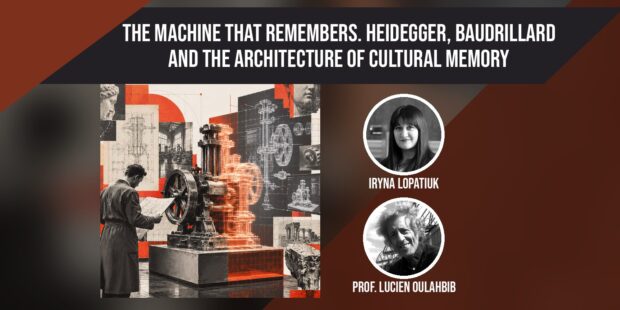
The Machine That Remembers. Heidegger, Baudrillard and the Architecture of Cultural Memory
by Iryna Lopatiuk and Prof. Lucien Oulahbib
Abstract
A civilisation does not truly remember a technology when it preserves its traces; it remembers it when those traces can still recover the action. This distinction becomes increasingly important in a culture capable of preserving an unprecedented quantity of objects, images, documents, recordings, archives, and digital representations of the past. The survival of a trace, however, does not necessarily imply the survival of the technological knowledge embedded in the action that produced it. A tool may remain while the skill disappears; a ritual may survive after its operative purpose has been forgotten; an archive may preserve instructions while losing the professional criteria required to interpret them. Cultural memory therefore cannot be reduced to the accumulation of preserved information. It must also be considered as an architecture through which past action remains, or ceases to remain, recoverable.
Drawing on Heidegger’s understanding of technology as a mode of revealing, Stiegler’s account of technics and temporality, and the theories of collective and cultural memory developed by Halbwachs, Assmann, and Ricoeur, this article proposes the concept of memory without action: a condition in which the traces of a technological practice remain available while the operational capacity that once connected those traces into meaningful action has disappeared. The article then places this problem in dialogue with Baudrillard’s analysis of objects, signs, symbolic exchange, and simulation. The danger begins when the sign of an action survives more successfully than the action itself, because cultural memory may then become simulacral memory: a convincing representation of a technological past that no longer retains its operational possibility. The article argues that the decisive criterion of technological memory is therefore not preservation alone but recoverability — the capacity of surviving traces to reconstruct the relation between operator, mechanism, purpose, action, result, and control.
Keywords: cultural memory; philosophy of technology; Heidegger; Baudrillard; technics; simulation; technological memory; memory without action; simulacral memory; reconstruction; signs; recoverability
INTRODUCTION
There is a comforting belief, common to museums, archives, historians, and ordinary human beings alike, that once a thing has been preserved, something important about the past has been saved with it. We keep the old tool behind glass, catalogue the document, photograph the machine, restore the building, record the ritual, digitise the manuscript, and then congratulate ourselves on having defeated time, at least administratively. The object remains where we put it, the file has been backed up, the photograph has acquired metadata, and the archive has become so large that one begins to suspect that forgetting itself may soon require a storage subscription. Yet there is a small difficulty in this triumph over oblivion: the survival of a thing does not necessarily mean the survival of what human beings once knew how to do with it.
A hammer can survive the disappearance of the craft that once gave it meaning, just as a ceremonial gesture can survive after the knowledge of why it was performed has vanished. A technical vocabulary may remain in dictionaries after the profession to which it belonged has disappeared, while an architectural ruin may preserve the material consequences of a sophisticated operation without preserving the sequence of actions that produced them. What remains, in other words, may be the evidence of a technology without the technology as an actionable capacity. This distinction is particularly important because technological action is rarely contained entirely within the object conventionally called a machine. A machine may involve operators, procedures, resources, rules, spatial arrangements, temporal rhythms, criteria of verification, and forms of professional knowledge distributed across material and social environments. When the machine disappears, its memory may therefore disperse rather than simply vanish.
This problem changes the meaning of cultural memory. If memory is understood primarily as the preservation of information about the past, then a civilisation possessing increasingly sophisticated archives should appear to be becoming progressively more capable of remembering. Yet if memory also concerns the capacity to recover a meaningful action from what has survived, the situation becomes less reassuring. Maurice Halbwachs (1992) demonstrated that memory is socially framed rather than existing as an isolated private storehouse, while Aleida Assmann (2011) showed how cultural memory is mediated through archives, texts, images, institutions, objects, and other carriers. Paul Ricoeur (2004), in turn, placed memory in a difficult relationship with history and forgetting, reminding us that preservation and loss cannot be cleanly separated. These approaches allow us to see that memory is never simply a warehouse of intact information. They do not, however, fully answer a more specific technological question: when the traces of an action survive, under what conditions do they still contain the possibility of recovering that action?
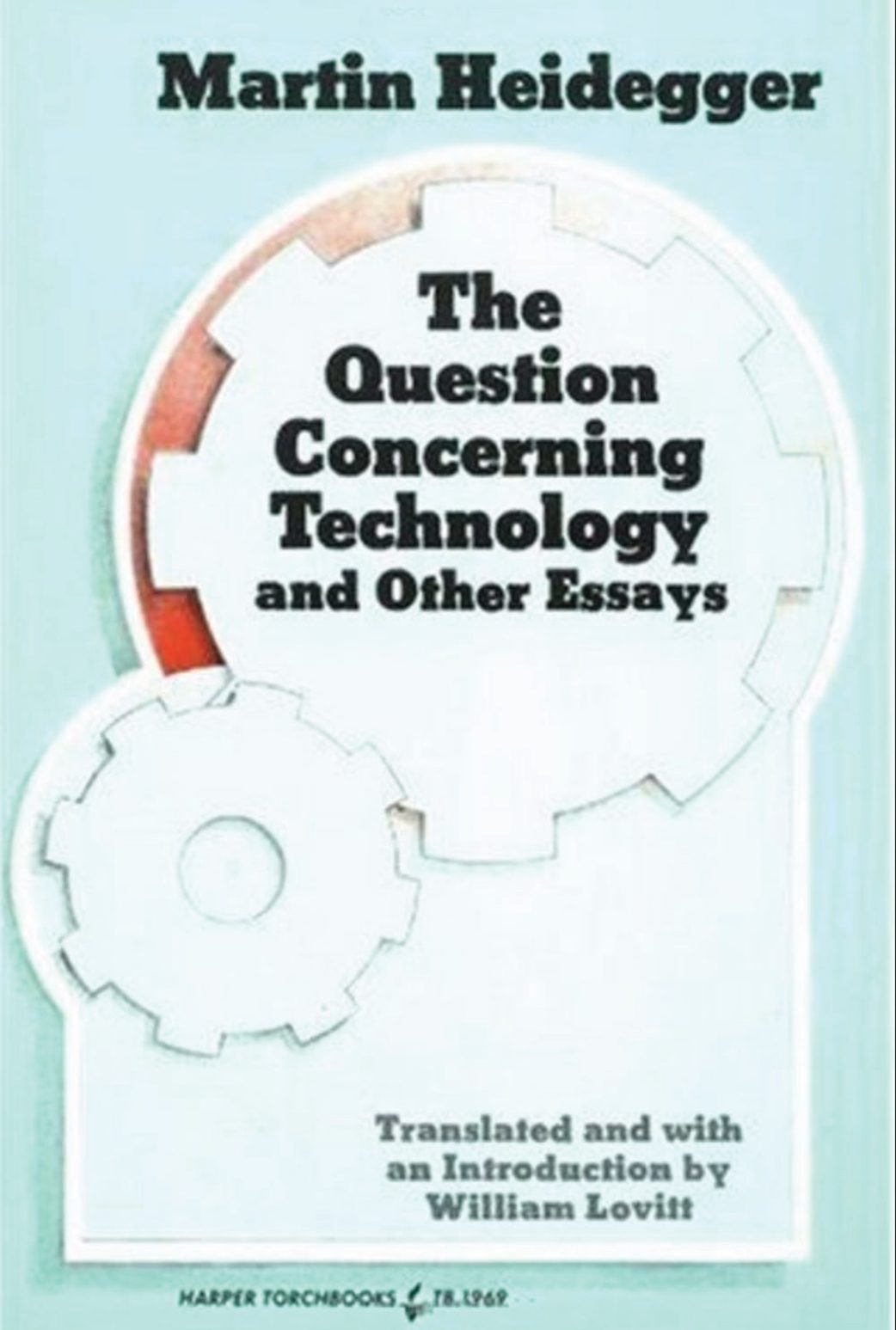
The question becomes sharper when technology itself is taken seriously as more than an ensemble of instruments. Heidegger’s (1977) analysis of technology shifted attention away from the familiar definition of technology as a neutral means toward the question of how technology discloses a world. Technology is therefore not merely something human beings use; it participates in determining how beings become available, ordered, encountered, and understood. Stiegler (1998) extends the problem into the temporal dimension by treating technics as inseparable from the transmission and exteriorisation of human memory. The machine, from this perspective, is not merely an object occupying space. It is also a way in which action can be stabilised, transmitted, repeated, and carried across time. This temporal dimension introduces an important paradox. A machine can preserve human action precisely by externalising it, yet the external trace can outlive the operational intelligence that once animated it. The surviving object then becomes ambiguous. It is at once evidence and absence: evidence that a particular action once existed, and evidence that the action itself may no longer be recoverable. The archive can tell us that something was done without necessarily enabling us to do it again. The museum can preserve the instrument without preserving the operator. The document can preserve the procedure without preserving the criteria by which the procedure was judged successful. In such cases, the cultural memory of technology becomes fragmented across unequal traces.
This is where the distinction between trace and memory becomes essential. A trace is evidence left by an interaction, whereas memory, in the stronger sense proposed here, requires the possibility of reconnecting that evidence with an intelligible structure of action. The difference may appear subtle until one encounters a vanished technology whose surviving components no longer form a working cycle. One may possess the material object, the description, the historical account, and even an apparently complete reconstruction, while still lacking the missing relation that once connected operator, mechanism, purpose, timing, control, and result. The problem is not that information has disappeared entirely. The problem is that the mechanism of relation has disappeared.
This is also the point at which the question of the sign enters the argument. Jean Baudrillard’s work provides an especially productive way of examining what happens when the surviving trace ceases to function primarily as a route back toward an absent action and begins instead to circulate as a sign in its own right. In The System of Objects, Baudrillard (1996) challenged the simple understanding of objects as merely functional things by situating them within systems of meaning and social differentiation. His subsequent analysis of the political economy of the sign (Baudrillard, 1981) made the problem more explicit: the sign does not merely transmit a meaning already securely contained elsewhere but participates in the organisation of social reality. In Symbolic Exchange and Death, Baudrillard (1993) pushed the problem toward disappearance, symbolic exchange, and the fate of systems whose signs continue to circulate beyond the conditions that originally sustained them.
The implications become still more radical in Simulacra and Simulation, where Baudrillard (1994) examines situations in which representations cease to function simply as representations of an external reality and begin to participate in the production of what is taken to be real. This provides a particularly useful lens for technological memory. If a civilisation retains the image, name, museum object, ritual reconstruction, documentary record, and digital representation of a lost technology, it may eventually possess an extraordinarily convincing memory of something that it can no longer actually perform. The representation can become more available, more reproducible, and more culturally visible than the action from which it originated. Baudrillard’s later analysis of the excessive circulation and transparency of contemporary signs further sharpens the problem, because the abundance of representations does not necessarily restore what has been lost; it may instead make the absence increasingly difficult to perceive (Baudrillard, 1993). The central argument of this article therefore begins from a deliberately uncomfortable proposition: a civilisation does not truly remember a technology when it preserves its traces; it remembers it when those traces can still recover the action. This proposition requires us to distinguish between preserved information and recoverable action, between archival memory and operational memory, and ultimately between memory that retains a capacity for reconstruction and memory that retains only the signs of having once possessed that capacity.
From this perspective, cultural memory can be approached as a distributed architecture of technological traces. A technology may survive partially in a tool, partially in a bodily skill, partially in a spatial arrangement, partially in a professional vocabulary, partially in a ritual, partially in a prohibition, and partially in the memory of a failure. The disappearance of one component does not necessarily destroy the whole system, but the loss of certain relations may make the system irrecoverable. What matters, therefore, is not simply how many traces remain but whether the surviving traces can still be connected into a functioning account of action.
This leads to the second proposition that governs the article: the danger begins when the sign of an action survives more successfully than the action itself. At that point, cultural memory may enter a different regime. The object remains, but its operation has vanished; the ritual remains, but its purpose is forgotten; the image remains, but its referent has become inaccessible; the archive expands, while the capacity to act contracts. What appears to be an excess of memory may therefore conceal a deficit of recoverability. The article calls this condition memory without action. It further proposes the notion of simulacral memory to describe the moment when representations of a lost technological practice become sufficiently autonomous that they reproduce the appearance of memory without retaining the operational possibility of the remembered action. The purpose is not to suggest that every archive, museum, reconstruction, or cultural representation is simulacral. Rather, the distinction allows us to ask a more demanding question of cultural memory: does what has been preserved still enable us to reconstruct what was once done?
This question matters beyond the reconstruction of obsolete machines. It concerns the ability of societies to transmit professional knowledge, remember failed practices, preserve prohibitions, understand the temporal conditions of action, and maintain the capacity to recognise when a familiar procedure can no longer be trusted. A culture can preserve the name of a profession while losing the skill, preserve the recipe while losing the judgement, preserve the machine while losing the operator, or preserve the archive while losing the mechanism that made the archive intelligible. It may even preserve the signs of successful action while forgetting the failures that once taught its practitioners when to stop. The problem, then, is not whether civilisation remembers enough. It is whether what civilisation remembers can still act as memory. Between the archive and the action lies a space occupied by traces, relations, operators, mechanisms, signs, interpretations, and omissions. It is in this space that Heidegger’s question concerning technology, Stiegler’s question concerning technics and time, the tradition of cultural memory studies, and Baudrillard’s analysis of signs and simulation unexpectedly converge. The machine that remembers is therefore not necessarily the machine that stores the most information. It is the machine whose surviving traces still contain a path back to meaningful action.
I. THE MACHINE THAT DISAPPEARS
There is a peculiar injustice in the way human beings usually remember machines. We tend to remember the object because the object is polite enough to remain visible. A building can stand for centuries after the people who knew how to inhabit it have disappeared; an instrument can survive in a museum long after the hands that knew its resistance, weight, timing, and proper use have turned to dust; a technical drawing can remain perfectly legible at the very moment when the knowledge necessary to turn the drawing into an operating process has become incomprehensible. The object is therefore often the last witness to a technological practice, but being the last witness does not make it a reliable witness. It may remember the shape of the action while having forgotten its grammar.
This is where the conventional distinction between machine and memory begins to look rather inadequate. If a machine were simply a physical device, its disappearance would be relatively easy to define: the mechanism breaks, the parts are lost, the building collapses, and the machine is gone. Yet technologies rarely disappear in such a tidy fashion. Their components migrate into other objects, their procedures survive in altered forms, their terminology enters ordinary language, their rhythms become institutional habits, and their prohibitions remain long after the original danger has ceased to be understood. What disappears is therefore not necessarily the material apparatus but the organisation of relations that made the apparatus capable of action.
Heidegger’s analysis of technology is useful precisely because it prevents us from reducing technology to equipment. The question concerning technology cannot be exhausted by asking what a device does, because technology also concerns a particular mode of revealing through which things become available within a particular ordering of the world (Heidegger, 1977). The machine, understood in this wider sense, belongs not only to the domain of objects but to the domain of disclosure: it organises relations between human beings, materials, purposes, time, space, and possible outcomes. When such an organisation disappears, therefore, the loss cannot be measured simply by counting how many physical components remain.
Stiegler’s intervention makes the temporal character of this problem even more difficult to ignore. If technics participates in the exteriorisation and transmission of human capacities across time, then every technical object can be understood as carrying something of a human action beyond the lifetime of its original operator (Stiegler, 1998). The machine becomes a peculiar kind of temporal arrangement. It allows an action to outlive the person who performed it, but it does not guarantee that a later person will still understand how to reactivate that action. The technical object may thus function as a memory carrier without necessarily functioning as a memory that can still be operationally understood.
This distinction matters because the history of technology is full of objects that are perfectly preserved and only partially understood. The problem is not always an absence of documentation. Sometimes the surviving documentation is extensive enough to make ignorance look almost embarrassing. There may be drawings, measurements, descriptions, fragments, photographs, inscriptions, manuals, oral traditions, and scholarly reconstructions, and yet something essential remains missing. The missing element may be a gesture, a sequence, a timing condition, a professional criterion, a particular material response, or simply the relation between several surviving elements. One can possess all the pieces of a machine and still not possess the machine as an action.
The distinction becomes especially visible when we consider professional knowledge. A craft may be recorded in a manual, but the manual does not necessarily preserve the bodily adjustment by which an experienced operator recognises that a material is behaving incorrectly. A ritual may preserve its gestures while losing the temporal conditions that once made those gestures meaningful. A technical process may survive in a diagram while losing the criterion by which an operator knew when to intervene, correct, or stop. In each case, the archive contains something true, but the truth contained in the archive is not necessarily sufficient to reconstruct the operation. The document has survived; the operational relation has not.
This is why the memory of a machine must be understood as distributed. Its memory may reside simultaneously in the object, the operator, the workspace, the vocabulary, the procedure, the calendar, the ritual, the prohibition, and the remembered failure. Some of these elements are material and some are not, but they participate in the same technological continuity. The disappearance of the machine therefore resembles less the destruction of a single object than the scattering of a system into fragments whose original relationships have become uncertain.
Such scattering also explains why cultural memory is inherently uneven. Stone may survive where wood has disappeared; a name may survive after the profession itself has vanished; a ritual may survive after its explanation has been forgotten; a document may survive after the operator who could interpret it has disappeared; a legend may preserve the existence of a technical operation while completely obscuring its technical cause. The archive does not preserve the past evenly because the world does not preserve its traces evenly. What survives is determined by material durability, institutional selection, cultural attention, accident, prestige, usefulness, and sometimes sheer historical bad luck.
Assmann’s account of cultural memory is particularly important here because it directs attention to the media and institutions through which societies preserve what they consider worth transmitting (Assmann, 2011). Yet once memory is viewed from the perspective of technological action, another question becomes unavoidable. It is not enough to ask what a culture has chosen to preserve. We must also ask what kind of action the preserved material still permits us to recover.
The distinction may seem unnecessarily demanding until one notices what happens when it is ignored. A society can begin to confuse the preservation of evidence with the preservation of competence. A museum object becomes an adequate substitute for the technology it once embodied; a reconstruction becomes equivalent to the lost practice; a photograph becomes evidence that the world represented in the photograph remains conceptually available. The archive begins to reassure precisely because it is full. The more traces it contains, the easier it becomes to assume that nothing essential has been lost.
However, something essential may have been lost, and it may be the least visible part of the machine. It may be the relation.
A machine is not merely a collection of components. It is a working relation between components, operators, resources, rules, purposes, transformations, and controls. Remove enough of those relations and the surviving objects become archaeological evidence rather than technological memory. They tell us that an action once existed, but they no longer allow the action to be reconstructed without introducing hypotheses, external knowledge, or invention. The difference is crucial. Reconstruction begins precisely where preservation ceases to be self-sufficient.
This is also why the question of failure belongs inside the architecture of technological memory. Civilisations do not survive only by remembering successful procedures; they survive by remembering what failed, what was dangerous, what had to be prohibited, and when an apparently functioning process had to be stopped. A warning sign, an accident record, a professional taboo, or a ritual prohibition may contain less visible information than a technical drawing, yet it can preserve something that the drawing cannot: the memory of a boundary. In that sense, negative memory may be one of the most technologically valuable forms of memory, because it preserves not simply what can be done but what must not be done.
Here the machine begins to look rather less like an object and rather more like a civilisation’s answer to the problem of transmitting action across time. Its memory is not stored in one place because its action was never located in one place. The operator knew something, the tool embodied something, the workspace constrained something, the calendar determined something, the ritual transmitted something, and the prohibition prevented something. The machine existed in the relation among these things. When the relation breaks, the machine can disappear even while almost every visible sign of its existence remains.
And this is perhaps the first uncomfortable conclusion of the argument. A machine does not necessarily disappear when its material body is destroyed. It may disappear much earlier, at the moment when its surviving traces can no longer be assembled into a recoverable action.
- The museum may still have the machine.
- The archive may still have the documents.
- The culture may still have the name.
What it may no longer have is the possibility of making the machine act again.
II. MEMORY IS DISTRIBUTED
Once the machine is no longer treated as a solitary object, its memory begins to look rather different. We are accustomed to asking where a technology is stored, as though knowledge were a document waiting patiently on a shelf, but technological memory is rarely so considerate. It may be distributed between the tool and the hand that uses it, between the procedure and the space in which the procedure becomes possible, between professional language and the bodily habit that gives the language practical meaning. A calendar, a prohibition, a ritual sequence, or the memory of a failed operation may carry information that no technical drawing contains, because technology is preserved not only in what people made but in the conditions under which they knew how to act.
This is why the disappearance of a machine should not be imagined as a single event. What disappears first may be the operator; what disappears later may be the professional vocabulary; what survives for centuries may be the building, the instrument, or the name. Cultural memory therefore behaves less like a library than like a dispersed technological landscape in which different fragments of an earlier action survive at different rates and with different degrees of intelligibility. Assmann’s (2011) account of cultural memory helps us recognise the importance of the media and institutions through which such fragments are preserved, while Halbwachs’s (1992) earlier formulation reminds us that memory is sustained through social frameworks rather than existing as an isolated possession of the individual.
Yet the technological problem begins precisely where the sociological description ends. A society may preserve the carriers of memory without preserving the relation between them. The instrument can survive without the gesture, the gesture without the purpose, the purpose without the criterion of success, and the criterion without the circumstances in which it was once applied. What looks like continuity from the outside may therefore conceal a broken operational chain. The culture remembers the parts, but it no longer remembers how the parts belonged together.
This is also why time itself must be considered a component of technological memory. A process may depend upon a particular season, a pause, a sequence of operations, a period of repair, a deadline, or a rhythm that cannot simply be extracted from the procedure and placed into another temporal environment without altering its meaning. Stiegler’s (1998) treatment of technics and time is important here because it makes clear that technical exteriorisation is also a form of temporal transmission. What is transmitted through a technical system is never merely what to do; it may also be when to do it, when not to do it, and when to stop. The last of these is particularly revealing. A technology without a mechanism of stopping is not simply an efficient technology; it is an incomplete architecture of action. The memory of stopping, therefore, belongs to the technology no less than the memory of production. A culture that preserves procedures but forgets their limits may possess an impressive archive and a dangerously poor memory.
The same applies to failure. The memory of an unsuccessful operation may survive in a prohibition, a scar on a material surface, an altered procedure, a professional warning, or a ritual whose original explanation has disappeared. Such negative traces may look insignificant beside monumental objects and official documents, yet they can contain the most valuable part of technological knowledge: the memory of where action ceases to be legitimate, safe, or effective. Ricoeur’s (2004) analysis of the relation between memory and forgetting is useful here, because forgetting is not merely the disappearance of information; it is also the disappearance of distinctions that once organised what could be remembered, repeated, or avoided.
The machine, then, is remembered through an ecology of traces. Some traces tell us what was made, others how it was made, others when it was made, and still others what happened when someone made it incorrectly. None of them is necessarily sufficient by itself. Their significance emerges from the possibility of reconnecting them into a structure of action. This is why the archive should not be judged only by its size. A very large archive may preserve millions of traces and still fail to preserve the relations that make those traces intelligible. At this point, cultural memory acquires an architectural meaning. It is not simply a collection of surviving materials but a system of relations through which the fragments of past action can, at least in principle, be brought back into connection. The decisive question is therefore no longer What has survived? but What can still be reconstructed from what has survived? And once that question is asked, the apparently innocent archive begins to acquire a rather more dangerous philosophical character, because the answer may depend less upon the quantity of information preserved than upon whether the signs still lead anywhere beyond themselves.
III. WHEN THE MECHANISM GOES MISSING
The most revealing moment in the life of a vanished technology is not necessarily the moment when the machine breaks, but the moment when its surviving parts cease to explain one another. A fragment of a device may remain perfectly identifiable, an inscription may tell us its name, a drawing may show its proportions, and a historical account may describe its supposed purpose, yet the whole system can remain strangely silent.
What is missing is often not another object but the relation that once connected the objects into an action. The machine has left evidence of itself, but the evidence no longer forms a working sentence.
This is where recoverability becomes a more demanding criterion than preservation. A technological trace is recoverable when it can still participate in the reconstruction of the action that produced it: who operated it, with what resources, according to which sequence, for what purpose, under what conditions, and with what means of verification or correction. Without these relations, the surviving trace may remain historically interesting while losing its technological intelligibility. One can know what a component was called without knowing what role it played, or know what a procedure was supposed to achieve without knowing the conditions under which it could actually succeed.
The distinction is important because reconstruction is often tempted by completeness. If enough fragments have been collected, the historian or archaeologist naturally wants to put them together and declare the machine recovered. Yet a collection of correct fragments does not necessarily constitute a correct mechanism. The missing relation may be precisely the element that made the entire system operational: the sequence between two actions, the timing of an intervention, the position of the operator, the source of energy, the criterion for correction, or the point at which the process had to stop. What has disappeared may therefore be invisible precisely because it was never an object in the first place.
This gives the notion of the missing mechanism a wider meaning. When surviving elements cannot form a functioning cycle, the gap should not immediately be filled with imagination merely because the archive dislikes an empty space. The absence itself becomes evidence. It tells us that the surviving memory is incomplete and that the missing relation must be treated as a problem of reconstruction rather than quietly converted into a fact. The most honest reconstruction is therefore not the one that produces the most beautiful machine, but the one that makes visible where the evidence ends and where hypothesis begins. The same principle applies to cultural memory more generally. A civilisation may preserve the object, the description, and even the ritual surrounding a past technology while losing the relation that once made the three parts mutually intelligible. At that point, memory remains abundant but becomes operationally thin. It knows about the action without necessarily knowing how to recover the action. This is the difference between possessing a trace and possessing a usable memory, and it is why recoverability must become one of the central criteria by which technological memory is judged.
IV. HEIDEGGER: TECHNOLOGY AS REVEALING
At this point Heidegger enters the argument, although not to rescue us from the missing mechanism. His importance lies elsewhere. Heidegger’s question concerning technology asks us to resist the comfortable assumption that technology is simply a collection of instruments standing between human intention and a desired result. If technology were merely a neutral means, the disappearance of a machine would be primarily a technical loss. But if technology participates in a particular way of revealing the world, then the disappearance of a technological practice may also mean the disappearance of a particular way in which the world had once become intelligible and available to human action (Heidegger, 1977).
This is what makes the problem of technological memory more serious than the preservation of historical artefacts. A technology does not merely tell us what human beings once possessed; it tells us something about what they were able to see, distinguish, measure, manipulate, anticipate, and control. The machine therefore belongs to a larger architecture of disclosure. Its procedures establish relations between material and purpose, between action and consequence, between what can be done and what must be avoided. When the technological practice disappears, the loss may therefore concern not only the operation itself but the world of distinctions that made the operation possible.
Heidegger’s notion of revealing also prevents us from romanticising reconstruction. To recover an old machine is not necessarily to recover the world that made the machine meaningful. We may reproduce its external form while failing to recover the mode of attention, temporal discipline, practical knowledge, or relation to material that once belonged to its operation. A reconstructed mechanism can therefore be technically impressive and historically misleading at the same time. It may reproduce the visible object while leaving unreconstructed the particular disclosure of the world in which the object once functioned.
Here the problem of memory becomes inseparable from the problem of action. If technology is a way of revealing, then technological forgetting cannot be reduced to the loss of information. A civilisation may retain abundant information about a vanished technology while losing the practical distinctions through which that technology once organised experience. The archive can preserve the answer while the question that made the answer meaningful has disappeared. We know the instrument, but not what kind of attention it demanded; we know the procedure, but not what counted as failure; we know the result, but not the world of possibilities within which that result mattered.
This is where our argument departs from a purely Heideggerian account. We are not asking only what technology reveals, but how the capacity for such revealing is carried through time. Specially when the hitlerism, leninism and actually scientism constructivism failed to reveal that the prometheean tool can be fall in the evil hands showing precicsely that technology is not outside human nature in order to “purifie” or “rebuilt” it but complexifie our relation with the reality as Baudrillard shows that. Once technological action is distributed across objects, operators, procedures, temporal rhythms, prohibitions, and signs, its memory becomes a problem of transmission. Stiegler’s (1998) account of technics and time helps to make this transition possible: technical exteriorisation allows human capacities to survive beyond individual bodies, but that survival remains dependent upon the transmission of the relations that make those capacities intelligible. What is transmitted, therefore, is never simply a thing. It is a possibility of action.
The question that now opens before us is consequently more uncomfortable than the familiar question of whether a civilisation has preserved its technological heritage. We must ask whether it has preserved the possibility of entering the relation with the world that the technology once disclosed. And this brings us directly to the problem of the sign, because once action disappears, its signs may remain extraordinarily successful at telling us that the action existed. The sign may survive the machine, circulate after the operator has disappeared, and eventually become more visible than the action from which it originated. That is where the memory of technology begins to approach the territory mapped by Baudrillard.
V. BAUDRILLARD: WHEN THE SIGN OUTLIVES THE ACTION
There is a moment in the life of every lost technology when the problem ceases to be whether anything remains and becomes instead a much more dangerous question: what exactly is it that remains? The museum gives us the tool, the archive gives us the document, the historian gives us the narrative, the reconstruction gives us the machine, and the photograph gives us the reassuring impression that we have not lost very much after all. Human beings are remarkably good at this sort of reassurance. We have always been capable of mistaking a portrait for a person, a map for a territory, and, with sufficient institutional assistance, a catalogue entry for knowledge. Yet the surviving object is not necessarily the surviving action, and the surviving sign is certainly not obliged to lead us back to either.
This is where Baudrillard becomes indispensable, because his work allows us to follow the trace after it has ceased to behave like a simple trace. In The System of Objects, Baudrillard (1996) showed that objects do not exist for us merely as functional things; they enter systems of meaning, differentiation, status, and social relations. The object therefore carries more than its physical utility. It becomes readable. It tells us something about the person who possesses it, the social order in which it circulates, and the world in which its function has been defined. This is already enough to disturb the comforting archaeological picture in which an object simply waits to reveal its original purpose. The object can survive while its function changes, and it can acquire meanings that have little to do with the action for which it was originally designed.
Consider, for a moment, the old machine behind museum glass. It may once have been an instrument of production, a device requiring trained hands, precise timing, material judgement, and a particular relation between operator and result. Today it may be illuminated, labelled, insured, photographed, and admired. Nothing about this process is necessarily false. The machine really did exist, and the museum really did preserve it. But something curious has happened: the machine has moved from the order of operation into the order of representation. It no longer primarily functions as something with which one acts; it functions as something through which one knows that a certain form of action once existed. That transition is not yet simulation. It is something more elementary and, for precisely that reason, more important. The object has become a sign.
Baudrillard’s analysis of the political economy of the sign allows us to see why this transition matters. In For a Critique of the Political Economy of the Sign, he (1981) challenged the assumption that signs merely carry meanings that have been securely established elsewhere. Signs participate in systems of differentiation and value; they acquire their significance through relations with other signs and through the social structures in which they circulate. Applied to technological memory, this means that a surviving machine can gradually cease to function as evidence leading us toward an absent action and begin functioning as evidence that stands in for that action. The distinction is subtle, but it is decisive.
The machine no longer says, in effect, “Here is something from which the action can be reconstructed.” It begins to say, “Here is what that action was.”
The first statement opens a path. The second closes it.
This is the moment at which memory becomes vulnerable to substitution. If the sign can successfully perform the cultural function of the absent action, there may be less incentive to recover the action itself. The museum does not need to teach the visitor how the machine worked; it needs to communicate what the machine means. The documentary does not need to restore the professional relation between operator and material; it needs to make the vanished practice intelligible to the spectator. The reconstruction does not need to recover every lost condition of operation; it needs to look convincing enough to satisfy the expectations attached to the historical image. The past becomes increasingly available as representation precisely while becoming increasingly remote as practice.
This is where Baudrillard’s Symbolic Exchange and Death becomes particularly useful. The problem is no longer simply that an object has changed its function. The deeper problem is that the relation between presence and absence itself has changed. The machine has disappeared as an active technological relation, but its symbolic existence may continue to circulate long after its operational existence has ended (Baudrillard, 1993). The dead machine can therefore acquire an extraordinarily successful afterlife. It may become a monument, a cultural emblem, a national symbol, a design reference, an aesthetic object, or a token of technological achievement. The more successful this afterlife becomes, the easier it may be to overlook the fact that the original relation of action has disappeared.
There is something almost comic about the situation. A civilisation can spend enormous resources preserving evidence that it once knew how to do something while becoming increasingly uncertain about whether it could do it again. It can restore the façade of a workshop, reproduce the tools, digitise the manuals, create an interactive exhibition, and then declare the heritage safely preserved. The machine has been saved from oblivion, although nobody has asked whether the knowledge has been saved from irrelevance. We have, in effect, preserved the answer to a question whose grammar we have forgotten.
This is precisely where the distinction between trace and sign becomes necessary. A trace points backward toward an interaction that produced it. A sign can circulate without requiring the recovery of that interaction. The trace retains a demand for reconstruction; the sign may be satisfied with recognition. The trace says, “Something happened here; find out how.” The sign says, “This is what happened.” The first creates an investigation. The second creates an image. And once the image becomes sufficient, the missing action can become culturally invisible.
Baudrillard’s Simulacra and Simulation gives us the language for the next transformation. The problem becomes acute when the representation no longer functions simply as a representation of a lost technological reality but begins to organise the reality through which the lost technology is understood (Baudrillard, 1994). At that point, we no longer have merely an object representing a vanished action. We have a whole environment of representations: photographs of the machine, reconstructions of the machine, stories about the machine, digital models of the machine, films showing the machine, educational diagrams explaining the machine, and perhaps even artificial systems capable of generating new images of how the machine supposedly operated. The original action has become only one element — perhaps the least accessible element — within an enormous system of representations.
The paradox is that representation becomes more complete as reference becomes weaker. The more perfectly the lost technology can be represented, the less obvious its absence may become.
This is the point at which the concept of simulacral memory becomes useful. We are not proposing that every representation of the past is a simulacrum, nor that archives inevitably falsify history. The more precise claim is that memory becomes simulacral when the cultural signs of an action become sufficiently autonomous to reproduce the effect of remembering without retaining the possibility of recovering the action itself. The memory looks full because the signs are abundant. The memory feels convincing because the representation is coherent. Yet the operational relation has disappeared.
A civilisation then arrives at a peculiar condition in which it possesses memory without action.
It remembers the image of the craft without the craft, the instrument without the operator, the procedure without the judgement, the ritual without the temporal order that made it effective, and the prohibition without the experience of the danger that produced it. What remains is not nothing. On the contrary, something highly sophisticated remains: a cultural representation of the lost technology.
But representation and recoverability have parted company.
This distinction allows us to reread Baudrillard’s earlier works as stages in the fate of the technological trace. The object becomes part of a system; the object is read through signs; signs become detached from the original relations of production and exchange; symbolic systems continue after the disappearance of their original referents; simulation ultimately makes representation capable of producing the reality within which the absent referent is understood (Baudrillard, 1981, 1993, 1994, 1996). The trajectory is not simply from object to image. It is from action to increasingly autonomous representation.
The Transparency of Evil adds another dimension to this problem because the contemporary world is not suffering from a shortage of representations. It is suffering, if anything, from their extraordinary proliferation. Images, records, copies, reconstructions, simulations, classifications, databases, and digital reproductions can circulate at a speed and scale that earlier cultures could hardly imagine. Baudrillard (1993) is therefore useful not only for understanding how the sign becomes autonomous but for recognising the peculiar condition in which visibility itself can become excessive. Everything can be shown, copied, archived, and circulated, while the relation that once gave the thing its operational meaning becomes increasingly difficult to recover.
This creates an unexpected inversion of the traditional problem of cultural memory. Earlier civilisations were often threatened by the scarcity of records. Contemporary civilisation may increasingly be threatened by an abundance of records that no longer guarantee understanding. We can preserve the photograph of the gesture, the description of the procedure, the sound of the language, the appearance of the tool, and the virtual reconstruction of the workshop, yet still fail to preserve the relation among them that made the original action possible. We have not lost the traces. We have lost the path between them.
And here the distinction between preservation and recoverability becomes decisive. Preservation asks whether something has survived. Recoverability asks whether what has survived can still be transformed into meaningful action. The first can be measured by storage, durability, cataloguing, digitisation, and access. The second requires something much more demanding: the restoration of relations between operator, mechanism, material, purpose, temporal condition, control, and result. A civilisation may possess an immense archive and still possess very little recoverable technological memory.
This is why the sign of an action can become more dangerous than the disappearance of the action itself. If the action simply disappeared, its absence would be visible and the need for reconstruction would remain obvious. But when its signs survive in convincing abundance, the absence can become difficult to recognise. The sign reassures us that the past remains available. It can therefore conceal the very loss that it appears to commemorate.
The danger begins when the sign of an action survives more successfully than the action itself.
At that point, the archive can become strangely self-sufficient. It no longer sends us back toward the missing mechanism; it surrounds the missing mechanism with enough representations to make the absence tolerable, perhaps even invisible. The civilisation does not necessarily become ignorant of its past. Something more peculiar happens: it becomes increasingly knowledgeable about the appearance of its past while becoming less capable of recovering its action.
This is the real significance of the machine that remembers. Its problem is not whether memory can survive the death of a machine. Memory has always survived in fragments. The problem is whether the fragments still form a route toward action, or whether they have become a closed circuit of signs referring primarily to one another. Once that circuit closes, the machine may remain everywhere — in museums, archives, images, narratives, databases, reconstructions, and collective imagination — while being absent at precisely the point where it matters most: in the possibility of acting again.
And this brings us to the central distinction of the article. A civilisation does not truly remember a technology when it preserves its traces; it remembers it when those traces can still recover the action. The question is therefore no longer whether the past has been successfully archived. The question is whether the archive still contains a path back to the machine as an event of human action, rather than merely a convincing collection of signs that tells us what we are supposed to remember.
VI. MEMORY WITHOUT ACTION
We have now reached the point at which the problem can no longer be solved by adding more documents to the archive. If the object has survived, the image has survived, the name has survived, and the story has survived, what exactly is missing when we still cannot recover the action? The answer is uncomfortable because it forces us to distinguish between two things that ordinary language prefers to keep together: knowing that something existed and remembering how to act within it. A civilisation may possess an excellent memory in the first sense and a remarkably poor one in the second. It may know more and be able to do less.
This is what we mean by memory without action. The term does not describe simple forgetting, because forgetting would be comparatively easy to recognise. Memory without action is more deceptive. It occurs when the traces of a former practice remain sufficiently abundant to produce knowledge, recognition, identification, and even emotional attachment, while the operational relations that once transformed those traces into action have disappeared. The culture remembers the technology as an object of knowledge, but no longer possesses it as a capacity of action. It can point toward the machine, describe it, classify it, reconstruct its appearance, and tell stories about the people who used it, yet the path from representation back to operation has been broken.
This distinction allows us to reconsider the familiar opposition between memory and forgetting. Ricoeur (2004) shows that memory is always entangled with forgetting, selection, representation, and the work of history, while Assmann (2011) demonstrates that cultural memory is carried through multiple media and institutional forms. From the perspective developed here, however, another distinction must be introduced: preserved memory and operational memory are not necessarily the same thing. The former concerns the survival and circulation of traces; the latter concerns the continued possibility of reconstructing meaningful action from them. The first may increase while the second declines, and there is no contradiction in this. Indeed, the modern archive may be exceptionally successful at producing precisely this combination.
Imagine a civilisation that has preserved every visible sign of a lost craft. Its tools are catalogued, its workshop reconstructed, its terminology recorded, its techniques described in books, its practitioners represented in photographs, and its products displayed in museums. A visitor can leave the exhibition with the confident feeling of having understood the craft. Yet if the visitor cannot determine how the material was judged, when the procedure had to be interrupted, which variation required a change of technique, or what a competent practitioner noticed before an inexperienced one did, then something essential has not been preserved. The archive has retained the description of competence without necessarily retaining competence itself.
This is why professional memory deserves particular attention. Much technological knowledge is not stored in explicit propositions at all. It may reside in posture, timing, resistance, correction, attention, anticipation, and the ability to recognise a deviation before it becomes an error. The expert does not merely know a rule; the expert knows when the rule has ceased to be sufficient. Such knowledge is notoriously difficult to archive because it is distributed between body, environment, material, and situation. One can describe it after the fact, but description is not identical with possession. The manual can say what should happen while the operator must still recognise what is happening.
Here the machine-memory problem touches the deeper issue already opened by Heidegger. If technology is a mode of revealing, then technical competence is partly a capacity to perceive the world in technologically meaningful distinctions. The experienced operator sees not simply a material object but a set of possibilities, limits, deviations, timings, and consequences. When that competence disappears, the world itself may become less differentiated. The machine remains, but the mode of attention through which its possibilities were once disclosed has weakened. In this sense, technological forgetting can be a forgetting not of information but of relevant distinctions.
Stiegler’s (1998) account of technics and time makes this problem still more consequential. Technical exteriorisation permits human capacities to survive beyond the individual who first possessed them, but exteriorisation does not automatically guarantee transmission. The technical object can carry memory forward while leaving the next generation with the task of discovering how to reactivate it. What survives materially may therefore exceed what survives operationally. The machine becomes a promise that its own culture can no longer necessarily fulfil. This also explains why a technological reconstruction can be both accurate and false. It can be accurate as an object and false as an action. The dimensions may be correct, the materials authentic, the mechanism plausible, and the visual result convincing, while the relation between operator, purpose, timing, feedback, and correction remains hypothetical. Reconstruction becomes problematic when the absence of knowledge is hidden by the completeness of the replica. The better the replica looks, the easier it becomes to forget that what has been reconstructed may be the appearance of operation, rather than operation itself.
At this point the three forms of memory proposed in this article become useful. Living memory is memory whose traces remain connected sufficiently well to permit the recovery of action. Archival memory preserves traces and information but may no longer preserve the relations required for their operational reconstruction. Simulacral memory goes further: the surviving signs become capable of producing a convincing representation of the lost action without requiring that action to be recoverable at all. These are not rigid historical stages through which every technology must pass, but analytical distinctions that allow us to identify different relationships between preservation and action.
The distinction matters because the three forms can coexist. A civilisation may possess living memory in one professional community, archival memory in its institutions, and simulacral memory in popular culture. A master may still know how to perform a technique while the museum presents it as heritage and the media transform it into an aesthetic image. The same technology can therefore exist simultaneously as action, archive, and sign, depending on who encounters it and what kind of relation to it remains possible. Cultural memory is consequently not a single condition shared equally by everyone. It is an uneven architecture in which different degrees of recoverability coexist.
This unevenness becomes particularly important when a society attempts to revive a lost technology. Revival is often described as a matter of recovering forgotten information, but information alone may not be enough. If the missing element is the relation between components, the criterion of success, the professional judgement, or the timing of intervention, then the task is not retrieval but reconstruction. One must infer the missing mechanism from the surviving traces, compare competing hypotheses, identify what remains uncertain, and determine whether the reconstructed cycle can actually function. The difference between historical description and technological recovery therefore lies precisely in whether the past can be transformed from an object of interpretation back into an organised possibility of action.
And this gives us a more precise meaning of recoverability. Recoverability is not the certainty that we can reproduce the past exactly as it was. History rarely offers that luxury. It is the degree to which surviving traces still allow us to reconstruct the relations necessary for meaningful action without disguising uncertainty as knowledge. A memory can therefore be incomplete and still be alive. What matters is whether its incompleteness remains visible and whether the surviving structure can still guide reconstruction. Conversely, a memory can be extraordinarily detailed and yet operationally dead if its details no longer connect.
This is where the argument returns, unexpectedly, to Baudrillard. The danger of simulation is not simply that a representation is false. A representation can be historically responsible and still participate in a process through which the absent action becomes unnecessary for the production of meaning. Once the sign can satisfy the cultural demand to recognise, admire, classify, or consume the past, the missing action may cease to matter. The museum visitor does not need to operate the machine; the image already performs the memory. The digital model does not need to restore the lost competence; it provides an experience of understanding. The reconstruction does not need to return us to the original relation; it gives us something that looks sufficiently like the relation to occupy its cultural place.
This is why memory without action is not the same thing as false memory. The signs may be entirely authentic. The machine may genuinely have existed. The documents may be accurate. The photographs may be genuine. The historical narrative may be carefully researched. What has disappeared is not necessarily truth but operational continuity. The problem is therefore subtler than misinformation. A culture can tell the truth about what it once knew how to do and still be unable to do it.
That distinction may be one of the most important consequences of the argument. The opposite of technological memory is not simply ignorance.
It can be knowledge without capacity. And knowledge without capacity is precisely what an archive can accumulate almost indefinitely. The archive can become richer while the action becomes poorer, until the civilisation possesses an increasingly elaborate description of a competence that no living operator can activate.
At this point, the question of cultural memory becomes a question of civilisational capability. What a society remembers is not only what it can tell its descendants about itself; it is also what it can still transmit as a capacity to distinguish, decide, operate, correct, and stop. The memory of a machine therefore includes the memory of its limits, its failures, its temporal conditions, its operators, and its reasons for existing. Remove enough of these relations and the machine survives only as a sign of itself.
The central formula can now be stated without metaphor: a civilisation does not truly remember a technology when it preserves its traces; it remembers it when those traces can still recover the action. This is why the quantity of preserved information cannot serve as a sufficient measure of cultural memory. What matters is whether the archive, the object, the ritual, the image, and the surviving practice can still be brought into a relation from which meaningful action may emerge.
And this produces a final inversion. We usually fear that civilisation will forget because its archives may be destroyed. Perhaps the more difficult danger is the opposite: that civilisation will preserve so many signs of what it once knew how to do that it will no longer notice when the ability itself has disappeared. The archive will remain full, the museum will remain open, the images will continue to circulate, and the machine will continue to exist everywhere except where it originally mattered — in the hands of someone who still knew what to do with it.
VII. DOES ANY CIVILIZATION REMEMBER HOW TO ACT?
There is, however, one part of technological memory that becomes visible only when we stop asking what a machine was able to produce and begin asking what it had learned not to do. A civilisation does not survive merely by transmitting successful procedures. It also survives by preserving the memory of failed attempts, dangerous conditions, forbidden combinations, and moments at which an operator had to stop rather than continue. The scar on a material, the warning attached to a procedure, the ritual prohibition whose original explanation has been forgotten, or the professional hesitation that prevents an experienced practitioner from proceeding too quickly may all carry technological knowledge that no inventory of successful operations can provide.
This form of negative memory is particularly revealing because it demonstrates that technological memory is not equivalent to a collection of instructions. An instruction tells us what may be done; a prohibition may preserve the knowledge of what must not be done, and the difference is not merely moral or procedural. It may contain the accumulated memory of a failure that no longer needs to be repeated because someone, at some earlier point, already paid the price for discovering it. When the prohibition survives but the reason disappears, however, the civilisation may retain the form of caution while losing the intelligence that made the caution meaningful. It knows that something must not be done, but no longer knows why.
Here the problem of recoverability acquires another dimension. To recover a technology is not simply to reconstruct its productive sequence; it is also to reconstruct its limits. The machine must be understood together with the conditions under which it should be interrupted, corrected, abandoned, or refused. A technology that can produce a result but cannot recognise when that result should not be pursued is not merely incomplete as a technical system. It has lost part of the memory that once made its operation intelligible. This brings the problem unexpectedly close to the contemporary world. We now possess extraordinary technical capacities for preserving traces, reproducing images, storing procedures, and generating representations of almost any historical object. Digital archives can hold more material than any previous civilisation could have imagined, while computational systems can reconstruct voices, faces, environments, documents, and increasingly complex representations of past events. The technical problem is therefore no longer simply whether the trace will survive. In many cases, the trace is almost guaranteed to survive. The more difficult question is whether the surviving trace still carries the relations necessary for judgement, action, correction, and restraint.
The abundance of traces may even conceal the poverty of recoverability. We can have thousands of photographs of a vanished practice without possessing the practitioner who knew which detail mattered. We can have complete-looking manuals without the tacit criteria by which an expert distinguished a correct operation from a dangerous approximation. We can generate a highly convincing reconstruction without knowing whether the reconstructed sequence preserves the original conditions of action. The archive becomes technically richer while the distance between representation and operation becomes harder to see.
This is where the contemporary significance of Baudrillard’s argument becomes unavoidable. The problem is not that digital representations are necessarily false. Quite the opposite: they may be accurate, detailed, and historically well documented. The problem is that representation can become so efficient at producing the experience of access that the absence of operational knowledge ceases to be felt as an absence. The image becomes available without the action, the simulation without the competence, the archive without the operator. What was once a technological capacity becomes increasingly available as an experience of knowing about that capacity.
The danger, therefore, is not that civilisation will forget everything. It is that it may remember too much in the wrong form. A culture may possess an enormous archive of what it once knew how to do while becoming progressively less capable of recovering the relations through which that knowledge was once enacted. The accumulation of representations can then create the appearance of continuity precisely where operational continuity has been broken.
This is why the question of artificial intelligence belongs at the very edge of the argument, rather than at its centre. AI systems can now generate representations from enormous bodies of preserved material, reconstruct patterns from fragments, and produce plausible continuations where the historical record is incomplete. Such capacities may become extraordinarily valuable for reconstruction. Yet they also sharpen the distinction on which this article depends: generating a convincing representation of an action is not necessarily the same as recovering the conditions under which that action was possible. A system may reconstruct the sign of competence without possessing, or transmitting, the human relations that made the competence meaningful.
The problem is therefore not whether machines will remember for us. Machines have been remembering for us for a very long time, from inscriptions and calendars to books, archives, photographs, databases, and digital systems. The deeper question is what kind of memory we are asking them to preserve. If we ask only for traces, we may receive an archive. If we ask for representations, we may receive a simulation. But if what we need is the capacity to act, then memory must preserve something more demanding: the relations between operator, mechanism, purpose, material, time, feedback, failure, and the possibility of stopping.
A civilisation that remembers only successful action may become efficient and reckless; a civilisation that remembers only representations may become knowledgeable and incapable; a civilisation that remembers both action and its limits retains something closer to technological intelligence. The distinction is therefore not between remembering and forgetting but between different architectures of memory. The decisive question is whether memory remains capable of returning from the sign to the action, from the object to the mechanism, and from the preserved result to the conditions under which the result could be meaningfully produced.
At this point the argument comes back to where it began. The machine that remembers is not the machine that stores the greatest number of traces. It is the architecture that keeps those traces connected strongly enough to make action recoverable. Its memory may be distributed across objects, bodies, spaces, procedures, temporal rhythms, prohibitions, failures, and signs, but the purpose of that distribution is not preservation for its own sake. It is the possibility that something once learned can remain available for meaningful action after the original operator, object, and historical situation have disappeared.
And perhaps this is the more difficult question for a civilisation that has become exceptionally good at recording itself: when we preserve the signs of everything we once knew how to do, how will we know whether we have preserved the knowledge itself? The answer cannot be found in the size of the archive, the resolution of the reconstruction, or the sophistication of the simulation. It must be found in whether the surviving memory can still restore the relations through which action becomes possible, intelligible, and responsible.
That is where technological memory ceases to be a problem of storage and becomes a ‘problem’ of civilisation.
CONCLUSION
The machine that remembers is therefore not simply a machine that has survived. It is a machine which traces continue to preserve a route toward action. This distinction changes the meaning of technological memory because it shifts attention away from the quantity of information preserved and toward the relations that remain recoverable between operator, mechanism, purpose, material, time, feedback, failure, and result. A tool can survive without its practice, a document without its competence, a ritual without its meaning, and a sign without the action that produced it. Preservation, in other words, is a necessary condition of memory but not a sufficient one. The argument developed here has also shown why technological memory must be understood as distributed. What once constituted a functioning machine may have been dispersed across objects, bodies, spaces, procedures, temporal rhythms, professional languages, prohibitions, and memories of failure. When these elements survive unevenly, the task of reconstruction is not simply to collect them but to determine whether their original relations can still be recovered. This is where the concept of recoverability becomes decisive. A trace becomes technologically meaningful when it can participate in reconstructing an intelligible action; when it cannot, the civilisation may possess evidence of a past capacity without possessing the capacity itself.
The Heideggerian problem of technology therefore acquires a temporal and mnemonic dimension. If technology is a mode of revealing, then the disappearance of a technological practice can involve the disappearance of a particular way of disclosing and organising the world (Heidegger, 1977). Stiegler’s (1998) account of technics and time helps us understand why such disclosure can be transmitted beyond individual lives through technical exteriorisation, while also showing why transmission can fail. What survives across time is never simply an object. It is a possibility of action, and that possibility depends upon relations that may be preserved, transformed, or lost.
Baudrillard allows the argument to move one step further. The disappearance of action does not necessarily produce the disappearance of its signs. Objects can become signs, signs can circulate independently of their original functions, and representations can eventually become sufficiently autonomous to produce the effect of memory without restoring the action to which the memory supposedly refers (Baudrillard, 1981, 1993, 1994, 1996). This does not mean that archives, museums, reconstructions, or representations are inherently false. The more difficult problem is that they can remain entirely authentic while still preserving the appearance of technological continuity after operational continuity has been lost.
This is the condition we have named memory without action. It is not simple forgetting, nor is it necessarily historical falsification. It is a condition in which a civilisation retains abundant knowledge about a former technological capacity while losing the relations that would allow that capacity to be meaningfully recovered. When the signs of that capacity become more culturally available than the capacity itself, memory may become simulacral. The civilisation remembers the image of having known how to act, while the action itself has become inaccessible.
The central distinction might therefore be stated once more: a civilisation does not truly remember a technology when it preserves its traces; it remembers it when those traces can still recover the action. This criterion does not demand perfect reconstruction, because historical continuity is rarely perfect and uncertainty is itself part of responsible reconstruction. It demands something more modest and more difficult: that the surviving traces retain enough relational structure to distinguish reconstruction from invention, competence from appearance, and operational memory from the mere circulation of signs.
The second conclusion follows from the first. The danger unfolds when the sign of an action survives more successfully than the action itself. At that moment, the abundance of cultural memory may conceal the loss of technological intelligence. A civilisation can become exceptionally good at displaying what it once knew how to do while becoming progressively less capable of recovering why it worked, when it failed, when it had to stop, and what kind of judgement was required to perform it responsibly. The future problem of technological memory may therefore not be how to preserve more, but how to preserve the relations that make what has been preserved capable of acting again. The question that remains after Heidegger and Baudrillard is consequently neither whether technology reveals the world nor whether signs can replace what they represent. It is whether a civilisation can transmit the capacity for meaningful action through time without reducing that capacity to its surviving representations. Perhaps the deepest form of cultural forgetting occurs not when the past disappears, but when its signs remain so successfully that we no longer notice that the action itself is gone.
References
Assmann, A. (2011). Cultural memory and Western civilization: Functions, media, archives. Cambridge University Press.
Baudrillard, J. (1981). For a critique of the political economy of the sign (C. Levin, Trans.). Telos Press. (Original work published 1972)
Baudrillard, J. (1993a). Symbolic exchange and death (I. H. Grant, Trans.). Sage. (Original work published 1976)
Baudrillard, J. (1993b). The transparency of evil: Essays on extreme phenomena (J. Benedict, Trans.). Verso. (Original work published 1990)
Baudrillard, J. (1994). Simulacra and simulation (S. F. Glaser, Trans.). University of Michigan Press. (Original work published 1981)
Baudrillard, J. (1996). The system of objects (J. Benedict, Trans.). Verso. (Original work published 1968)
Halbwachs, M. (1992). On collective memory (L. A. Coser, Ed. & Trans.). University of Chicago Press. (Original work published 1950)
Heidegger, M. (1977). The question concerning technology and other essays (W. Lovitt, Trans.). Harper & Row.
Ricoeur, P. (2004). Memory, history, forgetting (K. Blamey & D. Pellauer, Trans.). University of Chicago Press.
Stiegler, B. (1998). Technics and time, 1: The fault of Epimetheus (R. Beardsworth & G. Collins, Trans.). Stanford University Press. (Original work published 1994)
Discover more from BAUDRILLARD NOW
Subscribe to get the latest posts sent to your email.