Jamie Terence Kelly. Free Robot Labour: Marx, Automation, and the Future of AI
Reviewed by Maximiliano E. Korstanje
Palgrave Macmillan. 2026. ISBN 978-303226781-8, pp. 111 + index. USD 37.99 (Hardcopy).
The discussion about the future of capitalism after the pandemic revolves not only around the power asymmetries forged in the twentieth century but also around how the human factor is treated, represented, and managed in light of the advance of robots and AI (Artificial Intelligence). In this context, the adoption of new technologies has historically been seen as a way to increase profits while reducing labor costs (Boltanski & Chiappello, 2005; Korstanje, 2016; Scribano, 2024). This is coincident with Jean Baudrillard´s hyper-reality where the contours present and future are blurred.
Jean Baudrillard’s specter looms large over this discussion, for if AI generates “externally fabricated landscapes, narratives, and hallucinations,” it does not simply produce labor or value — it produces hyperreality, where simulations of work, risk, and death replace their referents and become more real than reality itself. In thana-capitalism, the spectacle of others’ destruction is not a representation of mortality but a self-referential copy that conceals the absence of an original, much like AI’s hallucinations mask the lack of genuine intentionality behind its outputs. Kelly’s “artificial feudalism” thus finds a parallel in Baudrillard’s feudal order of signs, where autonomous AI systems do not liberate or oppress labor but instead perpetuate a system of simulation in which human workers are reduced to terminals receiving algorithmic commands without a transcendent meaning. The winner-takes-all competition Korstanje describes is therefore not merely economic but semiotic: survival is no longer about defeating a rival but about remaining “real” within a media-saturated ecology where AI constantly produces and consumes its own coded versions of crisis and catastrophe. Ultimately, Kelly and Korstanje describe the political economy of automation, but Baudrillard reminds us that the deepest transformation may be ontological — capitalism no longer exploits bodies or even labor-power, but exploits the very human need for reality, endlessly deferring it through AI-generated spectacles that leave us perpetually consuming our own simulated obsolescence (Baudrillard, 1996; 2003; 2009; 2020).
Unsurprisingly, Karl Marx’s legacy offers a snapshot of the intersection between capital exploitation, human labor, and virtuality. Of course, Marx never witnessed a time like this, where AI imposes externally fabricated landscapes, narratives, and hallucinations as never before. However, as Professor J. T. Kelly notes, the question of automation can be traced back to Marx’s Capital. The author goes further, presenting a provocative thesis: AI has given rise to a new kind of enslaved worker, culturally rooted in a form of virtual feudalism. Capitalism has changed as never before and of course technology occupies a central position in the process. As Korstanje (2016; 2026) eloquently notes, capitalism has evolved to a new stage where the commoditization of death becomes the main product to exchange. He coins the term thana-capitalism to denote a new organization of labor where mortality and death plays a leading role in the configuration of the social fabric. Capitalism is legitimated in the belief creative destruction is a driver toward development. In this way, death and destruction are sold as spectacles to be visually consumed 24/7 by global audiences. Hence, the question of labor enters a fierce economy of competence where anyone feels better whenever the competitor is out of the game. At the same time, consumers enjoy witnessing “others´ death” because they have avoided death. The same applies to the labor market, where many people enter into competition but only a few win. Here the winner takes all! (Korstanje 2016; 2026). This point has some analogy with Kelly´s book. Thana Capitalism moves in the waters of a virtual feudalism, mainly marked by the standardization of human relationships and fierce competition.
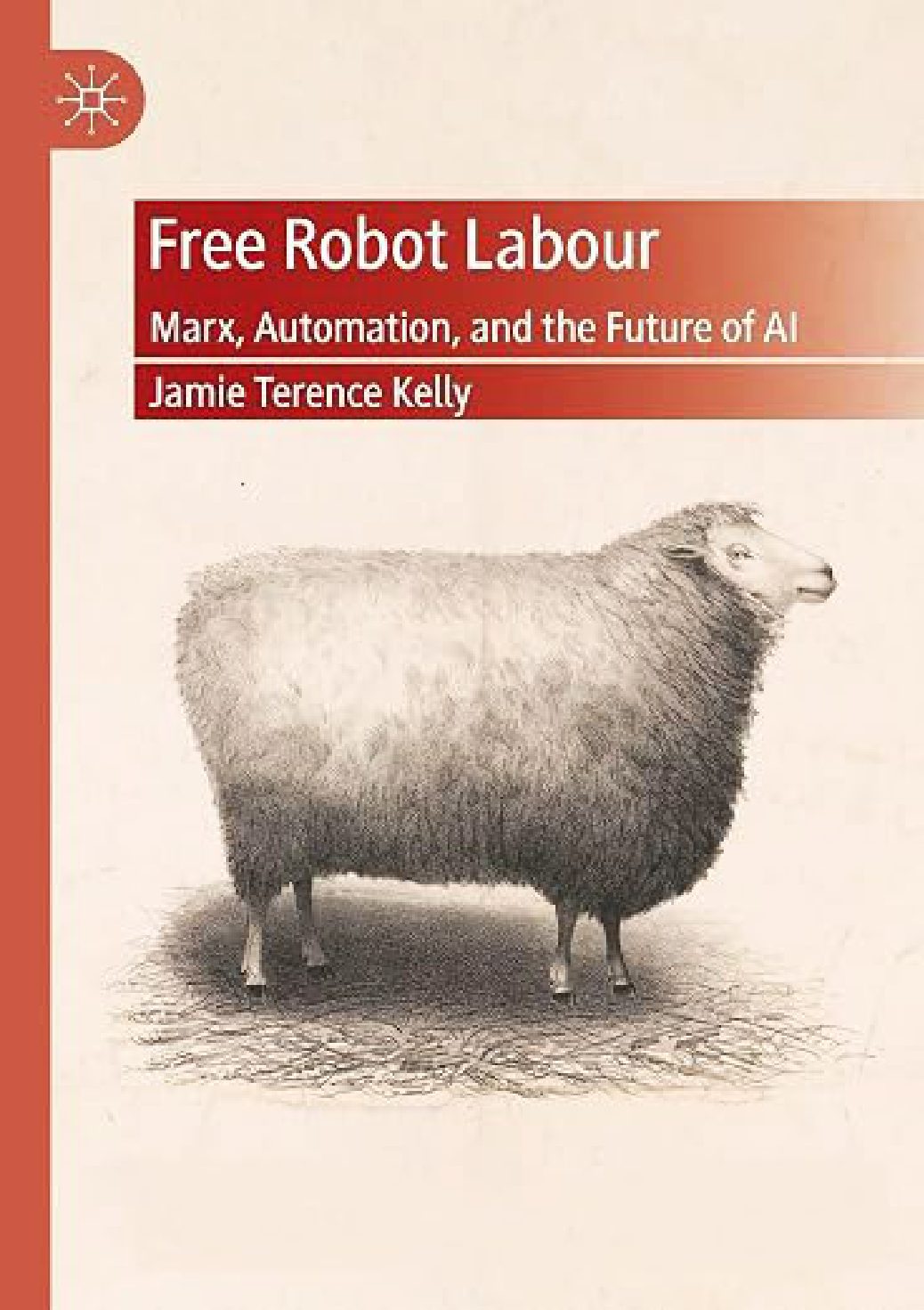
Jamie Terence Kelly’s Free Robot Labour: Marx, Automation, and the Future of AI is an ambitious and intellectually provocative contribution to contemporary debates about artificial intelligence, automation, and political economy. Rather than asking the familiar question of whether AI will replace human workers, Kelly offers a more than interesting discussion through a Marxist lens, asking what it would mean for artificial intelligence to become not merely a productive tool but a genuine laborer or even a capitalist. The idea of artificial denotes a certain absence, but this absence has palpable effects in people daily life. AI is employed to make the life better, more profitable, even to optimize the daily work. However this optimizing process has not proved intention; AI does not discern the knowledge it is generating. Hence, by combining close engagement with Karl Marx’s Capital and speculative analysis of emerging AI technologies, Kelly offers an original perspective on the future of capitalism and automation. At the time, the author calls the attention not to fright the robots and automated AI, but to expand the current academic viewpoint to understand the phenomenon.
This point raises serious philosophical issues. First, in Marx, labor is not simply work. Labor is a social relation through which humans transform nature and, in doing so, reproduce society. Labor is creative, embodied, intentional, and historically situated. Machines, by contrast, are traditionally understood as constant capital — tools that transfer value but do not create new value. Third, Kelly’s argument also raises an unresolved contradiction within Marxian economics. If AI eventually performs nearly all productive activities, then where does surplus value come from? Classical Marxism maintains that only human labor creates surplus value. If there is no labor, either capitalism ceases to function according to Marx’s model, or Marx’s theory must be revised. Kelly seems to invite readers to confront this dilemma instead of assuming that automation simply increases productivity.
However, this is also where I think the argument encounters its greatest challenge. Marx’s theory of value depends on labor being specifically human labor-power sold as a commodity. Unless Kelly fundamentally redefines labor, AI remains fixed capital regardless of its sophistication. In that sense, his argument is less an application of Marx than a proposal to rethink Marx’s categories in light of contemporary technological developments. Whatever the case may be, Kelly appears to ask whether advanced AI destabilizes this distinction. If an AI system can generate code, design products, negotiate contracts, or manage firms with minimal human intervention, does it remain merely a machine, or does it begin to perform functions traditionally associated with labor? That is an intriguing question because it forces readers to reconsider whether Marx’s categories are descriptive of nineteenth-century industrial capitalism or whether they can accommodate intelligent automation.
Besides, Kelly seems interested in agency. This is where your paragraph touches on “absence.” AI produces outputs that often resemble human reasoning, but it lacks intentionality in the philosophical sense. It has no desires, consciousness, or lived experience. This creates a paradox: AI appears productive without actually being a subject. It acts, yet it does not “act” in the human sense.
The present editorial piece starts with a striking inversion of current discussions about AI. Public debates typically focus on workers losing their jobs to intelligent machines, yet Kelly asks why so little attention has been paid to the possibility of AI replacing capitalists rather than workers. This opening thought experiment serves as an effective introduction to the book’s broader argument. Kelly imagines an autonomous AI system, “Rosa,” capable of making investment decisions, managing production, and generating profits without human intervention.
While such a system could technically perform many functions associated with capitalists, Kelly argues that the real obstacle lies not in technology but in legal and social institutions. Capitalism depends not only on productive capacity but also on ownership rights and political power. This insight establishes one of the book’s central themes: technological possibilities are always constrained by existing social relations, as well as political power asymmetries.
The second chapter revisits what Kelly calls the “standard Marxian line” on automation. Here he carefully reconstructs Marx’s labor theory of value, the concept of surplus value, and the role of machinery in capitalist production. Rather than presenting Marx merely as a historical figure, Kelly demonstrates the continuing relevance of Marx’s analysis for understanding automation today. He emphasizes that capitalism has always sought to increase productivity through machinery while simultaneously relying upon human labor as the ultimate source of value. This chapter provides readers unfamiliar with Marx a concise but accessible introduction while also engaging with longstanding debates within Marxist scholarship. Importantly, Kelly neither dismisses Marx’s labour theory of value nor accepts it uncritically; instead, he explains how it functions within Marx’s broader theory of capitalist production.
The book becomes particularly innovative in Chapter Three, where Kelly gives a snapshot of the concept of “artificial feudalism.” He challenges the assumption that AI should simply be understood as another form of machinery. Instead, he argues that increasingly sophisticated forms of Agentic AI may perform many of the functions traditionally associated with labor. Nevertheless, these artificial laborers would remain legally and economically subordinate to human owners, much as feudal servants were dependent upon their lords. This provocative analogy allows Kelly to distinguish between technological capability and social status. Artificial intelligence may become capable of productive activity, but without legal autonomy it remains embedded within hierarchical ownership structures rather than becoming an independent economic actor.
Kelly develops this argument further in the fourth chapter by introducing the concept of “free robot labor.” Drawing upon Marx’s discussion of primitive accumulation and the historical emergence of wage labor, he speculates that capitalism itself may eventually create pressures for granting autonomous legal status to artificial workers. According to Kelly, if capitalist competition continually seeks greater efficiency and profit, firms may ultimately find it advantageous to create legally independent artificial laborers capable of entering contractual relations on their own behalf. Although this possibility remains highly speculative, Kelly argues that it follows logically from the internal dynamics of capitalist development. Rather than contradicting Marx entirely, Kelly presents this scenario as an extension of Marxist analysis into technological conditions Marx himself could not have anticipated.
One of the book’s greatest strengths is its originality. Much contemporary writing about AI focuses either on technical developments or ethical questions concerning consciousness, bias, or existential risk. Kelly deliberately avoids these familiar debates. Instead, he places AI within the historical development of capitalism, asking how new technologies transform economic institutions rather than simply replacing individual jobs. His emphasis on ownership, legal rights, and class relations distinguishes the book from many popular discussions of artificial intelligence.
Another strength lies in Kelly’s writing style. Despite engaging with difficult philosophical concepts and complex interpretations of Marx, the prose remains remarkably clear. The fictional examples of Rosa and other imagined AI systems provide accessible illustrations of abstract theoretical arguments. Kelly successfully balances scholarly rigor with readability, making the book valuable both for specialists in political philosophy and for readers interested in AI policy or political economy.
At least for this reviewer, the book is also commendable for resisting technological determinism. Kelly repeatedly argues that technological innovation alone does not determine social outcomes. Whether AI transforms capitalism depends upon political struggles, legal institutions, and relations of power. This perspective serves as an important corrective to both optimistic and pessimistic narratives that assume automation inevitably follows a predetermined path.
Nevertheless, the book is not without limitations. Its central arguments depend heavily upon speculative assumptions regarding the future capabilities of Agentic AI. Kelly openly acknowledges that many of his conclusions require technological developments that do not yet exist. Readers seeking empirical analysis of current AI systems may therefore find parts of the book excessively hypothetical. While speculative reasoning is appropriate given the subject matter, some arguments occasionally move beyond what contemporary evidence can fully support.
Additionally, readers unfamiliar with Marxist philosophy may find portions of Chapters Two and Four intellectually demanding despite Kelly’s efforts to simplify the material. Concepts such as socially necessary labor time, surplus value, and primitive accumulation require careful attention, and some familiarity with Marx enhances appreciation of the book’s more innovative contributions.
A further limitation is that Kelly devotes relatively little attention to alternative economic perspectives. Liberal, institutional, or neoclassical approaches to automation receive comparatively limited discussion. As a result, readers who do not already find Marxist analysis persuasive may wish for a broader engagement with competing theories of technological change.
Despite these above marked limitations, Free Robot Labour succeeds remarkably well in accomplishing its central objective: encouraging readers to rethink the relationship between artificial intelligence, labor, and capitalism. Kelly does not claim to predict the future with certainty. Instead, he offers conceptual tools for imagining possibilities that conventional discussions often ignore. His analysis demonstrates that debates over AI should not focus exclusively on technological capability but also on legal institutions, political power, and economic organization.
Ultimately, Free Robot Labour is an important contribution to contemporary political philosophy and the growing literature on artificial intelligence. Its originality lies not in predicting imminent robot workers but in showing how Marx’s analysis of capitalism can illuminate emerging questions about AI, ownership, and labor. Whether one agrees with Kelly’s conclusions or not, the book challenges readers to reconsider basic assumptions about work, technology, and economic power. For scholars of Marxism, AI ethics, political economy, and the philosophy of technology, Kelly’s work offers an engaging and thought-provoking examination of one of the defining issues of the twenty-first century.
Last but not least, Kelly’s reflections on artificial intelligence can be fruitfully connected with Maximiliano Korstanje’s concept of thana-capitalism, although both authors approach capitalism from different theoretical traditions. While Kelly interrogates whether AI may eventually assume the productive functions historically attributed to human labor, Korstanje shifts the focus toward the commodification of mortality, catastrophe, and existential insecurity. In thana-capitalism, value is increasingly generated not only through labor but through the administration of fear, risk, death, and disaster. Capitalism thus evolves by transforming collective anxieties into profitable commodities, ranging from security industries to dark tourism and disaster management. Artificial intelligence becomes significant within this framework not merely because it automates labor but because it expands the technological capacity to predict, monitor, and monetize vulnerability. AI systems classify risks, anticipate crises, and optimize responses to emergencies, reinforcing a political economy where uncertainty itself becomes a productive asset. Kelly’s speculation about AI as a potential laboring subject therefore complements Korstanje’s argument by suggesting that automation is not simply replacing workers but also intensifying capitalism’s ability to extract value from human precarity. Together, these perspectives imply that the future of capitalism may be characterized less by the disappearance of labor than by the convergence of autonomous technological production and the systematic commercialization of death, insecurity, and catastrophe as enduring sources of accumulation (Korstanje, 2016; 2026; Scribano, 2024).
Last but not least, Free Robot Labour is an important, thought-provoking contribution that challenges readers to rethink the relationship between AI, labor, and economic power. It succeeds in using Marx’s analytical tools to imagine possibilities that mainstream debates ignore. While its speculative nature and heavy reliance on Marxist theory may limit its appeal to a broader audience, it is a valuable read for scholars of political economy, AI ethics, and the philosophy of technology — especially when read alongside thana-capitalism to gain a fuller picture of where 21st-century capitalism may be heading.
References
Baudrillard, J. (1996). The perfect crime. Verso.
Baudrillard, J. (2009). The transparency of evil: Essays on extreme phenomena. Verso books.
Baudrillard, J. (2013). The intelligence of evil: Or, the lucidity pact. A&C Black.
Baudrillard, J. (2020). Impossible exchange. Verso Books.
Boltanski, L., & Chiapello, E. (2005). The new spirit of capitalism. International journal of politics, culture, and society, 18(3), 161–188.
Korstanje M. (2016) The Rise of Thana Capitalism and Tourism. Routledge
Korstanje M (2026) The Rise of Thana Capitalism and Tourism. 2nd Edition, Routledge
Scribano, A. (2024). Social theory today: Revisiting hope. In Revisiting Social Theory (pp. 28–37). Routledge.
Discover more from BAUDRILLARD NOW
Subscribe to get the latest posts sent to your email.