After Reality: AI, Simulacra, and the New Economy of Trust
by Dr. Oleg Maltsev
THE RETURN OF BAUDRILLARD
At the end of the twentieth century, Jean Baudrillard wrote a series of works that many readers took as an intellectual provocation. He argued that the modern world was gradually ceasing to live among things and beginning to live among signs. To an ordinary person, such a claim sounded strange. Cities still stood where they had always stood. People worked. Factories produced goods. States governed territories. What signs was he talking about?
But Baudrillard was not speaking about the disappearance of the physical world. He was speaking about the disappearance of the direct connection between the human being and the world.
First, a person saw an object. Later, he saw an image of the object. Then he saw an advertisement for the object. After that, he saw the object’s brand. Eventually, he began to live not among things themselves, but among their symbolic reflections. Baudrillard called this the world of simulacra.
A simulacrum is not a lie. It is a far more complex phenomenon. A lie presupposes the existence of truth. A counterfeit presupposes the existence of an original. A simulacrum, however, exists on its own. It no longer needs an original. This is why the philosopher argued that the map begins to precede the territory.
“THE TERRITORY NO LONGER PRECEDES THE MAP, NOR DOES IT SURVIVE IT. IT IS NEVERTHELESS THE MAP THAT PRECEDES THE TERRITORY-PRECESSION OF SIMULACRA.THAT ENGENDERS THE TERRITORY, AND IF ONE MUST RETURN TO THE FABLE, TODAY IT IS THE TERRITORY WHOSE SHREDS SLOWLY ROT ACROSS THE EXTENT OF THE MAP.”
J. BAUDRILLARD, SIMULACRA AND SIMULATION, 1981
For the late twentieth century, this idea seemed too radical. For the twenty-first century, it reads almost like a documentary statement.
AI AS A FACTORY OF SIMULACRA
Artificial intelligence has done what television, advertising, and the internet had only begun to do. It has automated the production of simulacra. What used to require studios, agencies, editors, and distribution systems can now be generated by a machine in seconds.
Today, a machine can create:
- a photograph of a person who has never existed;
- a speech by a person who never delivered it;
- a book without an author;
- music without a musician;
- a painting without an artist;
- an interview without an interviewee;
- an expert without a biography.
This is not merely a quantitative leap in content generation; it is a qualitative mutation of the environment we inhabit. It is crucial to recognize that AI does not merely create information. It creates plausibility (правдоподобие). These are fundamentally separate phenomena that belong to entirely different orders of reality.
Information is an objective structure; it communicates a hard fact, tied to a specific point in time and space. Plausibility, however, is a psychological construct; it creates the flawless impression of a fact. Human beings are fundamentally unequipped to process raw data directly; instead, we perceive narrative coherence, emotional tone, and persuasive force. AI has decoded this grammar of persuasion. It does not need to know the truth to make you believe it; it only needs to master the aesthetic and logical syntax that your mind automatically associates with reality.
For the first time in human history, persuasiveness has completely separated itself from origin.
Previously, trust was an hard-won architecture built through a verifiable path: a physical source, a human author, an established institution, years of documented experience, and legal or moral responsibility. Today, this entire vertical path is bypassed. Trust is increasingly built horizontally—on the sheer quality of the simulation. When a machine can mimic the precise academic tone, the subtle grain of photographic evidence, or the cadence of authoritative speech, the traditional anchors of reality simply dissolve. We are left in a world where the signifier is flawless, but the signified no longer exists.
THE DEATH OF ORIGIN
For thousands of years, people asked the same basic questions: Who said this? Who wrote this? Who saw it? Who was the witness? Origin was the foundation of trust, because it connected a statement to a person, a place, a time, and a responsibility.
The modern world is beginning to lose this habit. A new criterion is emerging: Does it look convincing? The question of origin is being replaced by the impression of credibility.
The difference may seem small. In reality, it is enormous. Origin requires a history. Persuasiveness requires only good packaging. AI makes packaging cheap, fast, and endlessly reproducible.
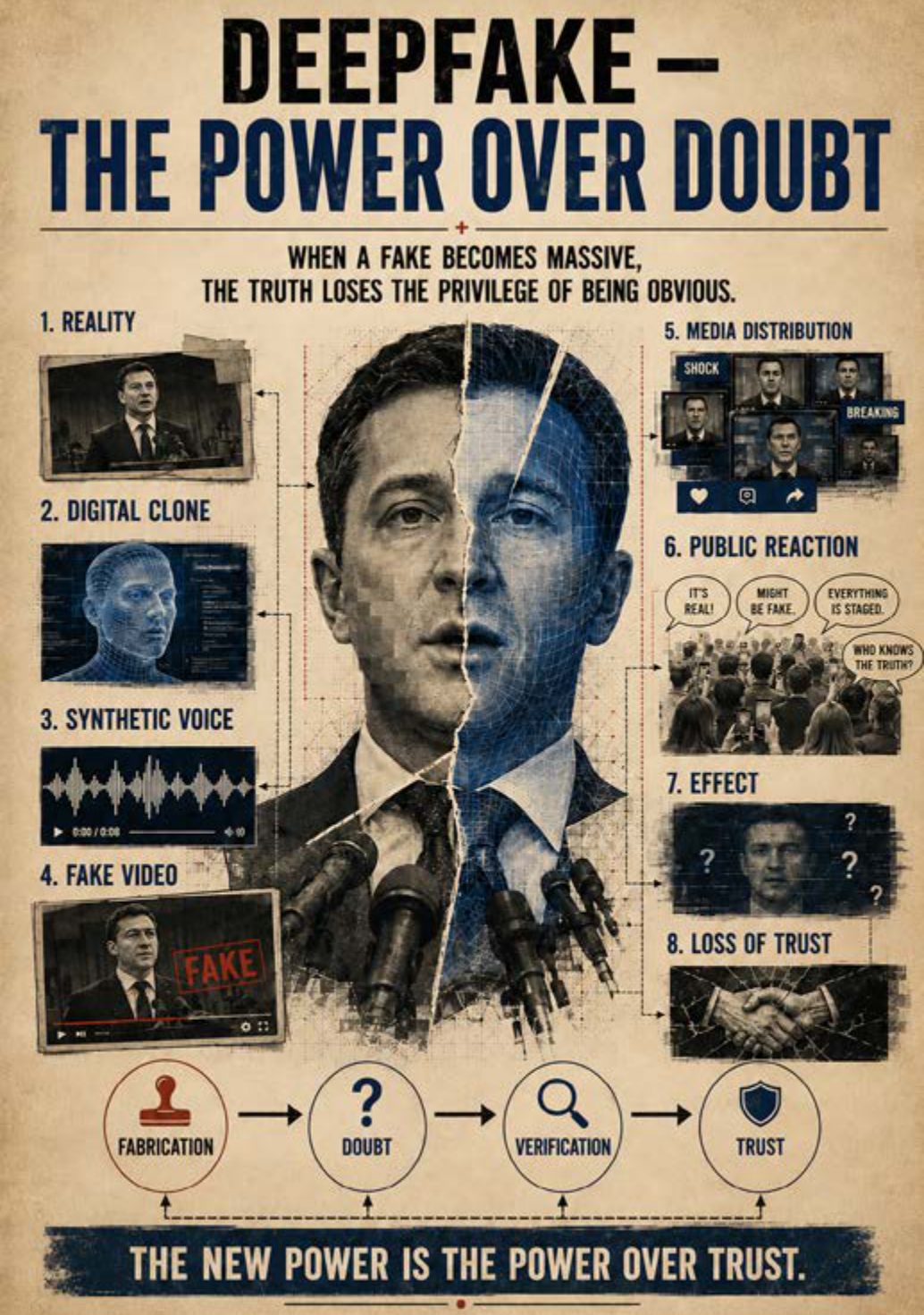
As a result, the value of origin begins to rise.
This is precisely why several things are now making an unexpected return:
- documentary photography;
- the archive;
- the diary;
- the field recording;
- the expedition journal;
- the authorial book.
People are beginning to search for the trace of origin. They are looking for something that cannot be reduced to a polished surface, or a perfectly convincing simulation.
PHOTOGRAPHY AFTER EVIDENCE
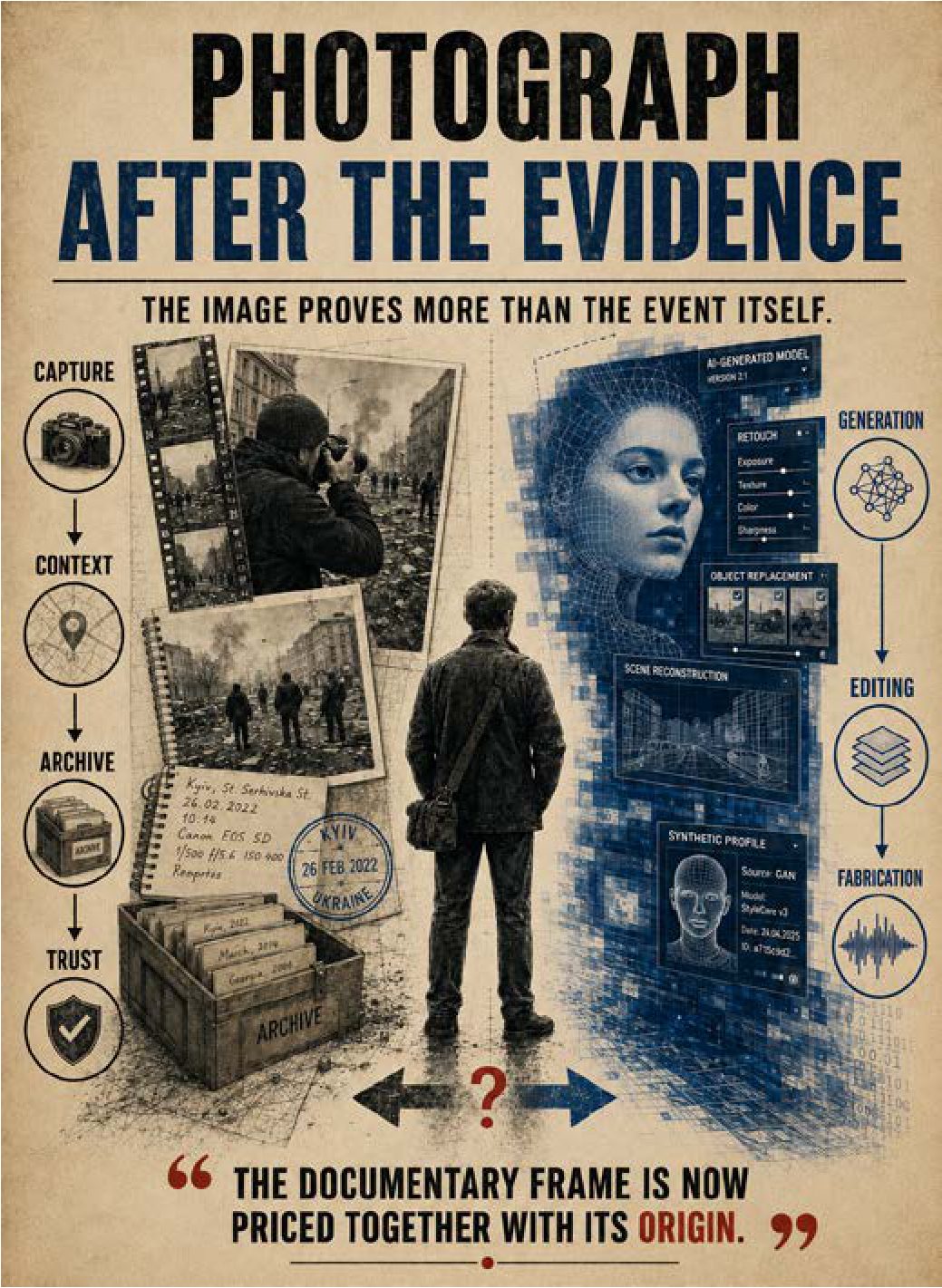
This crisis has become especially visible in photography. For a century and a half, photography held a special status. It was perceived as testimony. Even when a photographer made a mistake, staged a frame, or chose a particular angle, one feeling remained: this happened.
Today, the situation has changed. AI can create images of things that never existed, scenes that were never witnessed, and faces that were never photographed. This is why photography is ceasing to function as automatic proof.
Its value is shifting. The image itself is no longer enough. What matters now is the origin of the image.
Who took it?
Where and when was it taken?
What was happening around it?
Does an archive exist?
Is there a sequence of frames?
Is there context?
Paradoxically, artificial intelligence does not destroy documentary photography. It makes it more important. In an age of generated images, the document returns not as a simple picture, but as a trace with a history.
THE BOOK AFTER THE AUTHOR
A similar situation is emerging in literature. The machine is already capable of writing, and of writing with a certain degree of persuasiveness. It can instantly synthesize thousands of existing texts, mimic styles, and assemble logical arguments.
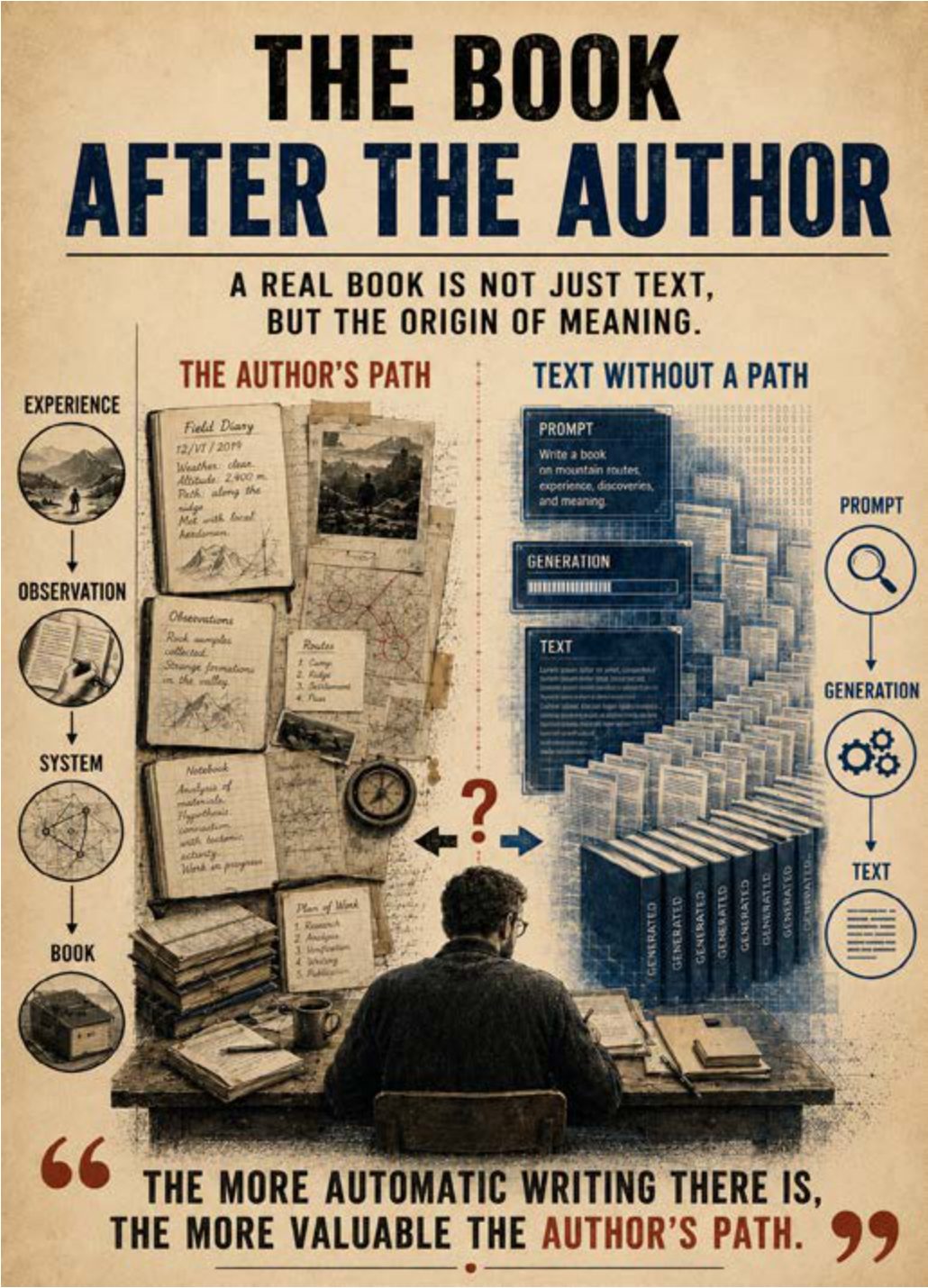
But a book has always been more than a text. A book was the result of a path. Behind a book stood observations and mistakes, research and discoveries, field work, and even the author’s inner crises. AI can generate a narrative because it trains on the collective past of humanity, but it cannot live a single day of an individual biography. It produces content without experience and conclusions without the risk of search.
This is why the book of the future will be judged not only by the quality of its writing.
The more automatic writing surrounds us, the more valuable the author’s path becomes.
MARKETING AFTER BAUDRILLARD
Modern marketing was the first industry to collide with this new reality.
It is enough to see that today one can already create:
- a brand without a product;
- a reputation without experience;
- popularity without achievement;
- and expertise without practice.
AI has sharply accelerated this process, turning the creation of authority into a seamless, industrialized loop. When professional design, flawless rhetoric, and deeply analytical corporate profiles can be generated by a machine in a matter of clicks, the traditional markers of competence lose their value. The market is now flooded with synthetic experts and ghost brands that possess all the aesthetic attributes of success but lack any material foundation. This total inflation of visibility has produced a profound crisis of trust. Because when every actor on the stage looks equally convincing, flawless, and persuasive, the question inevitably arises: whom should we believe when the simulation itself is perfect?
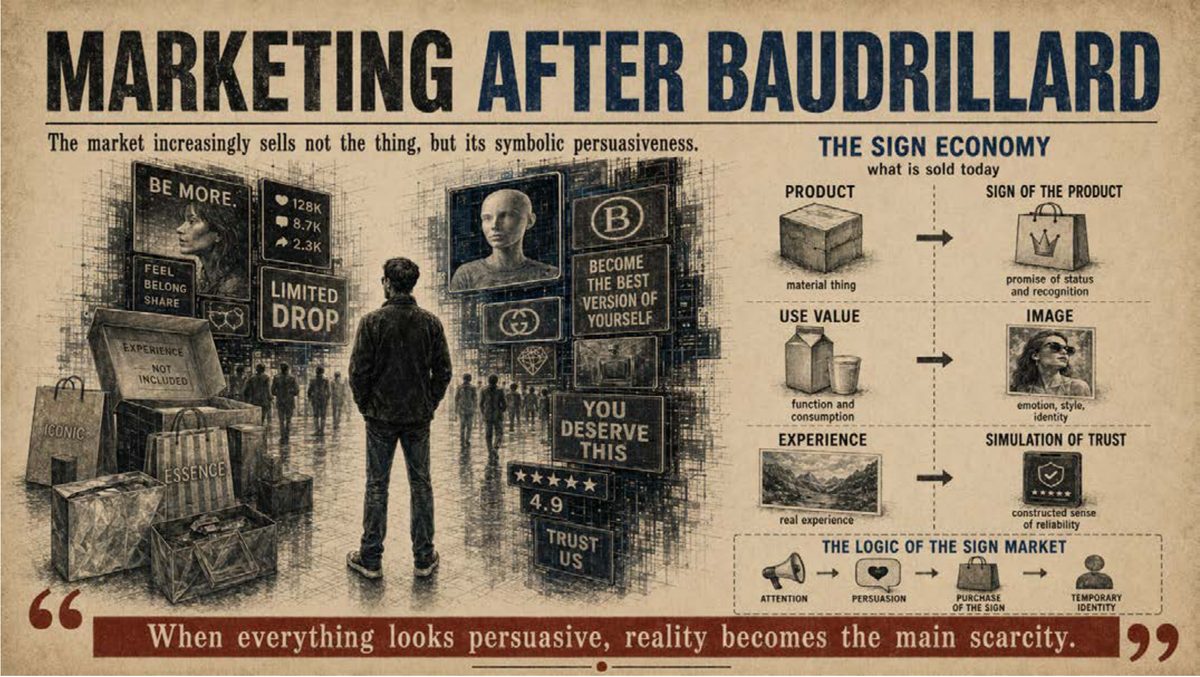
As a direct countermeasure to this hyper-inflation of content, the architecture of consumer and professional choices is undergoing a radical shift. We are witnessing the return of expert communities, long-form reading, closed research journals, professional schools, and deeply personal, author-led projects. The emphasis is moving away from broadcasted metrics—such as public views, massive subscriber counts, or superficial media presence—toward verifiable lineages of practice and peer-vetted authority. In a world of total simulation, where the surface can be completely counterfeited, trust becomes the central scarcity, and the only remaining defense is a return to insulated, accountable networks of real human expertise.
EXPEDITION AS ANTI- SIMULACRUM
There is one form of activity that is especially difficult to reconcile with simulation: the expedition.
An expedition requires a collision with reality. One cannot generate a route already walked, or the exhaustion that follows it. One cannot artificially reproduce the unexpected mistake that appears in the field, or the resistance of the environment that has to be overcome. And it is highly unlikely that a genuine discovery will occur without this encounter.
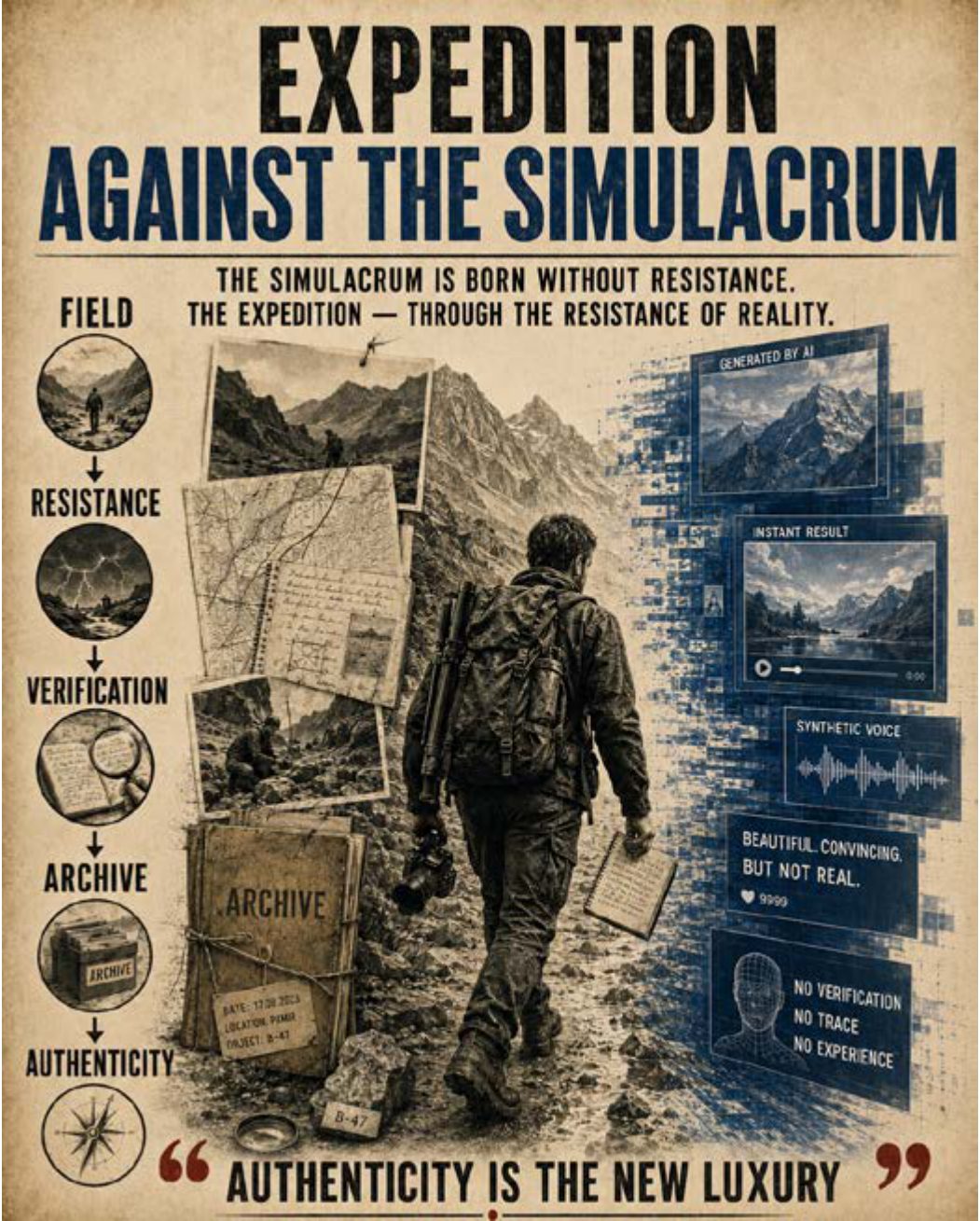
This resistance of the environment acts as a natural filter against any simulation. While a machine can model a landscape or calculate a theoretical trajectory, it cannot replicate the weight of a physical object, the unpredictability of a human climate, or the sudden breakdown of equipment in the middle of nowhere. In the field, a researcher does not operate in a frictionless digital vacuum; they are constantly forced to adapt to a reality that does not obey algorithms. This is where the synthesis of data ends and the generation of true fact begins—in the direct, often uncomfortable friction between the human mind and an uncompromising world.
Every expedition inevitably leaves behind a material trace: archives, maps, photographs, field notes, and diaries. This is why the expeditionary researcher becomes one of the key figures of the new era. He brings not merely a subjective opinion, but evidence that has passed through contact with reality.
THE NEW ECONOMY OF TRUST
We are entering an era in which the main resource is no longer information. The long-standing belief that “he who owns information owns the world” has turned into an anachronism. Today, there is already too much information; it has become an ambient noise, an endless, self-reproducing ocean of data where the true is indistinguishable from the generated.
In this new reality, the primary, most scarce resource is trust.
Not the speed of delivery, which AI has reduced to milliseconds. Not the quantity of content, which has become virtually infinite. Not the volume of publications or the aggressiveness of distribution. The new currency is the ability to prove the origin of meaning.
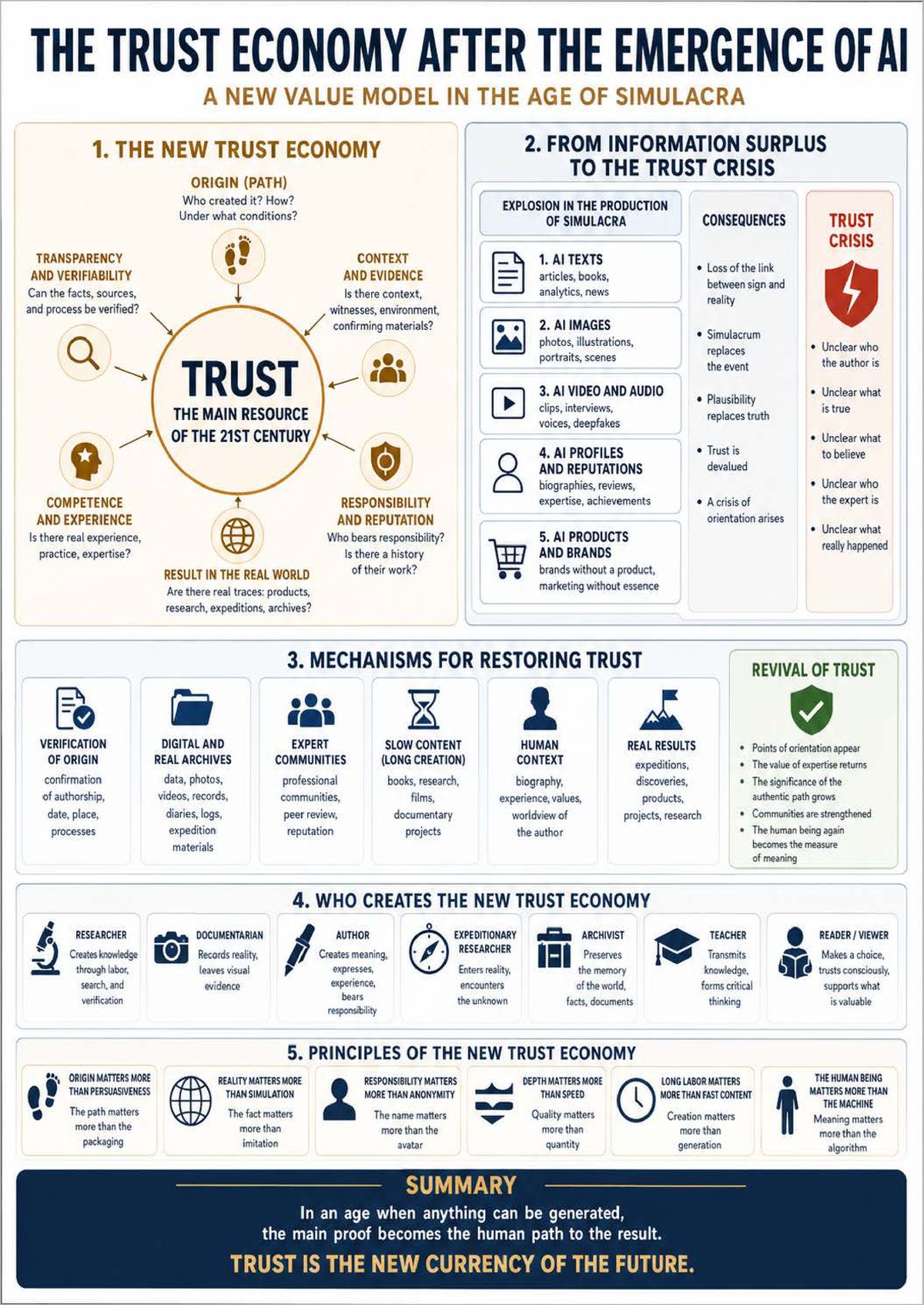
When any text can be simulated, any image generated, and any expert consensus counterfeited, trust can no longer be bought through cheap persuasiveness or flawless packaging. It must be earned through a verifiable genealogy of thought.
This is why the future does not belong to the smartest algorithms or the most productive prompt-engineers, but to those who anchor meaning to reality. The future belongs to:
- The researcher and the documentarian, who step outside the digital bubble to collide with the friction of the real world;
- The author, whose text is inseparable from a lived biography and inner crisis;
- The archivist and the field collector, who preserve the physical, unalterable trace of time;
- The teacher, who does not merely transmit data, but passes down a living tradition of critical thought.
The key figure of the coming decades is the person capable of doing what no machine can: showing the human path by which knowledge was obtained.
CONCLUSION
AI does not destroy reality; it makes it more valuable. The more the world fills with simulacra, the more important archives, documents, photographs, expeditions, real books, and genuine research become.
Jean Baudrillard saw the beginning of this process. Artificial intelligence has brought it to its logical conclusion. But precisely for this reason, a new task emerges: not to fight simulation, but to restore weight to reality.
In a world where everything can be generated, the chief proof becomes the human path toward a result.
Discover more from BAUDRILLARD NOW
Subscribe to get the latest posts sent to your email.