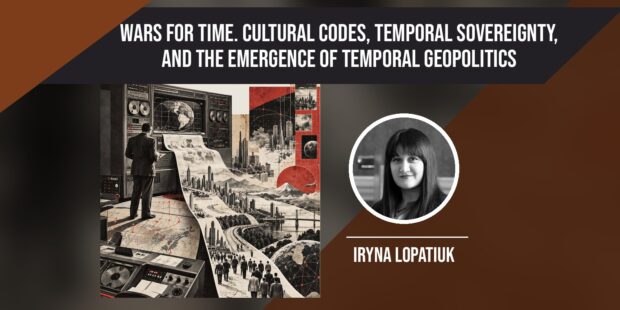
Wars for Time. Cultural Codes, Temporal Sovereignty, and the Emergence of Temporal Geopolitics
by Iryna Lopatiuk
Abstract
Geopolitics has traditionally been concerned with the distribution and control of territory. States compete for land, borders, resources, strategic corridors, infrastructure, and access to geographical space. Yet the political significance of territory increasingly depends upon another dimension that cannot be represented on a conventional map: the temporal order through which societies organize memory, attention, expectation, anticipation, and action.
This article develops Temporal Geopolitics as a framework for analysing this emerging condition. Its central proposition is that the cultural code should no longer be understood merely as a mechanism of collective identity. It should also be understood as a temporal infrastructure: a system through which a society determines what belongs to the past, what constitutes the present, which futures are imaginable, and what rhythm of change is considered legitimate.
The argument brings this proposition into dialogue with Jean Baudrillard’s analyses of simulation, acceleration, America, the perpetual present, and the disappearance of historical transcendence, as well as with scholarship on chronopolitics, social acceleration, historical regimes, and the geopolitics of temporality. The article distinguishes Temporal Geopolitics from the broader field of chronopolitics by focusing specifically on the encounter, competition, and asymmetry of different temporal regimes as geopolitical formations.
Four cases are used to develop the framework: the temporal discipline of the global economy, the algorithmic organization of attention by digital platforms, the coexistence of multiple temporal regimes within contemporary Japan, and the growing capacity of artificial intelligence to model and pre-structure possible futures. These cases demonstrate that temporal power can operate without territorial occupation and that geopolitical dependence may increasingly involve dependence upon externally imposed rhythms, horizons, and models of futurity.
The article suggests five analytical categories — temporal territory, temporal borders, temporal sovereignty, temporal colonization, and temporal insurgency — and concludes by presenting Temporal Geopolitics as an interdisciplinary research programme for studying the production, occupation, synchronization, disruption, and contestation of collective time.
Keywords: cultural code; temporality; chronopolitics; geopolitics; temporal sovereignty; temporal territory; Baudrillard; acceleration; digital platforms; artificial intelligence; futurity.
INTRODUCTION: THE LAST ILLUSION OF GEOGRAPHY
The classical geopolitical imagination begins with the assumption that power occupies space. Territory can be mapped, bordered, divided, administered, defended, invaded, exchanged, and transformed into a strategic resource. The map therefore appears to provide the most stable representation of political reality. Even when contemporary geopolitics moves beyond the state and begins to speak of networks, infrastructures, supply chains, information flows, or spheres of influence, the spatial grammar remains largely intact: someone is somewhere, something lies between two places, and power is exercised through the control of distance.
But what happens when different populations occupy the same geographical space while living according to different temporal regimes?
One society may understand the present as the continuation of a long historical process, while another experiences the present as a radical break with the past. One may regard technological acceleration as liberation, while another experiences the same acceleration as cultural dislocation. One political community may organize its expectations around an expansive future, while another may place its legitimacy in continuity, repetition, or restoration. One institution may operate through decades-long cycles, while another is compelled to respond within seconds.
These are not simply differences in opinion. They are differences in the temporal architecture through which reality becomes intelligible.
The traditional geopolitical map cannot represent this architecture.
This does not mean that territory has ceased to matter. It means that territory has become only one layer of a more complicated political topology. Alongside geographical territories there are territories of information, attention, memory, expectation, technological standards, economic rhythms, and historical legitimacy. A population can lose control over its geographical space while retaining a strong cultural code; conversely, it can preserve formal territorial sovereignty while becoming increasingly dependent upon temporal regimes produced elsewhere.
The geopolitical question therefore acquires another dimension. It is no longer sufficient to ask who controls the territory. We must also ask who determines the time in which the territory is experienced.
Jean Baudrillard offers an unusually productive point of departure. In Simulacra and Simulation, he writes that “the territory no longer precedes the map, nor survives it. Henceforth, it is the map that precedes the territory” (Baudrillard, 1994, p. 1). The proposition is usually understood as a statement about simulation and the replacement of reality by models. Yet its geopolitical implications are broader. If the model precedes the territory, then power no longer depends exclusively upon controlling material space. It also depends upon controlling the codes through which space, history, identity, and sequence are interpreted.
The present article proposes that time has become one of those codes.
The claim is not that time has suddenly become political. Time has always been political. Calendars, working hours, school years, electoral terms, religious observances, time zones, historical periodization, and institutional schedules have long regulated collective existence. The literature on chronopolitics has demonstrated this in considerable detail, distinguishing between the time of politics, the politics of time, and the politicization of time.
The argument developed here goes one step further. The twenty-first century is turning the cultural code itself into an infrastructure for organizing competing temporal regimes. The cultural question is consequently no longer restricted to Who are we? It increasingly includes a more fundamental question: What time do we live in?
What counts as the past? What constitutes the present? Which future is desirable? How quickly should transformation occur? What rhythms are considered natural? Which forms of delay are treated as pathological? Who is permitted to define what is “modern,” “backward,” “urgent,” or “inevitable”?
These questions lead directly to the problem of Temporal Geopolitics.
FROM GEOPOLITICS TO TEMPORAL GEOPOLITICS
The contemporary literature on chronopolitics provides the necessary starting point. Chronopolitics examines the political organization of time, the temporal rhythms of political institutions, and the use of temporal distinctions as instruments of power. Esposito and Becker’s formulation is particularly useful because it shows that political systems do not merely operate within time; they actively produce and regulate temporal relations.
Yet a specifically geopolitical question remains. What happens when different temporal regimes encounter one another as competing formations of power?
A temporal regime can include and exclude. It can establish a centre and a periphery. It can classify populations as advanced or backward, innovative or obsolete, future-oriented or trapped in the past. It can determine how quickly institutions are expected to respond, how long citizens are expected to wait, how far into the future organizations are capable of planning, and which historical events remain politically active.
Temporal structures therefore acquire properties traditionally associated with territory.
This is the specific sense in which the present article employs the term Temporal Geopolitics. The concept refers to the study of how collectively organized temporal structures become objects and instruments of geopolitical power, and how cultural codes produce, protect, export, impose, or resist these temporal structures. The distinction from chronopolitics matters.
Chronopolitics asks how time becomes political. Temporal Geopolitics asks what occurs when multiple temporalities become geopolitically consequential because they are forced into contact, competition, synchronization, or hierarchy.
The novelty proposed here does not consist in claiming terminological priority. Nor does it consist simply in adding the word “time” to geopolitics. Existing scholarship has already demonstrated that temporality is fundamental to political power. The more specific proposition is that temporal organization can itself function as a geopolitical domain, while cultural codes provide one of the principal infrastructures through which temporal sovereignty is produced and contested.
The map, in this formulation, does not disappear, it acquires another dimension.
CULTURAL CODE: THE HIDDEN ARCHITECTURE OF TIME
The cultural code is conventionally associated with values, symbols, rituals, language, collective memory, narratives, and patterns of interpretation. Such approaches remain indispensable. Yet they tend to emphasize the question of identity: who belongs to a collective, what that collective believes, and how it distinguishes itself from others.
A cultural code does something more fundamental. It tells a society when it is.
Every culture constructs relationships between past, present, and future. It determines which memories remain active, which events are allowed to become historical, which ancestors continue to possess authority, which futures appear desirable, and which forms of change are regarded as legitimate. It decides whether the present should be interpreted as culmination, crisis, transition, decline, restoration, or beginning.
A national myth is temporal because it organizes a sequence. A religious tradition is temporal because it connects ordinary existence to sacred origins and anticipated endings. Revolutionary ideology is temporal because it interprets the present as a transitional stage. Conservatism privileges continuity. Modernization theory constructs societies along a developmental sequence. Digital culture privileges immediacy and continuous updating.
The cultural code therefore functions as a temporal machine.
Baudrillard’s America offers an unusually sharp illustration. America, he writes, is “the original version of modernity,” while other societies become its translated or mediated versions; America “lives in a perpetual present” (Baudrillard, 1989, p. 76). The significance of this observation extends beyond national character. Baudrillard is describing a particular temporal regime: one in which origins become less important than immediacy, continuity gives way to renewal, and historical depth becomes an obstacle to permanent movement.
His observation that “driving is a spectacular form of amnesia” (Baudrillard, 1989, p. 9) is equally revealing. Movement does not necessarily intensify historical consciousness. Under certain conditions, movement becomes a technique for eliminating the landscape of what has just been left behind.
Culture, in other words, does not merely give meaning to time, it organizes the experience of time itself.
BAUDRILLARD AND THE DISAPPEARANCE OF HISTORICAL SYNCHRONY
Baudrillard’s later work makes the temporal problem considerably more radical. The issue is not simply that contemporary societies have become faster. It is that the acceleration of circulation threatens the structures through which events acquire duration, sequence, and historical meaning.
In The Illusion of the End, Baudrillard writes:
“No human language can withstand the speed of light. No event can withstand being beamed across the whole planet. No meaning can withstand acceleration. No history can withstand…” (Baudrillard, 1994, p. 2)
The unfinished character of the sentence is almost more important than its completion. Something has happened to the possibility of historical completion itself.
An event can now become globally simultaneous before it has become locally meaningful. Everything arrives at once. The past becomes archived information. The future becomes ‘forecast’. The present becomes an interface through which both circulate.
Baudrillard’s claim that “history, meaning and progress are no longer able to reach their escape velocity” is therefore not merely an observation about media culture (1994, p. 4). It suggests that acceleration can flatten historical difference.
And yet this flattening produces an extraordinary paradox. The more the world becomes synchronized technologically, the more temporal differences between societies can become politically visible.
Everyone receives the same event. Not everyone places it in the same historical sequence.
Everyone encounters the future. Not everyone imagines the same future.
Everyone experiences acceleration. Not everyone possesses the same ability to control its rhythm.
Global simultaneity therefore does not eliminate temporal difference. It makes temporal difference confrontational.
TEMPORAL TERRITORY
A temporal territory is a social field within which a particular relationship between past, present, and future becomes sufficiently stable to organize collective action.
Unlike geographical territory, it has no fixed coordinates. It is constituted by calendars, historical narratives, rituals, institutional rhythms, technological infrastructures, expectations, and patterns of attention.
This explains why temporal territories can survive geographical displacement. Diasporic communities, religious traditions, professional communities, and transnational organizations may be distributed across multiple countries while preserving shared temporal structures. A geographical territory can fragment while a temporal territory remains intact.
The reverse is equally important. Population may remain within the same geographical territory while its temporal environment is radically transformed.
Digital platforms provide an obvious example. The user enters not simply a new informational space but a new rhythm of existence. Notifications, continuous updates, recommendation systems, real-time metrics, and endlessly replenished feeds privilege immediacy. The distinction between “now” and “later” becomes operational rather than experiential.
The platform does not simply distribute information.
It distributes attention across time.
A new territorial layer therefore emerges over the geographical one. The state retains its territory, but the platform establishes a competing temporal environment within it. This is the beginning of Temporal Geopolitics.
TEMPORAL BORDERS
If temporal territories exist, then temporal borders must also exist. A temporal border separates incompatible regimes of sequence, rhythm, and expectation. It does not necessarily stop physical movement. Instead, it determines whether different populations are permitted to appear as contemporary.
Modern political language is filled with temporal borders. Developed and developing. Modern and traditional. Innovative and backward. Future-oriented and obsolete. Fast and slow.
These distinctions appear descriptive. They are actually hierarchical.
To define a society as “behind” is to place it in a subordinate temporal position. To describe another society as the embodiment of the future is to claim authority over the direction of historical development.
This logic has deep roots in modernity. Johannes Fabian’s concept of the “denial of coevalness” demonstrated how supposedly scientific representations of other societies could place them into a different temporal location, transforming cultural difference into temporal distance.
The geopolitical consequence is substantial. If one society can define itself as the future, another can be defined as its past The temporal map is already a map of power.
Case I: The Global Economy and the Power of Tempo
The global economy offers perhaps the clearest example of temporal geopolitics without territorial conquest.
Financial markets operate across time zones. Supply chains distribute production according to differences in labour costs, availability, logistics, and working hours. Digital commerce expects immediate response. Organizations increasingly treat delay as inefficiency. The global economy therefore does not merely connect territories. It attempts to synchronize them. But synchronization is never neutral. The actor capable of establishing the rhythm possesses an advantage over the actor who must adapt.
This is where Paul Virilio’s analysis of speed becomes important. Modern power is not simply the ability to occupy space; it increasingly involves the ability to control the velocity at which events occur. Hartmut Rosa’s analysis of social acceleration similarly demonstrates that modernization transforms the rhythms and expectations through which social life is organized. Baudrillard adds the necessary paradox. “Every acceleration produces an equivalent or even greater mass,” he writes; “every mobilization gives rise to an equal or greater immobility” (Cool Memories). Acceleration does not simply eliminate inertia. It can produce new forms of it. The global economy illustrates this contradiction everywhere. A company may communicate instantly while becoming less capable of long-term planning. A worker may be connected to a global market while having less control over the rhythm of work. A consumer may receive goods almost immediately while becoming trapped in an endless cycle of anticipation.
The result is a peculiar form of dependence. A territory can become economically integrated while becoming temporally subordinate. This is temporal colonization without territorial occupation.
Case II: The Platform and the Permanent Present
The digital platform represents a more intimate form of temporal power. Earlier media systems imposed relatively stable temporal structures: editions, broadcasts, programmes, publishing cycles, schedules. The platform replaces these with continuous circulation. The feed does not end.
There is always another message, another image, another notification, another recommendation. The present constantly reproduces itself. The consequence is a new temporal regime of permanent imminence.
Something is always about to happen. The platform therefore does not merely control information. It controls the transition between what has happened, what is happening, and what might happen next.
Here Baudrillard’s concept of simulation becomes especially useful. Simulation is not simply an imitation of reality. It is “a generation by models of a real without origin or reality” (Baudrillard, 1994, p. 1). Applied to temporality, this means that events increasingly appear within systems of circulation before they acquire independent historical duration.
The event arrives already formatted as content. The present arrives already prepared for replacement.
The user scrolls backward into the past and forward into anticipated content without leaving the same interface. Chronology becomes subordinate to circulation. The platform consequently establishes a temporal territory whose border is not geography. Its border is attention.
This is geopolitically significant because these temporal infrastructures operate across national borders while remaining only partially subject to the temporal institutions of the societies in which they function. A state may regulate territory. It cannot automatically regulate the rhythm of attention within that territory.
Case III: Japan and the Coexistence of Temporal Worlds
Japan offers a particularly revealing case because it demonstrates that temporal geopolitics does not require a conflict between different countries. Different temporal regimes can coexist within the same civilization.
Modern Japan is often associated with technological sophistication, industrial discipline, punctuality, high-speed transportation, and intense organizational efficiency. Yet these features coexist with other temporal structures: seasonal cycles, ritual calendars, long historical continuity, inherited forms, generational transmission, and a strong cultural sensitivity to the passage and transience of time.
The significance of this coexistence is not that Japan represents “tradition versus modernity.” Such a formulation is too simple. The more interesting phenomenon is the ability of different temporal regimes to remain simultaneously operative.
The high-speed train and the seasonal festival do not belong to the same temporal logic. The automated convenience store and the inherited ritual do not measure time in the same way. The technological future and the cultural memory of impermanence are not simply opposites. They can coexist within the same social order.
This makes Japan analytically valuable for Temporal Geopolitics because it demonstrates that temporal sovereignty does not necessarily mean choosing one temporal regime and eliminating all others. It may instead mean maintaining the ability to coordinate multiple temporalities without allowing one of them to become universally dominant. The question is therefore not whether a society is modern or traditional. The question is whether it can determine how different temporal regimes coexist. This is a much more sophisticated conception of sovereignty. It also reveals a weakness in many theories of modernization. If modernization is interpreted as movement from an earlier time toward a universal future, then coexistence appears as contradiction. From the perspective of Temporal Geopolitics, coexistence can instead be a form of temporal complexity — and therefore a potential source of autonomy.
Case IV: Artificial Intelligence and the Pre-Occupation of the Future
Artificial intelligence introduces a still more radical temporal problem because it does not merely accelerate the present. It increasingly attempts to anticipate and pre-structure the future.
Predictive systems estimate future behaviour. Recommendation systems anticipate preferences. Generative systems produce texts, images, strategies, designs, and scenarios before the human actor has fully formulated them. Organizations use AI to model demand, risk, markets, security, and possible decisions.
The significance of AI therefore cannot be reduced to automation. Its deeper geopolitical significance lies in the production of anticipated futures.
Baudrillard’s concept of simulation becomes relevant again. If models can generate representations of what has not yet occurred, then the future can become hyperreal before it becomes real. Institutions may begin acting according to predicted futures, thereby transforming the prediction into one of the conditions of its own realization. The central geopolitical question becomes: Whose model of the future is being used?
If one technological infrastructure becomes dominant in forecasting behaviour, allocating resources, identifying risks, or defining likely scenarios, then its assumptions about the future can become embedded in institutional action.
The future is no longer merely awaited. It is increasingly preformatted. This introduces a new dimension of temporal sovereignty.
A society may retain the ability to choose among political alternatives while losing the ability to imagine alternatives outside the predictive architectures through which those choices are presented.
The most consequential struggle over AI may therefore not concern whether machines become more intelligent than humans. It may concern who gets to model tomorrow.
TEMPORAL SOVEREIGNTY
The concept of temporal sovereignty follows from these cases.
Territorial sovereignty traditionally refers to the authority to regulate what occurs within a geographical domain. Temporal sovereignty refers to the capacity of a collective to determine, protect, and reproduce its own temporal organization. This sovereignty has several dimensions.
The first is memory sovereignty: the capacity to determine which elements of the past remain politically and culturally active.
The second is rhythmic sovereignty: the capacity to regulate the rhythms of labour, education, communication, ritual, and everyday life.
The third is anticipatory sovereignty: the capacity to formulate expectations about the future rather than simply importing externally produced futures.
The fourth is synchronization sovereignty: the capacity to determine with whom, and according to whose rhythm, a society synchronizes.
The fifth is interpretive sovereignty: the capacity to determine whether an event represents continuity, rupture, crisis, decline, restoration, or transformation.
These dimensions reinforce one another. A society that loses control over its historical narrative may gradually lose the ability to define its political future. A society dependent upon external economic rhythms may become unable to determine its own institutional tempo. A population whose attention is continuously organized by external platforms may find it increasingly difficult to reproduce slower cultural rhythms of reflection and transmission. Temporal sovereignty is therefore not a poetic metaphor for independence. It is the condition of political autonomy.
TEMPORAL COLONIZATION
Colonialism traditionally involved the occupation of territory, extraction of resources, reorganization of labour, and imposition of institutions. Temporal colonization operates differently.
It reorganizes the sequence through which a society understands its own existence.
The colonized society is encouraged to perceive itself as late, incomplete, backward, transitional, or obsolete. Its past becomes primitive; its present becomes deficient; its future becomes an imitation of another society’s present.
This is why modernization can function as a temporal hierarchy.
You are here. They are there. You must become what they already are. The future has already been occupied.
Temporal colonization therefore differs from ordinary cultural influence. Cultural exchange allows several codes to coexist. Temporal colonization establishes one temporal code as universal and transforms alternative temporalities into evidence of deficiency.
The most powerful temporal colonizer is not necessarily the society that says, “Become like us.” It is the one that succeeds in making another society believe: There is no… alternative future?
TEMPORAL INSURGENCY
If temporal colonization is possible, temporal resistance must also be possible.
A temporal insurgency occurs when a collective refuses the dominant organization of past, present, and future. It may preserve a memory that an official system seeks to render obsolete. It may deliberately slow a process presented as inevitable. It may refuse the technological demand for permanent immediacy. It may maintain a ritual calendar, a language, a craft, a social practice, or an institutional rhythm that does not conform to the dominant tempo.
Temporal insurgency therefore does not always look like political opposition. Sometimes it looks like refusal to synchronize. This may be one of the most important political forms of the coming decades. If contemporary power increasingly operates through synchronization, then desynchronization can become a form of resistance.
- To refuse acceleration is political.
- To refuse compulsory forgetting is political.
- To refuse a prescribed future is political.
- To maintain an alternative rhythm is to preserve an alternative form of sovereignty.
THE GREAT TEMPORAL FRAGMENTATION
This brings us to the paradox at the centre of globalization.
We assumed that globalization would gradually eliminate cultural differences. Global markets, mass communication, technological convergence, migration, and international institutions seemed to point toward a common world.
However, globalization may have produced something very different. It has not eliminated temporal difference. It has placed different temporalities into permanent proximity.
A global financial market operates according to one rhythm; a family according to another. A religious community may organize life according to a sacred calendar while its members work according to a corporate schedule and consume media according to the uninterrupted rhythm of the platform. A national institution may plan in years while an algorithm operates in milliseconds. A cultural tradition may transmit knowledge across generations while an AI system produces a replacement within seconds.
The result is neither complete synchronization nor complete fragmentation. It is simultaneous asynchrony. Everyone is connected. Everyone is not living in the same time. This may be one of the defining contradictions of the twenty-first century.
THE POLITICS OF ACCELERATION
Modernity has repeatedly associated speed with progress.
The faster society becomes, the more advanced it is assumed to be. Slow institutions appear inefficient; rapid innovation appears desirable; immediate communication appears superior to delayed communication. But speed is a political resource. The ability to force another actor to respond quickly is itself a form of power.
A market can create urgency. A media cycle can demand immediate reaction. A platform can reward instantaneous participation. An algorithm can reduce the time available for reflection. A crisis can compress decision-making until deliberation itself becomes impossible. The question therefore changes.
It is no longer simply: Who possesses more power?
It shifts into: Who determines the tempo at which the other actor must decide?
This is where Baudrillard’s paradox becomes strategically useful. If acceleration produces its own forms of inertia, then increasing speed cannot be treated as a simple increase in freedom.
A society that is permanently reacting may lose the capacity to initiate. An institution that is continuously updating may lose the capacity to remember. An individual exposed to uninterrupted novelty may lose the capacity to distinguish transformation from repetition.
The fastest actor is therefore not necessarily the most sovereign. Sovereignty may belong instead to the actor capable of deciding when not to accelerate.
THE END OF THE FUTURE
The deepest temporal conflict concerns not the past but the future.
Modern political systems have traditionally justified themselves through futurity. Progress, development, modernization, revolution, emancipation, and technological improvement all presupposed that the future would be meaningfully different from the present. Baudrillard questions precisely this assumption. “We are, then, unable to dream of a past or future state of things,” he writes. Things have become “de-finitive”—deprived of their end (Baudrillard, 1994, p. 120).
The paradox is unmistakable. The contemporary world is obsessed with the future — AI, innovation, longevity, space exploration, predictive analytics, technological singularity — while often becoming less capable of imagining genuinely different futures.
There is more prediction but perhaps less futurity. More scenarios but fewer horizons. More innovation but less transformation.
The future increasingly appears as a sequence of upgraded versions of the present. This is why the cultural code becomes strategically important again. A cultural code does not merely preserve the past. It determines whether a society can imagine a future that is not simply the present accelerated.
Temporal sovereignty therefore requires the ability to produce futures that are not already contained within the dominant temporal model.
FROM CULTURAL DIFFERENCE TO TEMPORAL DIFFERENCE
We are ready now to formulate the central comceptual reversal. For much of the twentieth century, globalization was interpreted as a process that would reduce cultural difference. Traditional identities would weaken, consumption would standardize, communication would converge, and modernization would gradually produce similar institutions.
But if cultural codes are temporal infrastructures, globalization has produced another effect.
It has made temporal differences politically visible.
The opposition between traditional and modern is partly a disagreement about legitimate time.
The opposition between conservative and progressive is explicitly temporal.
The conflict between technological acceleration and cultural preservation is temporal.
The conflict between economic growth and ecological limitation is temporal.
The conflict between institutional deliberation and algorithmic immediacy is temporal.
The conflict between human anticipation and machine prediction is temporal.
What appear to be separate political problems may therefore be manifestations of the same underlying phenomenon: competing answers to the question of which temporal order should organize collective reality.
The decisive cultural difference may no longer be what people believe. It may be how they experience time.
THE BAUDRILLARDIAN REVERSAL
At this point Baudrillard allows us to reverse the usual perspective once more. We normally imagine that societies move through time. But perhaps, under contemporary conditions, time moves through societies.
Technologies arrive with their own rhythms. Markets impose their cycles. Platforms reorganize attention. Political narratives reactivate historical periods. Algorithms generate anticipated futures. Global infrastructures synchronize distant populations.
The individual no longer simply inhabits chronological time. The individual is inserted into several temporal systems simultaneously.
This is one of the deepest implications of Baudrillard’s work. The instability of distinctions between reality and representation, event and circulation, origin and model, movement and inertia eventually becomes an instability in the experience of time itself.
The present becomes difficult to locate because it is continuously replaced. The future seems difficult to visualize because it is continuously simulated. The past is difficult to stabilize because it is continuously reformatted.
The contemporary world does not suffer from a shortage of time, it suffers from an excess of competing temporalities.
THE NEW BATTLEFIELD
If this argument is correct, geopolitical competition will increasingly involve questions that cannot be answered by a conventional map. Who determines the rhythm of technological adoption? Who controls the temporal architecture of digital attention? Who determines how quickly an institution must respond? Who defines historical legitimacy? Who establishes the tempo of economic integration? Who has the power to impose urgency? Who controls predictive infrastructures? Who defines which future is treated as inevitable? Who can force another society to synchronize?
And, perhaps most importantly:
Who retains the right to live in a different time?
These questions transform the meaning of geopolitical power. A state may possess territorial sovereignty while losing temporal sovereignty.
A society may possess political independence while importing its future from elsewhere. A culture may preserve its language while losing control over the rhythms through which that language is transmitted.
An organization may possess formal autonomy while being unable to determine the tempo of its own decisions. Territory remains. But territory alone no longer explains sovereignty.
A RESEARCH FRAMEWORK FOR TEMPORAL GEOPOLITICS
The framework proposed here can be operationalized through five analytical categories.
Temporal Territory
A relatively stable temporal environment within which a collective organizes its relationship to past, present, and future. The central research question is: What temporal regime does this collective inhabit?
Temporal Border
A boundary separating incompatible temporal regimes through differences in historical sequence, rhythm, expectation, or definitions of development.
The research question becomes: Where does temporal incompatibility become politically consequential?
Temporal Sovereignty
The capacity of a collective to determine its own rhythms, historical sequence, anticipatory horizons, and relations of synchronization.
The question is: Who has the power to determine when — and according to whose rhythm?
Temporal Colonization
The imposition of an external temporal regime that defines another society as backward, late, obsolete, or incomplete and prescribes the future toward which it should move.
The question is: Whose future becomes the universal model?
Temporal Insurgency
The deliberate preservation or production of alternative rhythms, memories, sequences, and futures in resistance to a dominant temporal regime.
The question is: How can temporal difference itself become a form of resistance?
These categories make temporality empirically researchable. They can be applied to institutions, technologies, markets, political narratives, educational systems, media environments, religious practices, organizational cultures, and international relations.
Temporal Geopolitics is therefore not intended as a metaphorical extension of geopolitics. It is intended as an analytical framework.
TEMPORAL GEOPOLITICS AS A RESEARCH PROGRAMME
The concept opens several directions for future research.
The first concerns digital temporal infrastructures. Platforms should be analysed not only according to what information they distribute, but according to how they allocate attention, compress intervals, and construct the experience of the present.
The second concerns global economic synchronization. Financial markets, supply chains, labour systems, logistics, and corporate organizations can be examined as mechanisms for establishing transnational rhythms and distributing temporal dependence.
The third concerns civilizational temporal plurality. Japan offers one particularly interesting case because highly accelerated technological and economic systems coexist with ritual, seasonal, historical, and generational temporal structures. Similar research could compare societies in which multiple temporal regimes coexist without necessarily collapsing into a single developmental sequence.
The fourth concerns artificial intelligence and futurity. AI systems can be examined as infrastructures for modelling, narrowing, accelerating, and pre-formatting possible futures.
The fifth concerns temporal inequality. Just as geopolitical systems distribute geographical space unequally, temporal systems distribute waiting, urgency, leisure, anticipation, and decision-making capacity unequally. Some actors can compel others to wait; others must respond immediately. Some institutions can plan across decades; others are trapped in short- term cycles.
The sixth concerns institutional desynchronization. Governments, corporations, universities, media organizations, families, and technological systems may operate according to incompatible temporal rhythms. Some contemporary crises may therefore be interpreted not as failures of information or coordination but as failures of temporal synchronization.
The seventh concerns alternative futurity. The most fundamental question may be whether cultural codes retain the capacity to generate futures that are not simply accelerated versions of the dominant present.
These directions suggest that Temporal Geopolitics could become a genuinely interdisciplinary field connecting political geography, cultural anthropology, sociology of time, media studies, organization theory, futures studies, technology studies, and the philosophy of simulation.
Its object would be neither “time” nor “geopolitics” in isolation. Its object would be the geopolitical organization of collective time.
CONCLUSION: THE FUTURE WARS WILL BE WARS FOR TIME
The geopolitical imagination has spent centuries drawing lines across the surface of the Earth.
The next step might be to understand the lines being set across time.
A temporal border cannot be seen on a satellite image. A temporal territory has no coordinates. Temporal sovereignty cannot be measured simply by military capacity. Yet these structures increasingly determine how populations interpret events, organize collective action, remember the past, and imagine the future.
The core issue of this article may therefore be stated with some simplicity:
The cultural code is becoming a mechanism not merely for organizing identity, but for organizing time.
This changes the meaning of cultural difference. We thought globalization was destroying cultural differences. In fact, it is making temporal differences politically decisive.
The more tightly the world becomes synchronized technologically and economically, the more consequential differences in memory, rhythm, anticipation, and historical sequence become. Globalization does not necessarily produce one time. It produces a world in which multiple temporalities are forced into permanent proximity.
That proximity generates friction.
The past becomes a geopolitical resource since it legitimizes the present. The present turns into the geopolitical resource due to control over attention determines visibility. Speed becomes a geopolitical resource because the ability to impose urgency can deprive another actor of the capacity to deliberate. The future shifts into a geopolitical resource because whoever defines what is inevitable acquires power over what others consider possible.
Baudrillard’s America, living in a perpetual present; his map that precedes the territory; his acceleration that absorbs meaning; his history that cannot reach escape velocity — these are not merely diagnoses of postmodern culture. They describe the conditions under which contemporary power increasingly operates. The decisive geopolitical resource may therefore no longer be simply the capacity to occupy more territory.
It may be the capacity to determine the temporal conditions under which territory, identity, and political action become meaningful.
Temporal Geopolitics begins from precisely this proposition.
It asks us to study not only who controls land, borders, resources, infrastructures, and information, but who controls sequence, rhythm, memory, anticipation, synchronization, and futurity.
A civilization occupies two territories. One is visible on the map. The other exists in time.
And the wars over the second territory have already taken place.
References
Baudrillard, J. (1989). America. Trans. Chris Turner. London: Verso.
Baudrillard, J. (1993). Symbolic Exchange and Death. Trans. Iain Hamilton Grant. London: Sage.
Baudrillard, J. (1994). The Illusion of the End. Trans. Chris Turner. Cambridge: Polity Press.
Baudrillard, J. (1994). Simulacra and Simulation. Trans. Sheila Faria Glaser. Ann Arbor: University of Michigan Press.
Baudrillard, J. (1995). The Perfect Crime. Trans. Chris Turner. London: Verso.
Baudrillard, J. (1996). The Transparency of Evil: Essays on Extreme Phenomena. Trans. James Benedict. London: Verso.
Esposito, F., & Becker, T. (2023). The time of politics, the politics of time, and politicized time: An introduction to chronopolitics. History and Theory, 62, 3–23.
Fabian, J. (1983). Time and the Other: How Anthropology Makes Its Object. New York: Columbia University Press.
Hartog, F. (2015). Regimes of Historicity: Presentism and Experiences of Time. New York: Columbia University Press.
Klinke, I. (2013). Chronopolitics: A conceptual matrix. Political Geography, 37, 31–39.
Koselleck, R. (2004). Futures Past: On the Semantics of Historical Time. New York: Columbia University Press.
Kratochvíl, P. (2022). Temporality and geopolitics: The case of global Catholicism. Geopolitics, 27(3), 921–947.
Maltsev, O. (2025). Methodological Guide “Research into Methods of Managing Cultural Codes. Volume I”, 79, 15–42.
Rosa, H. (2013). Social Acceleration: A New Theory of Modernity. New York: Columbia University Press.
Virilio, P. (1986). Speed and Politics: An Essay on Dromology. Los Angeles: Semiotext(e).
Wallis, G. W. (1970). Chronopolitics: The impact of time perspectives on the dynamics of change. Social Forces, 49(1), 102–108.
Discover more from BAUDRILLARD NOW
Subscribe to get the latest posts sent to your email.