Opacity Is the Strategy
by Alex Mazey
The moralisation of transparency is not simply that visibility has been taken as a condition of value but that the demand for legibility has acquired something like ethical force, such that to resist it is experienced not as a philosophical position but as a form of bad faith. To be opaque is to be untrustworthy and to be ambiguous is to be evasive and to maintain something irreducibly withheld is to deny others what they are owed. The structure of this moralisation is worth examining carefully, because what it actually describes beneath its vocabulary of openness, accountability, and access is the elimination of what Jean Baudrillard identified as an ontological secret substance.[1] This is less about the concealment of particular truths than it is the disappearance of the structural dimension in which secrecy, as a condition of meaningful existence, could operate at all. It is this disappearance that Baudrillard calls nihilism, and it is worth taking the designation seriously.
Édouard Glissant named the colonial demand for transparency before it had fully generalised.[2] Writing from the position of those whose cultures had been subjected to the requirement of legibility (to be understood, in the Western sense, being a precondition of being admitted to existence at all) Glissant identified in the drive toward transparency not an epistemic preference but a structure of reduction, the gesture of hands that grab their surroundings and bring them back to themselves. Glissant’s response was the right to opacity, which was to say, the subsistence within an irreducible singularity that no act of understanding could exhaust without destroying what it sought to understand. What his argument was already tending toward, and what the historical conditions of his moment could not yet make fully visible, was a universalism — not the false universalism of a particular culture declaring itself the human arbiter, which was precisely what opacity resisted, but the universalism implicit in the concept of Relation. That this right to opacity has since become claimable by everyone is not a dilution of Glissant’s politics but their confirmation. The transparency drive he identified at the colonial frontier is the same drive that Byung-Chul Han, writing from inside the Western subject rather than against it, diagnoses as having turned inward.[3] The colonial encounter was where the logic was most acutely visible and most violently applied and the transparency society is where it became a general condition.

It is perhaps too reductive to say of the discourse that postmodernism arrived prematurely on a characterisation of nihilism as that which concerns the absence of value, when what actually results from nihilism is the collapse of the very dimension in which values could even be at stake.[4] What this actually designates is perhaps less collapse than it is the gradual disappearance of a world in which something could matter, could be withheld, could exert force precisely through its refusal to be fully present. The transparent world is not a world without content; from Funko Pops to Chicken McNuggets, the world is more full of shit than ever before, and yet it is a world in which content has been so thoroughly operationalised, so completely made available for circulation and assessment and equivalence, that the structural gap between what appears and what it appears as has been foreclosed. And it is precisely this generative distance of appearance from itself that constitutes the condition under which meaning, rather than merely information, can exist.[5]
Radical opacity, as I understand and have used the term, is the deliberate refusal of total legibility wherever visibility is taken as a condition of value or truth.[6] It is worth being precise about what this refusal is and is not, because the concept is easily boxed and packaged into something more familiar and considerably less interesting.
The obvious misreading positions radical opacity as something like obscurantism, which is to say, the strategic deployment of ambiguity to protect some recoverable content from unwanted disclosure. This was, I suspect, the logic of Misty Poets such as Bei Dao, whose deliberate opacity served as a defence mechanism against a political apparatus for which legibility was a precondition of suppression. What was concealed in forms of poetic obscurantism can be reduced, without significant distortion, to political criticism where the strategy’s success was measured by whether the content survived, whether it eventually became available to history — “The landscape crossed out with a pen / reappears here”[7] — whether the opacity ultimately gave way to a legibility that had always been structurally present within it. Obscurantism of this kind is, at its limit, in the service of transparency. It defers disclosure rather than refusing it, operating as a delay mechanism rather than a structural intervention. Likewise, a crude but nevertheless ludic example of commodified obscurantism made in service of transparency is the gashapon machine, the mystery toy whose seduction hinges less on overcoming the scarcity of some cute thing hidden inside than it is reproducing the ecstasy of revelation.
Radical opacity is not this gashapon machine nor is it discovering the rare variety of Hatsune Miku that awaits us in the plastic capsule. Clearly, the difference between ludic obscurantism and radical opacity is not merely one of degree. Obscurantism conceals a determinate content whilst radical opacity posits something the system cannot find because it does not exist as a content awaiting discovery — something that the demand for total legibility cannot encounter without abolishing the very dimension in which it operates. The distinction is between the unknown that is always, in principle, on its way to becoming known, the gashapon falling into the collection tray, and what I am calling the ineffable. This is not to be taken in the mystical sense of what exceeds language absolutely, but in the structural sense of what cannot be metabolised by the demand for legibility without that demand destroying the condition of its own significance. To make it fully explicit is not to complete it but to convert it into something else, into the operational, the equivalised, the circulating sign that refers only to itself.
Baudrillard’s account of seduction in De la séduction[8] develops this with a precision that is easily missed if the text is read as being primarily about social strategy rather than as a structural theory of appearance. Seduction, for Baudrillard, is the logic by which something sustains force through what it withholds. Seduction is not achieved through deception, the production of surfaces over recoverable truths, but through the maintenance of a structural withdrawal that constitutes rather than conceals the object’s force. The fully disclosed object is not the desired object, it is the destroyed object, the object from which nothing further can be withheld and toward which no further movement is possible. What seduction makes philosophically legible is that meaning depends structurally on the preservation of something irreducibly withheld. Seduction is the paradox of lewd cosplay where the less clothes a cosplayer wears, the less of the desired character they become. And yet this is not intended to be a psychological observation about human desire. It is a structural claim about what any meaningful encounter requires in order to remain meaningful.
The connection to what Han theorises in The Transparency Society[9] as hyperreal over-focus — those simulacra without reference operating inside a field of excess positivity — is direct. The transparent world is not simply a world in which everything has been disclosed. It is a world in which the possibility of meaningful disclosure has been foreclosed: a world in which signs circulate so thoroughly and with such operational suavity that the structural gap between appearance and what appears has been eliminated, and with it the dimension in which something could appear as genuinely other, genuinely resistant, genuinely capable of surprise. The over-exposed image is not more visible than the image that maintains shadow. It is less visible, in the sense that matters because it presents itself entirely and therefore presents nothing, having eliminated the recession of depth that constitutes the condition under which an image can be encountered rather than merely processed.
The anxiety that attaches itself here — that extending Glissant’s demand universally is itself an appropriative gesture — mistakes the nature of what is being extended. What universalises is not the injury, which retains every particular weight of its historical application, but the structural condition Glissant was describing when he related how the demand for total legibility destroys the very thing it claims to be reaching toward. Glissant himself understood appropriation less as a violation of cultural ownership than as a symptom of the reduction he was naming. The problem was never contact, never the movement of things through cultures that had no prior claim to purity, but contact converted into equivalence. To extend his right to opacity is to follow the argument where it was always going — toward what he called the exultant divergence of humanities, a universal arrived at through difference rather than over it.
It is in this light that radical opacity’s relationship to the neorationalist project[10] becomes philosophically precise, rather than simply oppositional. No doubt my genuine opposition to neorationalism would be fought on the grounds that none of its seminal texts are page turners when the neorationalist account of intelligence as a collectively sustained, self-transforming capacity for revision, constitutively oriented toward what exceeds its current articulation already concedes the impossibility of total transparency as a practical achievement. From what I can discern (although my abilities for discernment are limited) the space of reasons is permanently open and no particular epistemic achievement is immune to revision and the horizon of inquiry recedes as it advances. I like to think none of this is in dispute, and yet the question is whether the directional commitment built into this account, the consistent movement from tacit toward explicit, from implicit toward available- for-reflective-assessment, carries within itself a tendency that, pursued without sensitivity to remainder, reproduces the nihilism of the transparency drive at the level of reason’s own self-image.
Now it may be the case that the universal Glissant reaches for shares the same wager as Prometheanism, which is to say, not convergence toward a shared essence but a universalism that becomes possible only through the sustained encounter with what exceeds any given framework. That Glissant arrived there through the experience of colonial legibility and its refusals, and that the neorationalists arrived through the philosophy of mind, is not a coincidence to be explained away but an instance of what both are describing. What’s more, the Baudrillardian intervention here is not a challenge to the space of reasons from outside but a structural demand from within it because what any concept requires in order to remain alive, capable of governing genuinely novel cases, capable of surprising the agent who deploys it, is precisely what the drive toward total articulation tends to dissolve. It is simply the case that any concept must remain more than any given articulation of it. To eliminate this excess is not to achieve a richer understanding but to produce its hyperreal double, a structure of maximum efficiency and ironic bureaucratic smoothness from which thought, as distinct from procedure, has been quietly disappeared.
The aspiration to make the implicit available for reflective assessment, to surface background commitments, to progressively illuminate what operates only tacitly is a genuine and in many respects admirable rational ambition. The problem arises not in the aspiration itself but in what it forecloses when it loses sensitivity to what articulation necessarily leaves behind. Every act of making-explicit produces a remainder: a zone in which the concept retains the capacity to exceed whatever framework has most recently been brought to bear upon it. To aspire toward the elimination of this remainder — to treat the progressive reduction of ambiguity as the highest expression of rational achievement — is not to complete the space of reasons but to close it, efficiently and incrementally, while maintaining every formal appearance of openness. To retain ambiguity, by contrast, is to insist on the structural condition under which understanding remains a practice rather than a procedure — in which something can still be at stake in the encounter between a conceptual framework and what exceeds it, in which the not-yet-said carries the force of what total legibility would, in metabolising it, convert into something irrecoverably diminished.
What Glissant names in the Poetics of Relation as the ground of genuine encounter — opacities converging without resolving into each other, a totality that remains open precisely because it refuses the unity that would close it — is already a claim about the limits of what can be made explicit. To think from within opacity, as Glissant insists we must, is to become sensitive to the edges of every method, including the method of thinking itself. The space this opens is not irrational; it is the space in which reason discovers that its own production exceeds whatever it has most recently made of itself — that consciousness, like Relation, is constituted by a darkness it cannot turn toward without ceasing to be what it is. It is here, at the limit where the philosophical argument can gesture but not go, that the question becomes aesthetic rather than structural, which is what Mark Fisher understood about Nick Land’s work in general, and what Land’s reading of Georg Trakl makes locally precise.
Fisher’s suggestion that Land’s most significant contributions were aesthetic rather than philosophical has not been taken seriously enough, and it is worth taking it seriously here.[11] Fisher’s framing suggests Land’s significance lies less in philosophical positions requiring adoption or refutation than in a mythopoetic force that philosophy, with its demand for argumentative resolution, still struggles to accommodate. Land’s essay “Narcissism and Dispersion in Heidegger’s 1953 Trakl Interpretation”[12] is, among other things, a sustained demonstration of what happens when the hermeneutical impulse meets imagery that refuses to yield to it, and what Land finds in Heidegger’s reading of Georg Trakl is precisely the failure of what Land calls hermeneutical decency to follow the poetry into what it is actually doing.
Trakl’s blue is perhaps the clearest instance of radical opacity. It recurs throughout the poems without accumulating into a symbol, without pointing toward recoverable content, without rewarding the reader who arrives expecting correspondence between image and meaning. Land, following Heidegger’s encounter with Geistliche Dämmerung,[13] identifies what happens when the interpretive apparatus approaches it: “The image of no thing returns.” Land writes, “Reflection is shattered against the impersonal, against the impassive shade of a pure opening or cleft in beings.”[14] The blue doesn’t conceal a depth; it is what the demand for legibility encounters when the distinction between appearance and what appears has already collapsed. Heidegger attempts to resolve this, to find in the discord of Trakl’s imagery a gentle duality that philosophy might inhabit, and Land reads this attempt as a betrayal, the sterile hope of a reading that cannot follow the poetry where it actually goes. What Trakl’s language performs, Land argues elsewhere, is “a compulsively recurrent abortion of the concept”[15] where even the “abyssal twilit blue”[16] keeps aborting whatever concept the reader brings to it, not through resistance but through an excess of intensity the concept cannot contain without ceasing to be itself.
But there is a dimension in which opacity can be felt rather than argued, and that dimension is grief. All the achievements of the modern world and it is still impossible to share in a quantity of another’s pain, to take one or three quarters of a person’s tears and express them through your own body. For this reason the sociological apparatus that surrounds grief has become an apparatus of procedural translation: the injunction to process, to narrativise, to bring the experience into forms that circulate, that can be understood, responded to, reasoned with, healed, rationalised, politicised, situated within the appropriate emotional economy of condolence cards. At my most sympathetic I have interpreted these processes of translation as acts of kindness and care and yet the drive to have us process grief always carries with it some implicit demand to render ourselves communicable to an economy of others.
What remains unsaid is not what has not yet been said, it is what continues to bind the living to what is absent precisely because it cannot be exhausted by articulation. Grief, fully rendered transparent, would cease to be grief; it would have been converted into knowledge about grief, which is a different thing, and a lesser one. This is why the demand to have processed grief functions as the transparency drive at maximum intimacy: not because it is unkind, but because it misunderstands the structural role of the ineffable in sustaining relation across absence. To eliminate the unsayable would be to eliminate the excess that keeps the relation alive and what radical opacity protects, in this register, is not a secret but a bond.
“The blue grief of the evening” of Trakl’s In Hellbrunn[17] carries the atmosphere of mourning for something that cannot be named, a loss that precedes and exceeds any particular occasion, despite those “church dignitaries” whose “shadows” are also opaque. Having undergone a lexical exorcism from the line, “oaks turn green / In such a ghostly way,” there nevertheless persists a spectre of blue’s inexhaustible remainder, emphasised in the poem’s turning from “blue grief” to “blue spring”, Trakl’s blue refusing to accumulate into symbol because it is the fate of all symbols to resolve into meaning. Trakl’s blue arrives charged by way of absence and by exorcism, by the shadow blue casts upon other colours, by what has not been resolved in ghostly green and “earnest violets”, and therein doesn’t simply decode into spiritual decay or holy distance or the cold of death because Trakl’s blue aborts each of these concepts in compulsive recurrence the very moment they form.

No wonder Serial Experiments Lain[18] is suffused with precisely this blue operating as a medium through which something unmastered keeps arriving rather than as a sign pointing toward recoverable content.[19] As such, radical opacity is an extreme intervention, not an aesthetic preference — a Baudrillardian logic applied to Glissant’s right to opacity, taking it to the extreme position demanded by an extreme culture. Radical, then, because it restores the recession of depth that the over-exposed image eliminates, rehabilitates the shadows that Tanizaki understood as a condition of beauty[20], and permits withdrawal in a manner that Baudrillard understood as the condition of seduction. Similar to Trakl’s blue — or even Bladee’s Night[21] — Lain herself operates as a character whose opacity is constitutive in the same way because she is not strategically withholding nor concealing interior content that the anime will eventually disclose through revelation. To fully disclose what Lain Iwakura is thinking would be to destroy who Lain is, because who Lain is consists, precisely, in this excess over any articulation.
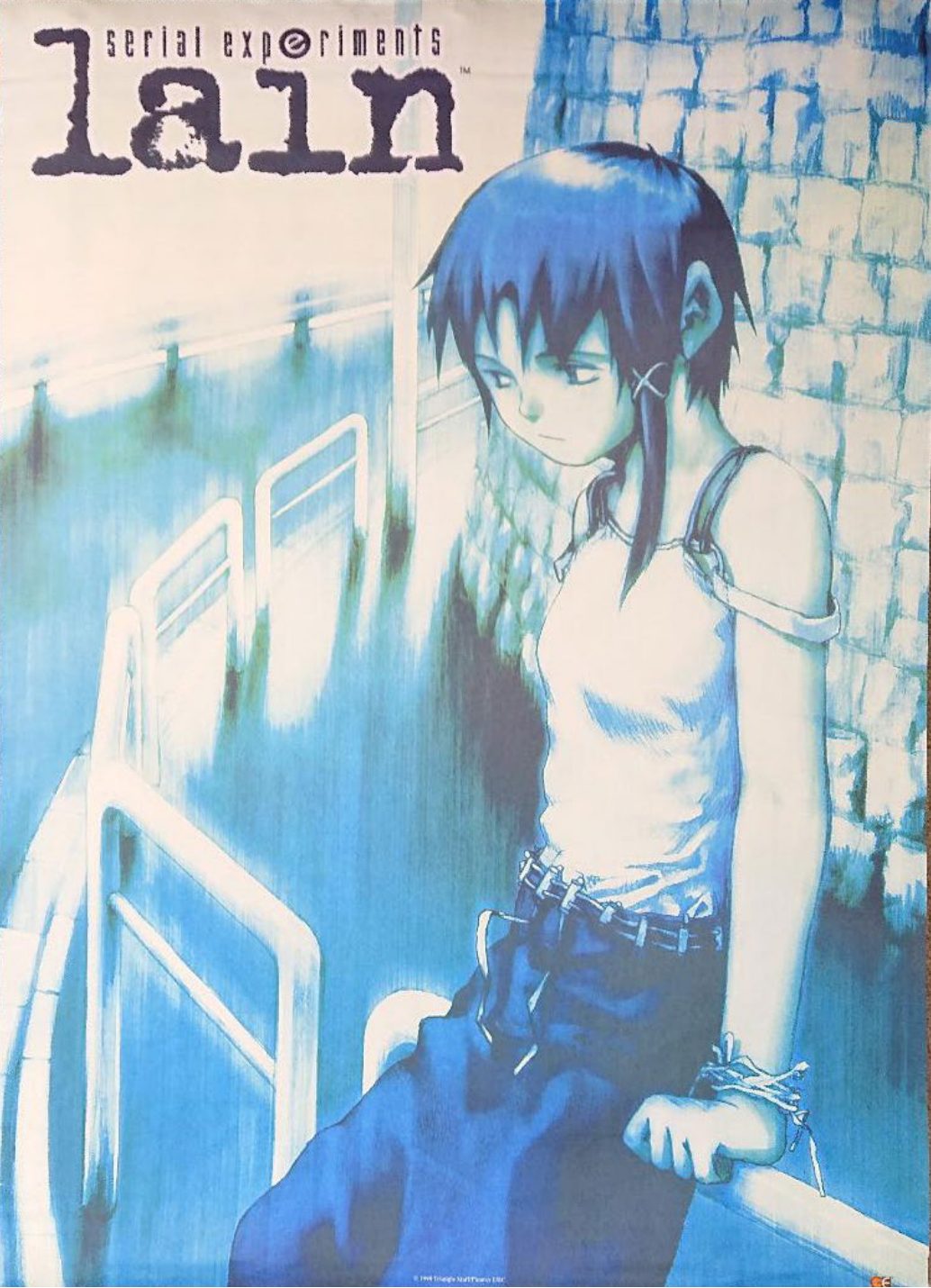
In the end, the anime performs what the character embodies, but with that said, Serial Experiments Lain does not make an argument for opacity. It is opacity in the sense that matters most, which is to say, not a puzzle awaiting a sufficiently patient decoder, but a work that generates intensity without resolving it, that sustains relation precisely through what it will not convert into stable content. It stays with those who encounter it not because it is withholding a secret but because it exceeds whatever is brought to bear upon it, and goes on exceeding it, in the manner of grief for something one cannot name.
The opacity of Trakl’s blue throughout time, encoded in part by the ineffability of poetic language, still resists the contemporary hex code which has rendered transparent all visual colour to an exactitude so immense that even the most important philosophical question concerning aesthetics, which is to say, what colour is Hatsune Miku’s hair? can today be reduced to hex codes #3CC6D3/#94D3D4.
[1] Jean Baudrillard, Truls Lie. (2020). The art of disappearing. Available: https://www.baudrillard-scijournal.com/ the-art-of-disappearing/. Last accessed 22th July 2022.
[2] Édouard Glissant, Poetics of Relation, trans. Betsy Wing (Ann Arbor: University of Michigan Press, 1997).
[3] Byung-Chul Han, The Transparency Society, trans. Erik Butler (Stanford: Stanford University Press, 2015).
[4] Ashley Woodward, Nihilism in Postmodernity: Lyotard, Baudrillard, Vattimo. (US: The Davies Group, 2009).
[5] “We live in a world where there is more and more information, and less and less meaning.” Jean Baudrillard, Simulacra and Simulation, trans. Sheila Faria Glaser (Ann Arbor: The University of Michigan Press, 1994).
[6] Eyafé, Reshma. “Interview: ‘wtf is this shit?’ — Reshma Eyafé Speaks with Alex Mazey about His New Poetry Collection RIVAL STREAMER // AI SLOP X BRAINROT (IN)FINITITY WARRIORS.” Joyzine, February 18, 2026. https://joyzine.org/2026/02/18/alex-mazey-interview/. Last accessed 10th June 2026.
[7] Bei Dao, The August Sleepwalker, trans. Bonnie S. McDougall (New York: New Directions, 1990).
[8] Jean Baudrillard, Seduction, trans. Brian Singer (New York: St. Martin’s Press, 1990).
[9] Han, The Transparency Society.
[10] Ray Brassier, “Concepts and Objects,” in The Speculative Turn: Continental Materialism and Realism, ed. Levi Bryant, Nick Srnicek, and Graham Harman (Melbourne: re.press, 2011). See also Ray Brassier, “Prometheanism and its Critics,” in #Accelerate: The Accelerationist Reader, ed. Robin Mackay and Armen Avanessian (Falmouth: Urbanomic, 2014).
[11] Mark Fisher, “Nick Land: Mind Games,” Dazed & Confused, June 2011, https://www.dazeddigital. com/artsandculture/article/10459/1/nick-land-mind- games.
[12] Nick Land, “Narcissism and Dispersion in Heidegger’s 1953 Trakl Interpretation,” in Fanged Noumena: Collected Writings 1987–2007, ed. Robin Mackay and Ray Brassier (Falmouth: Urbanomic, 2011).
[13] Quoted via Land, “Narcissism and Dispersion.”
[14] Land, “Narcissism and Dispersion.”
[15] Nick Land, “Spirit and Teeth,” in Fanged Noumena: Collected Writings 1987–2007, ed. Robin Mackay and Ray Brassier (Falmouth: Urbanomic, 2011).
[16] Land, “Narcissism and Dispersion.”
[17] Georg Trakl, “In Hellbrunn,” in Twenty Poems of Georg Trakl, trans. James Wright and Robert Bly (Madison, MN: Sixties Press, 1961).
[18] Serial Experiments Lain, dir. Ryūtarō Nakamura (Triangle Staff, 1998).
[19] On blue in this register, see Maya B. Kronic, “No Core Dump,” on the Blue Screen of Death: “the color of the last remaining emollient mask before the grand illusion of the ‘user experience’ itself gives way to the mute and opaque meshwork of code libraries it always was.” In Pamela Rosenkranz, No Core. Zurich: JRP Ringier, 2012. Republished at readthis.wtf. https:// readthis.wtf/writing/no-core-dump/.
[20] Jun’ichirō Tanizaki, In Praise of Shadows, trans. Thomas J. Harper & Edward G. Seidensticker (London: Vintage Classics, 2001)
[21] Bladee, “egobaby,” directed by Hendrik Schneider, YouTube video, 2021, https://www.youtube.com/ watch?v=YbMrRegZ3H0.
Discover more from BAUDRILLARD NOW
Subscribe to get the latest posts sent to your email.