The Anti-Corruption Scandal as a Simulacrum of Reform. Baudrillard, Post-Scandal Institutional Residue, and the Ukrainian Case
by Oleg Maltsev
Abstract
Anti-corruption scandals are usually read as signs of institutional failure. The more cases are exposed, investigated, and publicly discussed, the more corruption appears to be present. Yet this seemingly obvious relationship conceals a methodological problem: an increase in visible corruption may indicate not only an increase in corrupt activity, but also an increase in the capacity of institutions to detect what was previously hidden. The scandal, in other words, tells us that something has become visible. It does not, by itself, tell us what has changed.
This problem becomes particularly acute when scandal is treated as evidence of reform. Public exposure, investigation, prosecution, and punishment can produce a powerful appearance of institutional action while leaving the conditions that made the corrupt mechanism possible substantially intact. Jean Baudrillard’s analysis of Watergate provides a starting point for understanding this paradox. In Simulacra and Simulation, scandal can function not simply as a revelation of institutional disorder but as a mechanism through which the system regenerates its own legitimacy. Yet the Baudrillardian diagnosis leaves open a question that becomes decisive once the scandal has passed: what, precisely, remains inside the institution after the scandal is over?
This article develops a framework for answering that question. It distinguishes the corrupt event, the corruption mechanism, and the institutional opportunity infrastructure that allows such mechanisms to operate and reproduce. It then separates the law-enforcement circuit from the institutional-transformation circuit, since the successful completion of the former does not necessarily imply the completion of the latter. The analysis introduces the concept of post-scandal institutional residue (PSIR): the set of institutional changes, adaptations, vulnerabilities, routines, and unresolved conditions that remain after the media and political life-cycle of a scandal has ended.
The central proposition is that the effectiveness of anti-corruption reform cannot be inferred from the visibility or even the successful punishment of corrupt actors alone. The more demanding test is whether the exposed mechanism has lost its capacity for reproduction. This shifts analytical attention from the number of scandals and offenders toward the trajectory of mechanisms through institutions: what was exposed, what was disrupted, what was redesigned, and what remains capable of occurring again.
Using the Ukrainian anti-corruption system as the empirical context, the article proposes a reproducibility profile and a four-state analytical matrix for examining these trajectories. Recent international assessments of Ukraine illustrate why such a distinction matters: the country possesses an extensive anti-corruption regulatory and institutional architecture, while significant differences remain between formal rules and their implementation across particular domains. The article therefore treats anti-corruption not simply as a sequence of scandals, investigations, and punishments, but as a problem of institutional engineering: the transformation of the conditions under which corruption can reproduce itself.
Keywords: anti-corruption; corruption scandal; Jean Baudrillard; simulacrum; institutional reform; institutional residue; post-scandal institutional residue; corruption mechanisms; reproducibility; Ukraine; institutional legitimacy
INTRODUCTION
A corruption scandal arrives as a moment of clarity. Something that was hidden becomes visible; names acquire faces; documents become evidence; transactions become a story. Investigators enter the scene, prosecutors announce proceedings, journalists reconstruct the chain of events, and institutions demonstrate that they are capable of responding. For a brief period, the system appears to become unusually legible. The scandal seems to perform the work that institutions are expected to perform in the first place: it reveals a violation, identifies those responsible, and restores the boundary between what is permitted and what is not.
But there is another way to look at the same sequence.
Suppose that the number of detected corruption cases increases. What exactly has increased? Corruption itself? The capacity to detect it? The willingness to expose it? Or the visibility of the institutional response? The distinction is not semantic. A system that detects more corruption may be becoming more capable of seeing its own vulnerabilities. A system that produces more scandals without changing the conditions that generated them may simply be becoming more efficient at staging the discovery of the same problem.
This is where the anti-corruption scandal becomes analytically difficult. The event that appears to demonstrate institutional failure may simultaneously demonstrate institutional capacity. Investigation can mean that corruption persists; it can also mean that detection works. Prosecution can signal accountability; it can also become the endpoint of a process that leaves the underlying institutional arrangement untouched. Even punishment, however real and necessary, does not automatically tell us whether the mechanism that produced the offence has lost its ability to operate again. The problem is therefore not whether a scandal is “real.” The problem is what kind of reality the scandal produces.
Jean Baudrillard saw this problem with unusual precision. Writing about Watergate, he refused to treat scandal simply as the exposure of an external corruption of an otherwise stable system. His argument was more disturbing: scandal could become part of the system’s own regenerative operation. “Watergate was thus nothing but a lure held out by the system to catch its adversaries — a simulation of scandal for regenerative ends” (Baudrillard, 1994, p. 16)
The point is not that nothing happened. On the contrary, something happened precisely because scandal has consequences. It concentrates attention, produces indignation, mobilises investigative procedures, and temporarily reconstructs a moral distinction between legitimate and illegitimate conduct. As Baudrillard put it elsewhere in the same discussion, “The denunciation of scandal always pays homage to the law.” (Stanford University) The exposure of transgression can therefore reinforce the principle against which the transgression is measured.
This observation remains useful for contemporary anti-corruption analysis, but it is not sufficient. Baudrillard gives us a powerful theory of what scandal can do to legitimacy; he does not give us an operational method for determining what happens after the scandal has done its work. That question becomes especially important in institutional environments where anti-corruption agencies, prosecutors, courts, journalists, civil society organisations, and international monitoring bodies have all become part of a permanent infrastructure of scrutiny.
The contemporary anti-corruption system is therefore faced with a paradox. It must produce visibility in order to produce accountability, yet visibility alone cannot demonstrate transformation. The existence of an investigation tells us that an alleged mechanism has been detected. The existence of a conviction tells us that a legal process has reached a particular conclusion. Neither, by itself, tells us whether the institutional conditions that allowed the mechanism to operate have been altered.
Research on the aftermath of scandals points precisely in this direction. Grimmelikhuijsen and Snijders ask what happens “after the storm” and demonstrate that scandals do not automatically produce changes in integrity policy. (PubMed Central (PMC)) Other research has approached inquiries as institutional processes through which legitimacy itself can be reconstructed, while work on corruption scandals in Brazil shows that scandals can also create opportunities for the development of anti-corruption institutions (McGrath & Marshall, 2024; Prado & Carson, 2018). The empirical picture is therefore neither that scandal is meaningless nor that scandal equals reform. Its consequences depend on what follows. That “what follows” is the analytical space this article addresses.
The Ukrainian case makes the problem particularly visible because the country now possesses a substantial and differentiated anti-corruption architecture, while international assessments continue to distinguish between formal institutional arrangements and their practical implementation. The OECD’s 2026 assessment, for example, records a sophisticated strategic framework while separately measuring the extent to which the relevant criteria are implemented in practice. In the area of conflict of interest, Ukraine meets 100% of the OECD’s regulatory criteria but 67% of its implementation criteria. (OECD) The European Commission’s 2025 Ukraine Report likewise treats the strength and independence of the anti-corruption framework as an important element of the country’s institutional trajectory. (Enlargement and Eastern Neighbourhood)
These distinctions suggest a different way of reading the anti-corruption record. Instead of asking only how many scandals have occurred, how many investigations have been opened, or how many officials have been prosecuted, we can ask a more demanding institutional question:
What happened to the mechanism after it was exposed?
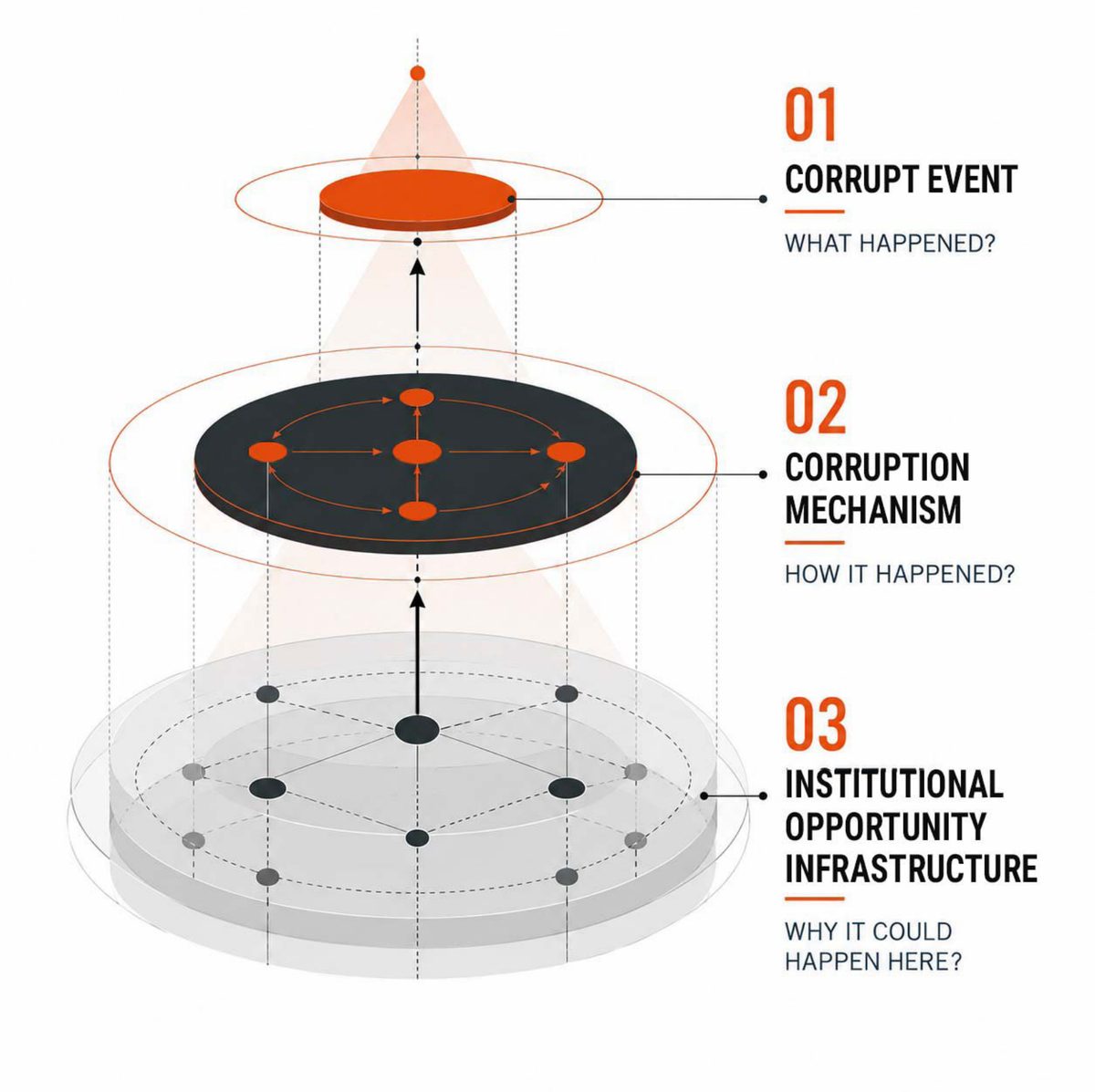
To answer it, three objects must first be separated. A corrupt event is the observable episode: a payment, a decision, an allocation, a conflict of interest, an abuse of office. A corruption mechanism is the reproducible arrangement through which such an event becomes possible. And an institutional opportunity infrastructure consists of the rules, procedures, organisational gaps, discretionary zones, information asymmetries, and relationships that allow the mechanism to function.
These objects are related, but they are not interchangeable. The arrest of an individual addresses an actor. The prosecution of an offence addresses a legal event. Institutional reform must address the conditions under which a comparable mechanism could reproduce itself.
This distinction also requires separating two institutional circuits that are often collapsed into one. The first is the law-enforcement circuit: detection, investigation, prosecution, adjudication, and sanction. The second is the institutional-transformation circuit: diagnosis of vulnerabilities, redesign of procedures, redistribution of discretion, strengthening of controls, organisational learning, and reduction of the mechanism’s capacity to reproduce.
The first circuit can be completed without the second being completed.
And this is where the scandal changes its analytical status. It is no longer merely an event to be investigated or a media cycle to be interpreted. It becomes a test of institutional memory.
When the cameras leave, when the headlines disappear, when the case moves from the front page into the legal record, the institution remains. Something has to remain with it. Perhaps a procedure has changed. Perhaps an access route has been closed. Perhaps a discretionary power has been redistributed. Perhaps a new control has appeared. Perhaps nothing structural has changed at all.
That remainder is what this article calls post-scandal institutional residue (PSIR).
The concept does not assume that every scandal leaves the same kind of trace. It asks us to identify the trace and determine its direction. Has the institution merely processed the event? Has it learned from it? Has it altered the mechanism? Or has the mechanism survived, adapted, and retained its capacity for reproduction?
The shift is subtle but consequential. The central character of an anti-corruption analysis is no longer necessarily the offender. It is the trajectory of the mechanism through the institution.
Once the question is formulated this way, the apparent contradiction between Baudrillard’s simulacrum and institutional reform begins to dissolve. A scandal can simultaneously be a real exposure, a legitimate law-enforcement event, a source of institutional legitimacy, and a mechanism of symbolic regeneration. None of these descriptions excludes the others. The decisive question is what happens to the underlying mechanism after the spectacle of exposure has passed.
The anti-corruption system therefore needs another measure of success. Not simply whether corruption was discovered. Not simply whether someone was punished. Not even simply whether a reform was formally adopted.
The harder question is whether the exposed mechanism can still reproduce itself.
That is the point at which the analysis moves beyond the scandal — and from Baudrillard’s simulation toward the institutional problem that the scandal leaves behind.
WHAT HAPPENS AFTER THE SCANDAL?
A scandal has a peculiar ending. A crime may end with an arrest, a trial, a conviction, or an acquittal. A scandal ends differently. At some point, the cameras move elsewhere. The headlines disappear from the front page. The public argument loses its intensity. Investigators may continue working, prosecutors may continue litigating, and courts may continue hearing the case, but the scandal itself has already begun to recede.
The institution, however, does not recede.
It remains where it was.
And this creates a deceptively simple problem. If the scandal was supposed to expose an institutional failure, what should we expect to find inside the institution once the scandal is over?
Perhaps a new procedure. Perhaps a new control. Perhaps a redistribution of authority. Perhaps a new form of oversight. Perhaps a changed relationship between departments that previously operated with little effective scrutiny.
But perhaps nothing of the kind.
Perhaps the people have changed while the arrangement has not. Perhaps one route has been closed while another remains open. Perhaps the institution has become better at detecting the same mechanism without becoming better at preventing it. Perhaps the scandal has produced a powerful public demonstration of accountability while leaving the conditions that made the original conduct possible largely intact.
This is the point at which the usual chronology of an anti-corruption case becomes insufficient. We tend to follow the event forward only until responsibility has been established: something happened, investigators discovered it, prosecutors acted, someone was punished. Yet the institutional question begins precisely where that chronology appears to end.
What happened to the institution itself?
The question is easy to overlook because scandal produces an unusually strong sense of narrative completion. There is an identifiable event, identifiable actors, identifiable evidence, and, eventually, an identifiable response. Once the response has occurred, it becomes tempting to regard the episode as closed.
However, closure of the case and closure of the mechanism are not necessarily the same thing.
The difference is especially important because corruption is not simply a collection of individual acts. Some corrupt practices depend on arrangements that can outlive the people who operated them: concentrated discretion, gaps between formal and actual procedures, privileged access to information, weak separation of functions, opaque appointment structures, insufficient oversight, or informal relationships that continue to organise decisions after particular participants have disappeared. The event may be singular. The conditions that made the event possible may not be.
This gives the scandal an unusual temporal structure. It points backward toward an offence, but its institutional significance lies forward in time. The decisive question is therefore not only what happened?
It is: What became impossible, more difficult, more visible, or more costly after it happened?
That question takes us back to one of the most influential analyses of political scandal: Jean Baudrillard’s reading of Watergate.
Baudrillard’s intervention was unsettling because he refused to treat scandal simply as the moment when an otherwise stable political reality was interrupted by an exceptional violation. For him, the scandal could itself become part of the system’s operation. Watergate, in his formulation, was “a simulation of scandal for regenerative ends” (Baudrillard, 1994, p. 16).
The claim is easy to misunderstand if it is reduced to the proposition that Watergate was somehow unreal. That is not the useful point for the present analysis. The event, the investigation, the evidence, and the political consequences were real. What Baudrillard asks us to examine is something else: what does the exposure of transgression do to the system that exposes it?
His answer is that denunciation can restore the very principle against which the violation is defined. “The denunciation of scandal always pays homage to the law,” he writes. (Stanford University)
The scandal therefore performs a double movement. It says that something has gone wrong, but it also demonstrates that the system can still identify what counts as wrong. It exposes a breach while reaffirming the boundary that has been breached. In this sense, the scandal can become regenerative: the system appears damaged and, through its response to the damage, demonstrates its continuing capacity to define, denounce, and punish deviation.
This is the point at which Baudrillard becomes indispensable to an analysis of anti-corruption scandals. Nevertheless, it is also the point at which the present problem begins. Yet, even if scandal restores legitimacy, restored legitimacy does not tell us whether the institutional mechanism has changed.
And that brings us back to the question with which we began. The cameras have left. The institution remains. What, exactly, remains inside it?
THE FIRST WRONG ANSWER: COUNT THE SCANDALS
The first thing we do when a corruption scandal breaks is remarkably simple: we count. We count the investigations, the suspects, the indictments, the convictions, the sums involved, and, increasingly, the number of scandals themselves. The logic seems almost unavoidable. If more cases are being exposed, there must be more corruption to expose; if fewer cases appear, perhaps the system is finally becoming cleaner. Numbers offer the comfort of an apparently objective story, and the scandal readily supplies them.
The difficulty begins when we ask what exactly the number is measuring. Imagine an institution in which corrupt practices have been operating for years beyond the reach of effective detection. Then the investigative system improves. Financial information becomes easier to reconstruct, agencies exchange information more effectively, journalists gain access to documents, whistleblowers become more willing to report, and investigators acquire better tools for following complex transactions. The first visible consequence may be an explosion of cases. From the outside, the institution suddenly looks more corrupt than it did before. Yet the increase may have occurred not because corruption itself became more extensive, but because the boundary between hidden and observable conduct moved.
The reverse is equally uncomfortable. A decline in reported cases may be a sign that corrupt mechanisms have become less common, but it may also reflect weaker detection, less transparency, reduced reporting, or a diminished capacity to investigate. The same number can therefore tell two completely different stories depending on what has happened to the system that produces the number. What appears to be a measurement of corruption may actually be a measurement of the institution’s ability to see corruption.
This is why the distinction between observed corruption and existing corruption becomes unavoidable. The anti-corruption system does not observe corruption directly; it observes what reaches the threshold of detection, investigation, documentation, and public visibility. Once detection capacity changes, the meaning of the observed series changes with it. An increase in visible cases may be a sign of institutional deterioration, but it may also be evidence that previously hidden activity has become detectable. A decrease may indicate improvement, but it may equally indicate that fewer mechanisms are being brought into view.
Research on the aftermath of scandals makes the problem even more complicated. Grimmelikhuijsen and Snijders examined 17 integrity scandals in Dutch municipalities and found that almost half were followed by no change in integrity policy. Their study also showed that media attention alone did not explain whether policy changed; other institutional conditions, including external audits and the involvement of civil servants, mattered in determining what happened after the scandal. The storm could be highly visible without necessarily changing the institutional landscape that existed after it.
This matters because the most visible part of an anti-corruption process is rarely the part that takes the longest to change. An investigation produces documents. An arrest produces an image. An indictment produces a legal event. A conviction produces a clear endpoint. By contrast, a redesigned procedure may remain unnoticed for years, and the disappearance of a particular institutional vulnerability may never become a news story at all. The public can therefore become exceptionally well informed about the existence of corruption while remaining poorly informed about whether the conditions that made it possible have actually changed.
The Ukrainian case makes this distinction particularly concrete. NABU and SAPO reported 360 investigations initiated in the first half of 2026, alongside 107 notices of suspicion, 56 indictments involving 106 accused persons, and 55 guilty verdicts involving 76 persons. These are important indicators of the activity and output of the enforcement system, but they cannot by themselves tell us whether the underlying prevalence of corruption has increased or decreased. They tell us what the enforcement system has brought into view and processed.
The same problem appears in the distinction between rules and their implementation. The OECD’s 2026 assessment of Ukraine separates the existence of regulatory arrangements from their implementation in practice; in the area of conflict of interest, Ukraine met 100% of the OECD’s regulatory criteria while meeting 67% of the corresponding implementation criteria. The difference is precisely the kind of gap that disappears when institutional reform is represented as a single number or a single announcement.
So the first apparently sensible solution does not survive examination. Counting scandals can tell us how much has become visible, but it cannot tell us how much existed before visibility changed, nor can it tell us what happened to the institutional conditions that produced the visible events. The question therefore shifts almost imperceptibly from how many scandals occurred? to what, exactly, did each scandal expose?
At first, the answer seems obvious: it exposed the people involved. A corruption investigation gives us names, positions, relationships, transactions, and eventually judgments. The institution can point to an individual who has been removed, prosecuted, or convicted and say that something has been done. Yet this apparent clarity conceals the next problem in the investigation, because a person can leave an institution much more easily than the institutional arrangement through which the person acted.
That is where counting offenders leads us next: toward the difference between the corrupt event that can be reconstructed and the corruption mechanism that may survive it.
THE SECOND WRONG ANSWER: COUNT THE OFFENDERS
The temptation is to move from scandals to people. If the number of scandals tells us too little, perhaps the number of offenders will tell us more. A person arrested, a suspect identified, an indictment filed, a conviction obtained, an official removed from office — these are concrete events, and unlike the abstract question of institutional vulnerability, they have names attached to them. The system can point to an individual and demonstrate that the case did not simply disappear into public discussion: someone was investigated, someone was held responsible, someone was punished.
There is a certain institutional logic to this. The law-enforcement circuit is necessarily concerned with individual conduct because criminal responsibility cannot be assigned to an abstract “system.” An offence has to be reconstructed through actions, evidence, participants, transactions and decisions. The person who performed those actions therefore becomes the natural centre of the investigation. In that sense, personalization is not an analytical error at the level of criminal law. The problem begins later, when the conclusion of the criminal case is silently treated as the conclusion of the institutional story.
This is where the apparently simple statement — this official participated in the corruption — can gradually turn into a much stronger statement: this official was the corruption problem. The difference may look semantic, but it changes the object of analysis. Once the person has resigned, been dismissed, arrested or convicted, the public narrative has a natural ending. The photograph disappears from the news cycle, the next investigation begins, and the institution can present the removal of the individual as evidence that the problem has been addressed.
Yet the institution does not necessarily lose the arrangement through which that individual acted. A procurement procedure can remain unchanged after the official who manipulated it has gone. A discretionary power can remain concentrated in the same place. An informational monopoly can survive the departure of the person who exploited it. Informal relationships can simply acquire new participants. Even a mechanism that has been exposed and blocked in one form may return through another technical route while performing essentially the same function.
The original article puts the distinction sharply: the same corruption mechanism may be used repeatedly by different actors, which means that removing an individual does not necessarily remove the mechanism. Beneath that mechanism lies an even broader layer — the institutional opportunity infrastructure — consisting of the formal and informal arrangements that make a class of mechanisms viable: concentrated discretion, weak separation of functions, opaque appointments, insufficient audit capacity, fragmented responsibility, asymmetric access to information, informal networks, or poorly designed procedures.
The distinction changes the question we ask about the person who has been removed. Instead of asking only what the official did, we can ask what the official was able to do, and why the institution allowed that particular form of action to become possible. The first question reconstructs responsibility. The second begins to reconstruct reproducibility. It moves the investigation from the operator toward the machinery in which the operator functioned.
This also explains why the disappearance of an offender can create such a strong feeling of closure. People are visible in ways that mechanisms are not. A person can resign; a procedure does not resign. A person can be prosecuted; an information asymmetry cannot appear in court as a defendant. A person can be removed from an office overnight, while redistribution of authority may require months of administrative work and may produce no dramatic image at all. The scandal therefore naturally compresses a complicated institutional process into a human story with a beginning, a protagonist and an ending.
But suppose the same functional arrangement appears again after the protagonist has disappeared. The new participant may have a different name, occupy a different office, use a different intermediary, or exploit a different technical procedure. If the underlying relationship between authority, information, discretion and control remains sufficiently similar, treating the second case as an entirely new event misses something important. What has returned is not necessarily the same crime. What has returned is the capacity of the institution to generate a comparable mechanism.
At this point, the investigation has to abandon the offender as its final unit of analysis. The person remains important — responsibility does not disappear simply because we begin looking at institutions — but the person can no longer be the endpoint of the explanation. The more revealing question is what passed through that person and continued beyond them.
The main character therefore changes. It is no longer simply the official whose name appears in the indictment. It becomes the trajectory of the mechanism through the institution.
And once the trajectory becomes the object of the investigation, the next question becomes unavoidable: what, exactly, was exposed by the scandal — the event, the mechanism that produced it, or the institutional environment that made the mechanism possible?
WHAT WAS ACTUALLY EXPOSED? — EVENT, MECHANISM, INFRASTRUCTURE
Once the offender is no longer treated as the final explanation, the scandal begins to look different. What appeared at first to be a single corrupt act turns out to have several layers, and each layer tells us something different about the institution. The visible event is the easiest layer to reconstruct: money was transferred, a contract was manipulated, a decision was taken, an appointment was arranged, a public resource was redirected. It is the part of corruption that can be placed on a timeline, attached to documents and attributed to identifiable actors. It is also the part most easily converted into a scandal.
But the event is only the point at which a much larger arrangement becomes visible. Behind the individual transaction there is usually a corruption mechanism: a repeatable functional arrangement through which an actor can convert institutional authority, access, information or discretion into a private advantage. The mechanism matters precisely because it is not identical to the particular event in which it was discovered. Different people can operate it. Different resources can pass through it. Its technical form can change while its underlying logic remains recognizable. What makes the mechanism analytically important is therefore not that it happened once, but that it could happen again.
This distinction creates a useful movement from the event toward the mechanism. Imagine that an investigation establishes how a procurement decision was manipulated. The investigation can reconstruct who influenced the decision, how the information moved, which procedural steps were bypassed and what benefit was obtained. That is already more than simply identifying an offender. But even a complete reconstruction of the mechanism leaves one question unanswered: why was this mechanism available in the first place?
That question takes us to the third layer, which the original model calls the institutional opportunity infrastructure. This is the broader configuration of formal and informal conditions that makes a class of corruption mechanisms viable. It may involve excessive discretionary authority, weak separation of functions, opaque appointment procedures, insufficient audit capacity, information asymmetry, informal networks, fragmented responsibility or procedural arrangements that allow one actor to control several stages of a decision. None of these conditions is necessarily corruption by itself. Their significance appears when they combine to create an environment in which a corrupt mechanism can be constructed and reproduced.
The three layers therefore answer three different questions. The corrupt event tells us what happened. The corruption mechanism tells us how it happened. The institutional opportunity infrastructure asks why this kind of mechanism could happen here at all. The distinction is not merely terminological. It determines what counts as a successful response.
If the response stops at the event, success means that the case has been exposed and reconstructed. If it reaches the mechanism, success requires more: the mechanism must be disrupted. But if the institutional opportunity infrastructure remains intact, the institution may still be capable of producing another mechanism that performs the same function through a different configuration of actors and procedures. Removing the operator therefore does not necessarily remove the capacity.
This is where the apparent success of an anti-corruption intervention can become analytically ambiguous. A scandal may reveal a mechanism with extraordinary clarity, produce a successful investigation, generate prosecutions and lead to the removal of the officials involved. From the perspective of the law-enforcement circuit, these are substantial outcomes. Yet from the perspective of institutional transformation, the decisive question has not yet been answered. What changed in the institution that makes the mechanism harder to reproduce?
The difference is crucial because corruption is not reproduced only by corrupt individuals. It is reproduced by the interaction between individuals and institutional possibilities. When one participant disappears, another may enter the same position. When one channel is closed, another may be constructed. When one technical form becomes too risky, the mechanism may migrate into a different procedure. The institution does not have to reproduce the same crime in order to reproduce the same vulnerability.
This gives the scandal a strange dual character. At the moment of exposure, it appears to reveal the corruption. After the cameras leave, however, the more difficult question emerges: did it reveal a person, a mechanism, or an infrastructure capable of producing mechanisms? The answer determines what happens next.
And this is precisely where two very different institutional trajectories begin to separate. One follows the case backward, toward responsibility and punishment. The other follows the mechanism forward, toward redesign and prevention. The scandal may have triggered both — but they are not the same circuit, and they do not necessarily arrive at the same future.
THE INSTITUTION BEHIND THE OFFENCE
Once the distinction between event, mechanism, and institutional opportunity infrastructure is made, the investigation has to move one level deeper. The question is no longer simply how a particular mechanism worked, but what kind of institutional environment allowed that mechanism to become workable in the first place. This is where the apparently individual story of corruption begins to reveal an architectural dimension. A person may exploit discretionary authority, an informational monopoly, a weak procurement procedure, or a fragmented chain of responsibility, but those conditions were not created at the moment the offence occurred. They were already embedded in the institution.
This does not mean that the institution itself is the offender. The distinction is important. An opaque appointment procedure is not a corrupt act; neither is concentrated discretion, incomplete auditing, fragmented responsibility, or asymmetric access to information. These become significant when they interact in ways that allow a repeatable corrupt arrangement to be constructed. The original model therefore treats institutional opportunity infrastructure as the broader configuration of formal and informal arrangements that makes a class of mechanisms viable: concentrated discretionary authority, weak separation of functions, opaque appointments, insufficient audit capacity, non-transparent data, fragmented responsibility, informal patronage networks, and poorly designed procurement rules.
This changes the meaning of institutional reform. If the institution simply removes the person who exploited a vulnerability, it may have corrected the most visible manifestation of the problem while leaving the vulnerability itself untouched. The next actor does not need to repeat the original scheme literally. The procurement process may be manipulated differently; the intermediary may change; the information may move through another channel; the decision may be taken by another official. What survives is the possibility of constructing a functionally equivalent mechanism. That is why the deepest form of anti-corruption reform cannot be limited to preventing the exact repetition of a known scheme. It has to alter the environment that made the class of schemes viable in the first place. The distinction is subtle but consequential. Blocking one route is not the same as redesigning the road network; removing one operator is not the same as changing the machine. An institution has learned from a scandal only when the knowledge acquired through the scandal has been translated into changes in the conditions under which comparable conduct can occur. At this point, however, another difficulty appears. The institutional environment does not change automatically simply because the law-enforcement system has successfully identified the mechanism. Criminal investigation and institutional redesign operate according to different temporal logics. One is concerned with what happened and who was responsible. The other is concerned with what must be different so that the same functional possibility does not return. The scandal has therefore brought us to a fork in the road: one path leads toward accountability for the past, while the other leads toward adaptation for the future.
And these two paths are not merely different descriptions of the same process. They constitute two different institutional circuits.
TWO CIRCUITS, TWO DIFFERENT FUTURES
The first circuit is the one most readily associated with anti-corruption itself: the law-enforcement circuit. It looks backward. Its task is to reconstruct conduct that has already occurred, establish who acted, determine what law was violated, collect and test evidence, and bring the case to the point at which legal responsibility can be assigned. Its outputs are therefore necessarily concrete: investigations, notices of suspicion, indictments, convictions, confiscation, asset recovery, and other forms of legal accountability. Without this circuit, corruption can become rationalized by impunity, because the expected cost of corrupt behaviour falls when the probability of detection and punishment is low.
But the existence of a functioning law-enforcement circuit does not tell us what has happened to the institutional conditions that produced the offence. That requires a second circuit, which the original model calls the institutional-transformation circuit. Its temporal direction is different. It looks forward. Its questions begin where the criminal case starts to become insufficient: Why was the mechanism possible? Which institutional vulnerability did it exploit? Which control failed? Where was authority concentrated? What information asymmetry protected the arrangement? Which procedural architecture made circumvention possible? And, after the intervention, could a functionally equivalent mechanism still be constructed?
The difference becomes clearer when we follow the same scandal through both circuits. The law-enforcement circuit may establish that a procurement process was manipulated, identify the people involved, reconstruct the chain of decisions, secure evidence, and eventually produce convictions. The institutional-transformation circuit would then have to follow the procurement system itself. Did the distribution of authority change? Was the vulnerable stage of the procedure redesigned? Were audit and monitoring capabilities strengthened? Was access to information redistributed? Were conflicts of interest made more difficult to conceal? Could another group of actors now reproduce the same functional arrangement through a different route?
These are not competing definitions of success. They are two different requirements of an anti-corruption system. The first establishes accountability for the past; the second establishes institutional adaptation for the future. As the source formulation puts it with unusual economy, “Without the law-enforcement circuit, there is impunity. Without the institutional-transformation circuit, there is recurrence.”
This distinction also helps explain why a state can become increasingly sophisticated at processing corruption cases without necessarily becoming equally capable of eliminating the conditions that make those cases possible. A system may investigate faster, prosecute more effectively, recover more assets, and generate increasingly visible evidence of enforcement while leaving parts of the opportunity infrastructure intact. In such a system, the law-enforcement circuit may become highly developed while the institutional-transformation circuit remains comparatively weak.
Research on what happens after corruption scandals points toward precisely this problem. Grimmelikhuijsen and Snijders (2016), examining whether scandals lead local governments to change integrity policy, show that scandal exposure does not automatically translate into policy change. Their work is important here not because it proves that scandals are ineffective, but because it breaks the assumed causal chain between exposure and institutional transformation. A scandal can create pressure for change, but pressure is not itself change. Prado and Carson (2018), studying the evolution of anti-corruption institutions in Brazil, similarly place scandals within longer institutional trajectories in which exposure can create opportunities for institutional development without making transformation automatic.
Once these two circuits are separated, the recurring nature of the scandal becomes visible in a new way. A system may repeatedly succeed at one task — detecting, exposing, investigating and punishing — while repeatedly postponing the other task: changing the institutional conditions that allowed the mechanism to exist. If that pattern becomes stable, the scandal no longer appears simply as an exceptional breakdown in institutional order. It begins to look like a recurring process through which the system processes its own failures.
That is the point at which the next question becomes unavoidable: what happens when a political and institutional system becomes very good at processing scandals, but not equally good at preventing the conditions that produce them?
WHAT IF THE SYSTEM BECOMES VERY GOOD AT PROCESSING SCANDALS? — THE SCANDAL MACHINE
Once the two circuits are separated, a more unsettling possibility comes into view. A state may become increasingly efficient at detecting corruption, reconstructing offences, prosecuting participants and demonstrating that institutions are capable of responding, while the institutional conditions that make comparable mechanisms possible remain only partially altered. In that case, the problem is no longer simply that corruption recurs. The deeper possibility is that the processing of corruption itself becomes a recurrent institutional pattern.
This is what the present analysis calls the scandal machine. The term does not imply conspiracy, and it does not require anyone to deliberately design scandals as political theatre. The machine can emerge from the ordinary interaction of law-enforcement institutions, political actors, media systems, public expectations and unresolved institutional vulnerabilities. Its operation is almost mechanical: a corruption mechanism operates within an institutional opportunity infrastructure; it produces a visible event; the event is detected; evidence enters the public sphere; the scandal intensifies; responsibility is personalized; an investigation, resignation, indictment or conviction follows; the state demonstrates corrective action; public attention eventually declines; and the institution continues operating. If the underlying mechanism or the infrastructure that supported it has survived, the functional logic can later return through different participants and perhaps a different technical form.
The important point is that the machine does not have to reproduce the same crime. It only has to reproduce the same relationship between institutional pathology and public correction. One official may be replaced by another, one procurement scheme by another, one channel of influence by another. The visible actors change, while the institutional vulnerability remains available. The system has therefore demonstrated that it can process failure without necessarily demonstrating that it has learned from failure.
This makes the scandal machine more complicated than a simple cycle of corruption and punishment. The scandal itself becomes a highly distributable informational object. Contemporary anti-corruption enforcement produces images and materials that travel extremely well through the media environment: seized currency, luxury objects, documents, surveillance footage, recordings, screenshots, searches and photographs of evidence.

Within a criminal proceeding, these materials may perform evidentiary functions; within the media environment, they perform semiotic ones. An image of seized cash can communicate simultaneously that corruption existed and that corruption was detected. The same sign therefore represents institutional pathology and institutional capacity at once.
That duality is what makes the scandal machine potentially self-reinforcing. The more effectively the state stages its capacity to detect and punish corruption, the more clearly it can demonstrate that the institutional order is capable of correcting itself. Yet the same communicative success can draw attention away from the much slower question of whether the conditions that produced the offence have actually changed. The public sees the search, the evidence, the suspect and the sanction almost immediately. The redistribution of discretion, redesign of procedures, strengthening of audit, or reduction of an information monopoly may remain invisible for years.
At this point, the scandal is no longer simply an interruption of institutional normality. It can become one of the ways in which the institution publicly demonstrates its capacity to respond to its own failures. And that leads directly to the next question: if scandal can damage legitimacy and the response to scandal can restore it, what exactly is being restored — and on what evidence?
WHY THE SCANDAL MIGHT RESTORE LEGITIMACY — SCANDAL-BASED LEGITIMATION
A corruption scandal places the state in an uncomfortable position because it communicates two messages simultaneously. The first is that something serious has gone wrong inside the institutional order. The second is that the institutional order possesses the capacity to discover, expose and punish what has gone wrong. The scandal therefore threatens legitimacy and can, through the response it generates, become part of the process by which legitimacy is reconstructed.
This is the point at which the concept of scandal-based legitimation becomes useful. It does not mean that restoring legitimacy after an investigation is somehow illegitimate. A political system should gain public confidence when powerful actors can be investigated, evidence can be produced, and legal responsibility can be established. The difficulty begins when demonstrated capacity to detect pathology is treated as sufficient evidence that the system producing the pathology has itself been transformed.
The distinction is already visible in the empirical literature. Grimmelikhuijsen and Snijders (2016), examining integrity scandals across Dutch municipalities, found that scandal did not automatically produce integrity-policy change; in a substantial proportion of the cases they studied, no such policy change followed. Their findings are important because they interrupt the apparently natural sequence from exposure to reform. A scandal can generate pressure, attention and institutional demands without those pressures necessarily becoming durable changes in integrity policy.
The opposite trajectory is also possible. Prado and Carson (2018), examining corruption scandals and the development of anti-corruption institutions in Brazil, show how scandals can create political windows in which previously blocked institutional reforms become possible. The lesson is therefore not that scandal is inherently empty, but that its institutional consequences depend on what happens after exposure. Scandal can open a reform trajectory; it does not determine its destination. A related insight comes from McGrath and Marshall’s (2024) analysis of tribunals of inquiry as instruments of legitimacy. Their work shows how official investigations can operate as ritualized institutional responses to crises of confidence, allowing the state to demonstrate that a breach has been recognized and subjected to public scrutiny. Investigation therefore has a dual function: it seeks knowledge about what happened while also communicating something about the capacity of the institutional order to respond. Baudrillard’s intervention becomes particularly sharp at precisely this point. In his reading of Watergate, scandal is not exhausted by the revelation of wrongdoing because the denunciation itself can serve the system by demonstrating the reality of law and the system’s capacity to expose violations. His formulation is deliberately provocative: “Watergate was thus nothing but a lure held out by the system to catch its adversaries — a simulation of scandal for regenerative ends” (Baudrillard, 1994, p. 16). He immediately pushes the argument further with the observation that “The denunciation of scandal always pays homage to the law.”
The present argument does not require us to conclude that contemporary anti-corruption scandals are therefore simulations, or that investigations and prosecutions are merely theatrical. That would erase the empirical distinction that the preceding sections have established. A real offence may be uncovered, real evidence may be produced, real people may be punished, and real institutional change may follow. The Baudrillardian question is more precise: what does the visible response signify about the system, and does that sign correspond to what has actually changed inside the institution?
The communicative asymmetry makes this difficult to answer. A search is visible; a redesigned appointment procedure is not. A table covered with seized currency is immediately legible; a new distribution of discretionary authority may require months of observation. An arrest produces a clear narrative endpoint; a reduction in the reproducibility of a corruption mechanism can only be established retrospectively. The sign of correction therefore has an enormous advantage over the evidence of transformation.
That is why scandal-based legitimation should not be treated as proof of simulation. It is better understood as a problem of measurement. The public response may legitimately restore confidence because the state has demonstrated investigative and punitive capacity. But whether the underlying institutional vulnerability has been reduced is a different empirical question. The two achievements may coincide, but they cannot be assumed to be identical.
And once that distinction is made, the investigation arrives at the question that Baudrillard leaves deliberately open for institutional analysis: when the scandal has ended and legitimacy has been restored, what remains inside the institution?
THE QUESTION THAT BAUDRILLARD LEAVES OPEN
By this point, the scandal has acquired a more complicated meaning. It can expose a real offence, activate real investigative institutions, produce real sanctions, and at the same time participate in a process through which institutional legitimacy is reconstructed. None of these dimensions cancels the others. The problem is precisely that they can coexist. A scandal may therefore be entirely real as an event and still generate a political representation of institutional self-correction that is stronger than the evidence of structural transformation.
This is where Baudrillard remains particularly useful, but also where his analysis reaches the limit relevant to the present investigation. His question is fundamentally semiotic: what does the scandal do to the system of signs through which a political order represents itself? Watergate can be read as a scandal that demonstrates the existence of corruption while simultaneously demonstrating that the system is capable of exposing and punishing corruption. The denunciation of the violation thus reinforces the distinction between the legitimate order and its violation. As Baudrillard puts it, “The denunciation of scandal always pays homage to the law” (1994, p. 16).
But an institutional researcher has to ask a question that semiotics alone cannot answer. Suppose the scandal has fulfilled this regenerative function. Suppose responsibility has been assigned, the investigation has been completed, legitimacy has partially recovered, and public attention has moved elsewhere. What remains inside the institution itself? Has a procedure changed? Has discretion been redistributed? Has a monitoring arrangement become more difficult to bypass? Has the information asymmetry that protected the mechanism been reduced? Or has the institution simply demonstrated that it possesses an effective procedure for processing the next scandal?
The distinction is crucial because the answer cannot be found at the moment of maximum visibility. During the scandal, almost everything that matters politically is concentrated in the present: the suspect, the evidence, the investigation, the statement, the resignation, the indictment. Institutional transformation operates on another temporal scale. It becomes visible only after the exceptional intensity of the scandal has declined and ordinary institutional behaviour has resumed. McGrath and Marshall’s (2024) analysis of inquiries as instruments of legitimacy is useful here precisely because it directs attention to the institutional work performed by official responses to crisis, rather than treating investigation simply as the neutral discovery of facts.
The investigation therefore has to follow the scandal beyond its own spectacular ending. The relevant object is no longer the event that everyone has seen, but the institutional remainder that can be observed after almost nobody is looking. This remainder may be substantial, weak, contradictory, or absent. It may consist of new procedures, altered authority structures, stronger controls and completed enforcement, but it may also consist of little more than announcements, personnel changes and institutional memory.
This is the point at which the concept of institutional residue becomes analytically useful. It gives us a way to name something that survives the public event without assuming in advance that what survives must be reform. The concept already has a history in institutional research; the task here is to specify what kind of residue is relevant when the event that produced it was a corruption scandal.
FROM INSTITUTIONAL RESIDUE TO POST-SCANDAL INSTITUTIONAL RESIDUE
The phrase institutional residue is therefore not introduced here as though it were an entirely new discovery. Anna Seleny used the expression “institutional residue of reform” in her analysis of transformation in socialist Hungary, drawing attention to the people, practices and ideas accumulated through successive reform episodes (Seleny, 1994). More recently, Nicolò Bellanca has developed the notion in a different theoretical direction, examining the socially organized afterlife of unrealized institutional values and choices (Bellanca, 2026). These approaches differ substantially in their objects and theoretical premises, but they share an important intuition: institutional episodes do not simply disappear when the episode itself is over. They leave something behind.
The present article narrows that intuition to a particular empirical problem and calls the result Post-Scandal Institutional Residue, or PSIR. The concept refers to the set of durable changes in rules, authority structures, monitoring arrangements, enforcement practices and organizational behaviour that remain after the public phase of a corruption scandal has ended and that reduce the future reproducibility of the mechanism exposed by that scandal.
The temporal qualification matters more than it may initially appear. A press conference is not PSIR. A promise of reform is not PSIR. The announcement of a new procedure is not necessarily PSIR. Even the adoption of a new law cannot automatically be treated as strong evidence of institutional residue if implementation remains ineffective. What matters is what can still be observed after the political and media intensity surrounding the scandal has declined: whether the rules under which people act have changed, whether authority is distributed differently, whether monitoring has acquired new capacity, whether enforcement has actually been completed, and whether the mechanism exposed by the scandal has become harder to reproduce.
This definition also prevents the concept from becoming a synonym for “reform.” Reform can be announced without being implemented; implementation can occur without changing organizational behaviour; and organizational behaviour can change without substantially reducing the vulnerability that made the original mechanism possible. PSIR therefore sits at the end of a longer chain. It asks not simply whether something was decided, or even whether something was formally changed, but whether the institutional environment left behind by the scandal is materially different from the one that existed before it.
The distinction becomes particularly important when viewed against the empirical problem identified earlier. If the number of detected scandals is an ambiguous indicator because detection capacity can change independently of corruption prevalence, then the number of reforms announced after scandals is equally insufficient as evidence of transformation. Both are visible outputs of the system. Neither tells us automatically what happened to the underlying mechanism.
PSIR therefore shifts the temporal position of the researcher. Instead of observing the institution at the moment when cameras arrive, the researcher returns after the cameras have left. The question is no longer what the institution said it would change, but what institutional condition now exists that did not exist before the scandal. That question turns the scandal from a media event into a longitudinal research object.
This is also why the concept should not be converted prematurely into a single numerical index. The source model deliberately avoids assigning arbitrary weights to different forms of institutional change before empirical calibration is available. A structured multidimensional protocol is more defensible at this stage: procedural change, discretionary change, control change, enforcement completion, and, most importantly, reduction in the reproducibility of the mechanism.
The last dimension changes the direction of the investigation once again. It is possible to demonstrate that procedures have changed and still discover that the same functional arrangement can be reconstructed through another route. It is possible to strengthen auditing and still leave the underlying concentration of discretion intact. It is possible to punish the original participants while leaving the institution capable of generating their functional successors. PSIR therefore cannot end with the question “What changed?” It must eventually lead to the more difficult question: “Did the mechanism become harder to reproduce?”
And that is where the residue of reform becomes something more precise: not merely what the institution remembers after the scandal, but what the institution has learned to make more difficult.
HOW DO WE KNOW THAT SOMETHING REMAINED?
Once PSIR has been defined, a practical difficulty immediately appears. It is relatively easy to point to a new law, a new procedure, a new oversight body, or a public commitment to reform. It is much harder to establish that these changes have actually survived the disappearance of the scandal and altered the conditions under which institutions operate. The danger is that PSIR itself could become another visible label attached to reform announcements rather than a way of investigating what happened after them.
For that reason, the present model deliberately avoids constructing a mathematically precise PSIR index at this stage. Without empirical calibration, assigning weights to different forms of institutional change would create an appearance of precision that the available evidence cannot justify. A structured multidimensional protocol is more useful. It allows the researcher to follow the institutional aftermath without pretending that procedural change, redistribution of discretion, stronger controls, completed enforcement and reduced reproducibility are interchangeable variables.
The first question concerns procedural change. Did the formal procedures that enabled the mechanism actually change? If the original mechanism depended on a particular sequence of approvals, procurement stages, appointment rules or reporting requirements, the researcher needs to establish whether that sequence has been redesigned in a way that affects the mechanism’s operation. A procedure that has merely been renamed or supplemented by another document does not necessarily represent meaningful institutional change.
The second concerns discretionary change. Was the concentration or distribution of decision-making authority modified? This matters because corruption mechanisms frequently depend not simply on the existence of discretion, but on its concentration in places where external verification is weak. If the same actor, office, or institutional node continues to control the same critical decision after the scandal, then a formal procedural reform may have left the underlying opportunity structure largely intact. The question is not whether discretion disappeared — institutions cannot function without discretion — but whether the particular concentration of discretion that made the mechanism viable has been altered.
The third dimension is control change. Have monitoring, transparency, audit, reporting or detection capabilities actually become stronger? Here again, the distinction between capacity on paper and capacity in practice becomes decisive. A new reporting requirement may exist formally while remaining weakly monitored. An audit institution may receive new powers without receiving the personnel, information or access required to use them. A database may become formally open while the information necessary to detect the relevant relationship remains inaccessible. What matters is therefore not the existence of a control mechanism, but its ability to alter the conditions under which the original mechanism could operate.
The fourth dimension is enforcement completion. An investigation that has been announced is not the same thing as an accountability process that has reached its legally relevant conclusion. Sanctions may be imposed; assets may be recovered where legally appropriate; institutional responsibilities may be clarified; and enforcement procedures may actually be completed rather than simply initiated. This dimension keeps the PSIR model connected to the law-enforcement circuit rather than treating institutional transformation as though accountability were no longer important.
The fifth dimension is the most demanding because it asks whether reproducibility has been reduced. Did functionally analogous mechanisms become more difficult to operate after the intervention? This is where the analysis returns to the distinction between the individual case and the institutional architecture. A reform can be visible, formally valid and fully implemented while still leaving another route open to essentially the same functional arrangement. That is why PSIR cannot be established at the moment of arrest, indictment, conviction or legislative announcement. It requires time. A useful research design would return to the same case after several intervals — six months, twelve months, twenty-four months — and examine what remains observable at each stage. The precise intervals can of course be adapted to the institutional cycle being studied, but the principle is essential: the endpoint of the scandal cannot be assumed to be the endpoint of its institutional consequences.
The central research question consequently becomes remarkably simple: What institutional condition exists after the scandal that did not exist before it? The question is deliberately comparative. It requires the researcher to reconstruct the pre-scandal configuration rather than merely describing the post-scandal one. Only then is it possible to distinguish an actual institutional remainder from the continuation of the previous arrangement under a new vocabulary.
But even this protocol leaves one problem unresolved. An institution can change and a mechanism can still survive. The rules may be different; the controls may be stronger; the responsible officials may be gone — and yet a functionally similar arrangement may still be possible. The investigation therefore has to move one step further, from the residue left by the scandal to the survival capacity of the mechanism itself.
THE MECHANISM THAT SURVIVES ITS OPERATOR — REPRODUCIBILITY PROFILE
The fifth dimension of PSIR introduces a problem that cannot be solved by simply counting new corruption cases. If five functionally similar mechanisms are detected in the year after a reform while only two were detected before it, the immediate conclusion might be that the reform failed. But the visibility paradox returns at exactly this point. Perhaps the mechanism became more common. Perhaps the investigative system simply became better at seeing it. Perhaps reporting improved, audit capacity increased, whistleblowers gained safer channels, or prosecutors acquired better access to information. The number of detected cases cannot tell us which explanation is correct.
For that reason, the model proposes a reproducibility profile rather than a simple recurrence coefficient. The object of observation is not the number of cases but the functional architecture that connects institutional conditions to corrupt outcomes. The researcher asks whether that architecture can still be reconstructed after the intervention, even when its visible form has changed.
The first question is whether the same functional architecture reappears. If the same relationship between authority, information, discretion and private advantage can be reconstructed through essentially the same institutional sequence, then the mechanism has survived in a fairly direct form. If the original route has been closed, the analysis does not stop there. The next question is whether the mechanism has migrated into another agency, administrative level, sector or procedural channel.
Migration is particularly important because institutional systems often respond to controls by shifting activity rather than simply stopping it. A mechanism that becomes difficult to operate in one location may become viable somewhere else where the same underlying vulnerability remains. The actors may change as well. New participants can replace the original ones while preserving the functional relationship that made the original arrangement possible. In this case, personnel turnover can produce the appearance of institutional renewal while leaving the mechanism structurally intact.
The mechanism may also change its technical form without changing its underlying function. A practice that once depended on direct intervention in a procurement process might later operate through an intermediary, a different contractual structure, an informational advantage, or a new administrative procedure. If the technical details change but the same institutional vulnerability continues to convert authority into private advantage, treating the second case as unrelated would obscure precisely what the reform failed to change.
At the same time, reproducibility should not be understood as an all-or-nothing property. A mechanism may survive but become considerably more difficult to operate. Detection may become faster. The resources, coordination or secrecy required to reproduce the arrangement may increase. The probability of successful completion may decline. An institutional reform may therefore reduce the survival capacity of a mechanism without eliminating every possible attempt to reproduce it.
This is why the profile has to capture several dimensions at once: whether the functional architecture returns, whether the original vulnerability remains exploitable, whether the mechanism migrates, whether new actors preserve the same relationships, whether its technical form changes while its function remains stable, whether detection becomes faster, whether reproduction becomes more costly, and whether the probability of successful completion decreases. The purpose is not to produce a single score, but to reconstruct the trajectory of institutional possibility after the scandal.
The shift may seem subtle, but it changes the unit of analysis completely. The question is no longer simply whether another official was caught, or whether another scandal occurred. Nor is it even whether the institution formally changed its rules. The deeper question is whether the institutional environment still permits the same kind of mechanism to organize itself.
The central object is therefore no longer the number of offenders. It is the survival capacity of the mechanism.
And once visibility and reproducibility have been separated, a new analytical possibility opens up: a scandal can be extremely visible without producing substantial institutional residue, while a significant institutional transformation can occur with remarkably little scandal or media spectacle. That is the point at which the investigation can finally construct its four-state map of what happens after the scandal.
TWO AXES ARE BETTER THAN ONE — THE FOUR-STATE MATRIX
By this point, two variables have emerged that should no longer be confused: the public visibility of the scandal and the institutional residue left after it. Once they are separated, the apparent contradiction at the centre of the argument becomes easier to see. A scandal can be highly visible and produce little structural change; it can be highly visible and produce substantial transformation; it can remain almost invisible while institutional vulnerabilities persist; or, more interestingly, meaningful reform can occur without dramatic scandal at all.
This gives us a simple four-state matrix. High visibility combined with low PSIR creates a simulacrum-of-reform risk: the public evidence of action is intense, but the observable structural transformation is comparatively weak. High visibility combined with high PSIR describes transformative exposure, where the scandal genuinely becomes an occasion for institutional learning. Low visibility combined with low PSIR indicates institutional stagnation or concealed persistence, where neither public pressure nor structural adaptation is strong. And low visibility combined with high PSIR points to quiet institutional reform — perhaps the least spectacular but analytically important possibility, because institutions can sometimes change without first passing through a major scandal.
The value of the matrix is therefore not that it classifies scandals as good or bad. It separates two things that public discourse habitually merges: how much we see and how much the institution changes. It also makes the notion of a simulacrum of reform more precise. The claim is not that an investigation is fictitious, or that punishment did not occur. It is that the public representation of institutional correction may become substantially stronger than the observable structural transformation that follows it.
The matrix also prevents the opposite mistake. Low visibility does not automatically mean institutional failure. A reform that quietly changes procedures, redistributes discretion, strengthens controls and reduces the reproducibility of a mechanism may be more consequential than a spectacular scandal that produces little institutional residue. The absence of spectacle is therefore not evidence of the absence of transformation. The four states give the investigation a map. But before using that map to interpret real cases, the model has to face a more uncomfortable question: what if we are simply mistaking sequence for causation?
NOW WE HAVE TO BREAK OUR OWN MODEL — METHODOLOGICAL AND CAUSAL CAUTIONS
A post-scandal analysis creates its own measurement problems. The most obvious is temporal: if a new law or institutional reform appears three months after a major scandal, it is tempting to treat the scandal as its cause. But the reform may have been drafted long before the scandal, required by international obligations, accelerated by administrative modernization, or produced by political competition that had little to do with the particular case. The mere fact that one event follows another does not establish that the first caused the second. A credible PSIR analysis therefore has to reconstruct the reform trajectory: what existed before the scandal, what reforms were already under consideration, what intervention followed the scandal, how implementation proceeded, and what institutional outcome eventually emerged.
The second problem returns us to the visibility paradox. If investigative capacity improves, the number of detected mechanisms may rise precisely because the system has become better at seeing them. A successful institutional intervention could therefore initially produce an apparent increase in recurrent cases. Changes in financial intelligence, digital evidence, inter-agency cooperation, whistleblower activity, audit intensity, access to information, or prosecutorial capacity can all alter the observed number of cases independently of the underlying prevalence of corruption. The researcher therefore cannot read recurrence directly from detection statistics without accounting for changes in the system of detection itself.
There is also a selection problem. The scandals that become nationally visible are not necessarily representative of corruption mechanisms as a whole. Some mechanisms produce dramatic evidence and photographs; others are dispersed across administrative procedures, technically complex, or so normalized that they rarely become spectacular news. A model built entirely from high-profile cases would therefore risk describing the media ecology of corruption rather than the institutional ecology of corruption.
Finally, formal reform cannot be treated as equivalent to implementation. A new rule may exist while organizational practice remains substantially unchanged; a new oversight mechanism may possess legal authority without sufficient operational capacity; a formally strengthened control may be bypassed through an informal arrangement. This is precisely why the OECD distinction between regulatory frameworks and implementation is methodologically important: the existence of a rule is evidence about the institutional architecture, but not by itself evidence about how that architecture operates in practice.
These cautions do not invalidate the model. They make it harder to use — which is exactly what a useful model should do. The purpose is not to turn every reform following a scandal into proof of causation, nor every recurrence into proof of failure. The purpose is to force the investigation to reconstruct what actually changed, when it changed, and whether the mechanism itself became harder to reproduce.
Only after those controls are in place is it possible to put the model against a real institutional case. And the Ukrainian case is particularly useful for that test.
WHAT THE UKRAINIAN CASE REVEALS
Ukraine makes the model interesting because the country does not present a simple opposition between enforcement and reform. Both are taking place at the same time, and both are increasingly visible. The analytical problem is therefore not to decide whether Ukraine is “successful” or “unsuccessful” in combating corruption, but to ask what becomes visible when the distinction between detection, punishment and institutional transformation is applied to an actual institutional environment.
The enforcement circuit is clearly observable. In the first half of 2026, NABU and SAPO reported 360 investigations initiated, 107 notices of suspicion, 56 indictments involving 106 defendants, and 55 guilty verdicts concerning 76 people. The cases included high-profile investigations in the energy and defence sectors as well as cases involving senior public officials. These figures provide concrete evidence of an active law-enforcement circuit; they do not, however, provide a direct measure of the prevalence of corruption in the institutional system as a whole.
That distinction matters because the Ukrainian case illustrates the visibility paradox particularly clearly. More investigations and more public exposures can mean that more corruption is occurring, but they can also mean that the state has become better at detecting and processing corruption that was previously less visible. The enforcement statistics therefore tell us something important about institutional capacity, but they cannot by themselves answer the question that has become central to this article: has the capacity of the exposed mechanisms to reproduce themselves been reduced?
The institutional picture is more complicated. The OECD’s 2026 assessment of Ukraine’s strategic anti-corruption framework records relatively high levels of both regulatory provision and implementation against the OECD’s strategic-framework criteria: Ukraine met 73% of the criteria for regulations and 80% for implementation, compared with OECD averages of 38% and 32%, respectively. At the same time, the OECD describes Ukraine’s framework as one developed in response to significant corruption risks and the pressures of war, reconstruction and European integration. (OECD)
This is precisely the kind of evidence that requires the distinction developed earlier. A sophisticated formal and strategic framework is important evidence of institutional architecture, but it does not eliminate the need to observe how particular mechanisms behave inside that architecture. The European Commission’s 2025 Ukraine Report similarly treats the anti-corruption framework as part of a broader institutional process and notes concerns about ensuring a robust and independent anti-corruption framework.
The Ukrainian case therefore reveals something more interesting than a simple success/failure narrative. It shows why the two circuits have to be observed separately. The law-enforcement circuit leaves visible traces almost immediately: investigations, suspicions, indictments, verdicts and recovered assets. The institutional-transformation circuit leaves a different kind of trace: altered procedures, redistributed discretion, stronger controls, changed organizational behaviour and, ultimately, a reduced capacity for the exposed mechanism to reproduce itself. That difference becomes especially important when a scandal generates both a spectacular enforcement response and a substantial institutional reform programme. The two may reinforce one another, but they should not be analytically collapsed into a single indicator of success. Ukraine therefore functions less as an example that confirms the model than as a case that makes the model necessary. It forces us to ask, case by case, what exactly changed after exposure — and whether the change occurred in the people involved, in the procedure they exploited, or in the institutional conditions that made the mechanism possible in the first place.
And in Ukraine there is one further complication that cannot be treated as background noise. The institutional system is operating under wartime conditions. That does not invalidate the model; it changes the stakes against which its distinctions have to be observed.
THE SPECIAL PROBLEM OF CORRUPTION SCANDALS IN WARTIME
The Ukrainian case contains one further complication that cannot simply be treated as background. Corruption in a state at war acquires a different political and institutional intensity because the resources involved may concern defence procurement, energy, critical infrastructure, reconstruction, public finance, or international assistance. A public resource in such circumstances is not perceived merely as budgetary capital. It can be materially connected to security, resilience, operational capability and, ultimately, human survival. The symbolic force of a corruption scandal therefore becomes unusually high.
This changes the dynamics of the scandal without changing the analytical problem. The demand for punishment becomes stronger, political pressure accelerates, and the public meaning of exposure becomes more emotionally charged. A corruption investigation may therefore acquire a significance far beyond the particular transaction that triggered it. Yet precisely because the stakes are higher, the distinction between punishment and institutional transformation becomes more important, not less. A highly visible prosecution can establish accountability for what happened; it does not by itself establish that the institutional conditions that made the mechanism possible have been altered.
The wartime context also creates a particular temptation to treat the removal of a corrupt participant as sufficient institutional protection. If resources are urgently needed, the immediate priority is understandably to identify the violation, stop the loss, recover resources where possible, and establish responsibility. But the forward-looking question remains: what must change so that an equivalent mechanism cannot simply be reconstructed under comparable conditions?
This is why the relevant question in wartime cannot stop at who violated the system. It has to move toward what must be changed so that the system cannot be violated in the same way under equivalent conditions. The distinction is not abstract. When the cost of institutional failure is amplified by war, the cost of leaving the underlying opportunity infrastructure intact is amplified as well.
The wartime case therefore reinforces rather than weakens the model developed here. The more consequential the resources, the greater the need to distinguish the successful processing of a scandal from the successful reduction of the mechanism’s reproducibility. And once the mechanism becomes the object of observation, the consequences extend beyond institutional research itself. They reach the way corruption is reported.
IF WE CHANGE THE UNIT OF ANALYSIS, JOURNALISM CHANGES TOO
Most scandal journalism begins with the revelation. Who participated?
How much money was involved? What evidence was found? Who resigned? Who was arrested? What did the recordings contain? These questions are indispensable because they establish the factual architecture of the case. But when the narrative ends with the arrest or resignation, journalism may reproduce the same temporal structure as the scandal machine itself: the story reaches its apparent conclusion at precisely the moment when the institutional investigation should begin.
A different form of reporting would follow the case beyond the spectacle of exposure. We can call it mechanism journalism. Its object would not be only the person who operated the mechanism, but the institutional trajectory through which the mechanism became possible, functioned, was exposed, and either disappeared or returned.
Such journalism would ask what institutional history produced the vulnerability, which formal controls were supposed to prevent it, where those controls failed or were bypassed, where decision-making authority was concentrated, who possessed privileged information, and what changed after the scandal. Most importantly, it would return to the case later and ask whether the mechanism appeared again, perhaps through different people, a different procedure, or a different institutional location.
This changes the temporal structure of the story. Traditional scandal reporting is strongest at the moment of revelation; mechanism journalism becomes more valuable after the initial attention has declined. Its most important follow-up question may therefore be one that rarely produces a spectacular headline: what happened to the mechanism?
The change is also conceptual. The official remains part of the story, but no longer necessarily its main character. The main character becomes the trajectory of the mechanism through the institution.
That shift would transform a sequence of apparently disconnected scandals into cumulative knowledge about institutional architecture. One case could reveal a vulnerability; a later case could demonstrate whether it migrated; a third could show whether a reform actually reduced its reproducibility. Journalism would no longer merely document a succession of scandals. It could begin to document whether the state is learning from them.
And that leads to the broader institutional implication of the model: if every serious corruption case contains information about the architecture that permitted it, then anti-corruption cannot remain only a process of detecting failures. It must become a process of redesigning the system that produces them.
FROM PROCESSING FAILURE TO ENGINEERING THE STATE
This is the point at which anti-corruption can be understood in a broader sense: not merely as law enforcement, political ethics, or public transparency, but as a form of state engineering.
The analogy is straightforward. When an engineer encounters repeated equipment failure, identifying and replacing the damaged component is necessary but insufficient. The engineer asks why the component failed, whether the load was distributed incorrectly, whether the design contained a vulnerability, whether monitoring was adequate, whether the operating environment exceeded the system’s tolerance, and whether the replacement component is likely to fail in the same way. The institutional equivalent is to treat the corrupt officeholder as an identified failure point, rather than as the complete explanation of the failure. Removing the person may be necessary. But it does not demonstrate that the system has been redesigned.
If the same concentration of discretion, information asymmetry, weak control or fragmented responsibility remains, the institution may simply generate another route to the same functional outcome.
State engineering therefore begins when each major corruption case is converted into structured institutional knowledge. The case becomes evidence not only for prosecution but for diagnosis. What configuration made the mechanism possible? Which control failed? Which authority was too concentrated? Which information was inaccessible? Which informal practice neutralized a formal rule? Which part of the mechanism can still be reconstructed?
The sequence consequently changes from case → investigation → punishment to something closer to case → diagnosis → institutional redesign → testing → reduction of reproducibility. The final stage matters because redesign cannot be assumed to work simply because it has been formally adopted. The institution has to be observed after the intervention, and the mechanism has to be tested against the new architecture.
This is also where PSIR becomes more than a descriptive concept. It becomes a way of asking whether the state has converted the information generated by scandal into durable institutional capacity. A scandal that produces only personnel replacement has generated information about an offender. A scandal that changes the conditions under which comparable mechanisms can operate has generated information about the state itself — and has acted upon that information.
The transformation is therefore not from “corrupt” to “uncorrupt,” a distinction too crude for the institutional reality under examination. It is from a system that processes failures to a system that learns from failures by altering the conditions of their reproduction.
At that point, the argument returns to Baudrillard, but from a different direction.
BEYOND BAUDRILLARD: THE PROGRAMMATIC PROPOSITION
At this point, the argument can move beyond Baudrillard without moving away from him. Baudrillard gives us the diagnosis: scandal can restore the political reality principle by demonstrating that violations are exposed, denounced, and subjected to the law. But if every scandal is therefore dismissed as a simulacrum, the analysis becomes empirically sterile.
Some scandals do produce reform. Some institutions genuinely learn. Some mechanisms become harder to reproduce. The task is not to decide in advance whether reform is “real” or “simulated,” but to determine when the public sign of correction corresponds to durable institutional transformation and when it does not.
This is what post-scandal institutional residue makes possible. It moves the analytical moment away from the peak of exposure and into the institutional aftermath. Instead of asking only whether an offender was punished, it asks whether the mechanism survived. Instead of treating reform as a declaration, it treats it as an observable change in future institutional possibility. In this sense, PSIR becomes a methodological bridge between Baudrillard’s semiotics of scandal and an institutional analysis capable of testing what the scandal actually left behind.
The argument can therefore be condensed into one proposition:
The mature unit of anti-corruption success is not only the punished actor but the corruption mechanism that the institutional system no longer permits to reproduce itself with comparable ease.
Investigations remain necessary. Indictments remain necessary. Convictions, asset recovery, and public exposure remain necessary. But none of these indicators, taken independently, establishes that the institutional mechanism has been transformed. A mature anti-corruption system has to operate in two temporal directions: backward, to establish responsibility for what happened, and forward, to determine whether the institutional architecture has learned from what happened. The first is accountability. The second is institutional adaptation. Only their combination produces durable anti-corruption capacity.
That is the point at which the scandal changes status. It is no longer merely an event to be processed. It becomes diagnostic information about the state itself.
CONCLUSION: AFTER THE CAMERAS LEAVE
The most important phase of a corruption scandal may begin when the scandal is no longer news.
During the public phase, the system produces its most visible evidence of action: searches, recordings, statements, suspicions, resignations, prosecutions, trials, convictions. These events matter. They establish that the state can see, investigate, and punish. But they are not yet the final institutional result.
The decisive test comes later, when the media cycle has ended and ordinary institutional life resumes. The researcher must return to the site of the scandal and ask what, if anything, is now different. Has the procedure changed? Has authority been redistributed? Has a control become harder to bypass? Has an informational monopoly disappeared? Has a conflict of interest become more difficult to conceal? Has the opportunity infrastructure that supported the mechanism been dismantled? And, ultimately: can the machine still do the same thing again?
If the answer is no — or if reproducing the mechanism has become substantially more difficult, more detectable, more costly, or less likely to succeed — the scandal has left behind something more durable than publicity. It has produced institutional knowledge. If the answer is yes, then the investigation, punishment, and public response may all have been real while the mechanism itself remains institutionally available. In that case, the system has processed the scandal without fully transforming the conditions that generated it.
This is where Baudrillard remains indispensable but no longer sufficient. The question is not whether the scandal was “real” or “fake.” The more useful distinction is between exposure and transformation. A state capable of repeatedly exposing corruption has developed an important capacity. A state capable of learning from each exposure so that the same mechanism becomes progressively less reproducible has developed something more: the capacity to convert scandal into institutional knowledge.
Overall, this finally changes the meaning of anti-corruption itself. It is no longer merely a recurring politics of revelation, in which the system repeatedly discovers its own violations and publicly demonstrates its capacity to punish them. It becomes a cumulative process of institutional learning in which each exposed mechanism is used to alter the conditions of its possible return.
At that point, anti-corruption has to move from catching the culprit to fixing the system. The real task is not to keep putting out the same fire, but to change the conditions that keep setting it.
References
Baudrillard, J. (1994). Simulacra and simulation (S. F. Glaser, Trans.). University of Michigan Press. (Original work published 1981). https://doi.org/10.3998/mpub.9904
Bellanca, N. (2026). The residue of tragic choice: Institutions, memory and the politics of unrealised values. European Journal of Social Theory. Advance online publication. https://doi.org/10.1177/13684310261475255
European Commission, Directorate-General for Enlargement and Eastern Neighbourhood. (2025). Ukraine Report 2025. European Commission.
Grimmelikhuijsen, S., & Snijders, B. (2016). What happens after the storm? Investigating three conditions under which local governments change integrity policy after scandals. Public Integrity, 18(4), 342–358. https://doi.or g/10.1080/10999922.2016.1172931
McGrath, P., & Marshall, D. (2024). Tribunals of inquiry as instruments of legitimacy: A ritualization perspective. Organization, 31(4), 603–623. https://doi. org/10.1177/13505084221145578
National Anti-Corruption Bureau of Ukraine & Specialized Anti-Corruption Prosecutor’s Office. (2026). Report for the First Half of 2026.
OECD. (2026). Anti-Corruption and Integrity Outlook 2026: Harnessing the Integrity Advantage. OECD Publishing. https://doi. org/10.1787/16708b78‑en
Prado, M. M., & Carson, L. (2018). Corruption scandals, the evolution of anti-corruption institutions, and their impact on Brazil’s economy. In E. Amann, C. Azzoni, & W. Baer (Eds.), The Oxford Handbook of the Brazilian Economy (pp. 741–768). Oxford University Press. https://doi.org/10.1093/oxfordhb/9780190499983.013.37
Seleny, A. (1994). Constructing the discourse of transformation: Hungary, 1979–82. East European Politics and Societies, 8(3), 439–466. https://doi.org/ 10.1177/0888325494008003004
Discover more from BAUDRILLARD NOW
Subscribe to get the latest posts sent to your email.