Passing into the Hyperreal: Simulation in The Vanishing Half by Britt Bennett
by Asst. Prof. Fatih Yücel and Irmak Zengin
1. INTRODUCTION
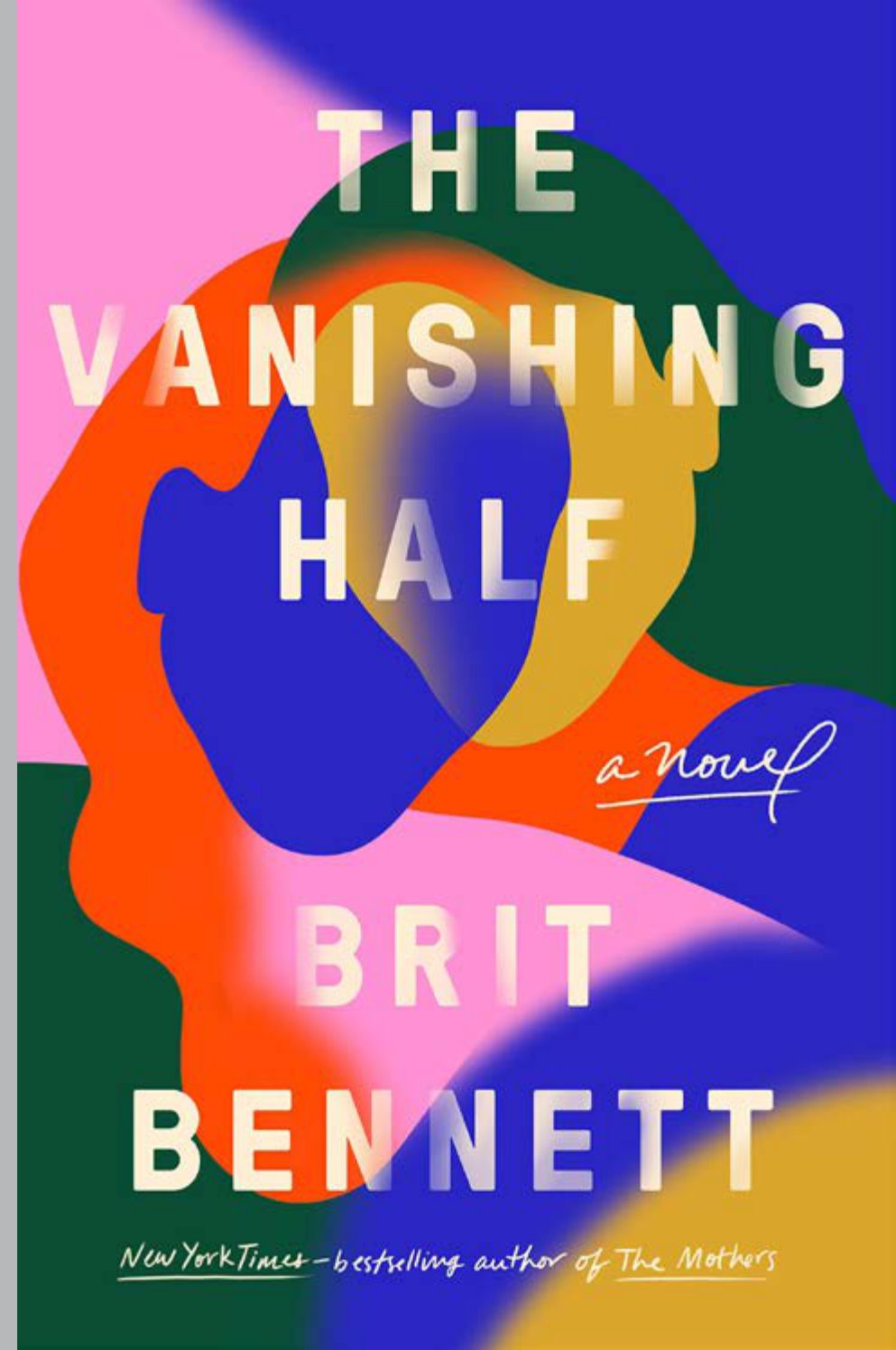
“It is no longer a question of imitation, nor duplication, nor even parody. It is a question of substituting signs of the real for the real itself” (Baudrillard, 2008). This is also what happens in Brit Bennett’s book The Vanishing Half (Bennett, 2021).
First published in 2020, the book is an exploration of colorism, family relations, sisterhood, identity, race and especially passing as white. Stella, one of the twins who grow up in a small town, decides to pass as white and leaves her sister and her past behind. The quote above, therefore, captures how Stella’s life as white is not just a lie or imitation but it is now what her identity which is hyperreal with Baudrillard’s term.
The book starts with one of the twins’ returning to the town where they run away from fourteen years ago. Spanning the decades and their daughters lives as well, the novel follows the twins’ different chosen paths; one gets married to a dark-skinned man, which is not appreciated in her town light skin is prized and the other one pretends to be a completely different person. As the sisters walk in their different paths, their daughters’ roads cross.
In this novel, self-reinvention is achieved both through choices made by individuals with regard to whom they racially identify with, and through the individual identity that they prefer to build in spite of social norms and expectations that their communities have (Akre, 2023). Especially the process of Stella’s self-reinvention of her identity which can be argued as a constructed simulation aligns perfectly with Jean Baudrillard’s hyperreality theory and his four stages of simulation.
As Łapińska argues (2024), the novel highlights how identity, racial in this case, is flexible in terms of being shaped by perceptions, personal decisions and choices and past experiences. She also mentions that how the act of passing, no matter what can be the reasons, destroys family ties and one’s identity by deteriorating the authenticity and realness (Łapińska, 2024). Applying Jean Baudrillard’s theory of hyperreality, Stella’s decision to pass fits into the Baudriallard’s concept of simulation, which ultimately replaces her original identity, showing that hyperreal construct can eventually be experienced more real than the reality itself.
2. BAUDRILLARD’S HYPERREALITY AND FOUR STAGES OF SIMULATION.
Hyperreality is the generations by models of a real without origin or reality (Baudrillard, 2008a, p.1). Baudrillard also explains that “the real does not efface itself in favor of the imagery; it effaces itself in favor of the more real than real: the hyperreal. That truer than true: this is simulation” (Baudrillard, 2008b, p.29). So, the concept of hyperreality mentions a situation in which representations of reality become more real than the reality itself. Signs and images no longer refer to original objects or truths. Instead, they have their own reality and they exist independently. This created a new world where simulations which are reinvented images, performances, identities, are perceived as more real than their origins. It is more than an illusion but it is a transformation in which simulation replaces the real. Hence, a new reality is constructed where people experience images or models that do not reflect authenticity but are experienced as more real though. Our modern world is full of simulations which are the process of imitating or replacing the reality. According to Baudrillard (2008a, p.6), media, advertising, branding and even constructed identities are examples of simulations. He describes the four stages of simulation as follows: 1. it is the reflection of a profound reality; 2. it masks and denatures a profound reality; 3. it masks the absence of a profound reality; 4. it has no relation to any reality whatsoever: it is its own pure simulacrum.
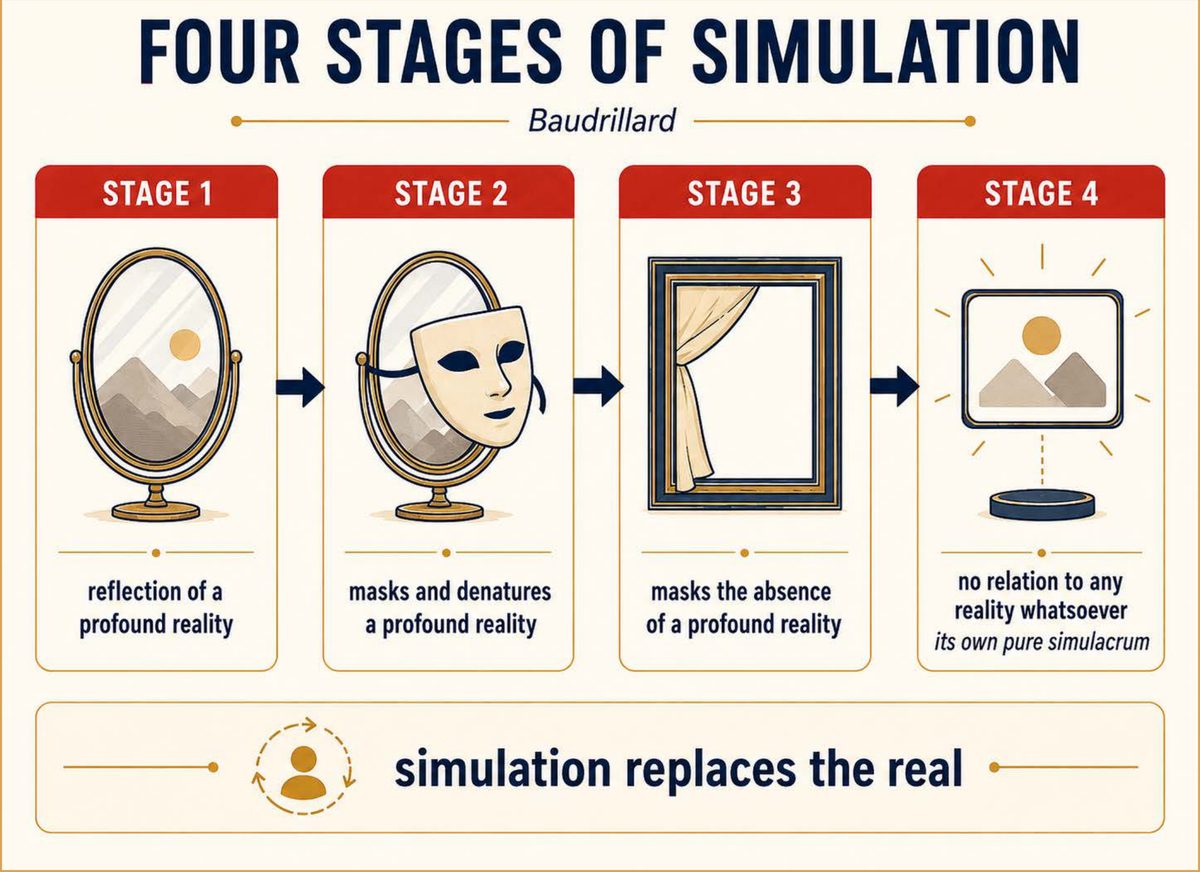
As he points out with these stages, in the first stage the image is an honest representation of the reality. The imitation is based on a real model. One example can be a photo of a woman sitting in the garden. It captures and reflect the woman as she is. As for the second stage, it is an evil appearance (Baudrillard, 2008a, p.6). Though the representation is linked to the original image, it distorts it. Let’s think of the photo of the woman sitting in the garden one more time. If Instagram filters are applied on this photo, it still represents the same person but their appearance is definably distorted. As for the third stage, the sign pretends to be the reality by hiding the fact that there is no longer any truth behind it. True crime documentaries or fake news can be counted as an example. Reality shows may pretend to portray the real life but they may mask the absence of reality so that one can never tell what is real any more. Finally, in the last stage, it is impossible to talk about any relation to the reality, meaning the simulation refers nothing real. The famous example is Disneyland. It is a fully constructed world having components nothing to do with authenticity. However, the visitors behave as if it is a real place because it is now experienced as more real than the real world.
3. STELLA’S HYPERREALITY.
Through the American history, passing have been used by racially ambiguous men and women as a strategy either to escape slavery or overcome societal prejudices (Akre, 2023). However, some black people passed because they had difficulties in accepting their racial identity and they wanted to get rid of their history and culture. Akre (2023) proposes that it can create a moral problem because people who pass in order to deny their true selves indirectly express their shame toward their race. Stella experiences this tension since her passing enabled her to have a mobility but it also makes her a lonely person, creates inner struggle and causes her to experience fear of loss especially after a black family moves to her neighborhood.
While Stella’s passing can fit the theory of hyperreality and simulations by Baudrillard (2008a), it can also be interpreted as a fatal strategy. Baudrillard describes fatal strategies as decisions that are beyond the logic or control (Baudrillard, 2008b). They are excessive and irreversible like her passing, which is an act of self-erasure; erasing her roots with her past. This makes her more than just a pretender; she is now being consumed by her lie and she disappears behind this passing, doubling the simulation.
“You can escape a town, but you cannot escape blood” (Bennett, 2021, p.7). That is the complete opposite of what Stella Vignes thinks although when they are kids, she is never willing to switch places even with her sister, with the fear of being caught. It is her sister, Desiree, who first encourages her to apply for the secretarial job at an office where a colored girl would never be hired. “It wasn’t lying if they thought she was white” (Bennett, 2021, p.65) Desiree claims. So the simulation begins.
Stella first gains awareness of whiteness as a social privilege during a museum visit. She visits the South Louisiana Museum of Art on an ordinary day when black people cannot use the main entrance, walks up to the side door. No one stops her and she fells stupid for not trying this earlier. This incident is a turning point for herself since she faces the possibility of crossing racial lines. She realizes that she acts like she belongs there, which also convinces people that she is white. However, a black security guide recognizes her and when she notices that, she gets horrified and accepts that passing is not easy. Here, she mimics whiteness with her attitude but she still recognizes herself as black. As in Baudrillard’s first stage of simulation (Baudrillard, 2008a), it is the truthful reflection of the reality; she imitates a white person. This imitation does not replace the reality yet. She does not believe her whiteness yet but now knows that she can imitate it. The basis for her future hyperreality starts at this very moment. She gets the social approval by not getting caught and therefore the museum incident marks the starting point for the simulation.
Stella enters Baudrillard’s second stage of simulation when she applies for a secretarial job thought to be available only for white people. To her surprise, she is accepted and starts working there as is she was a white person. At this point her reality is being distorted since she is not imitating whiteness anymore. In the second stage of simulation, original copy is being perverted and altered like applying an Instagram filter to a photograph. The reality is still there, but it is becoming masked. It is still a photo of somebody or something; but since the filter adds, colors or distorts certain things on the photo, it is now a manipulated version. Stella is not a black woman imitating whiteness anymore, but she is officially a white in the eyes of her employer and colleagues. When her boss, Blake asks her out and they become lovers, she finds herself thinking:
… she didn’t tell this to anyone, especially not Desiree. This life wasn’t real. If Blake know who she truly was, he would send her out of the office before she could even pack her things. But what had changed about her? Nothing, really. She hadn’t adopted a disguise or even a new name. She’d walked in a colored girl and left a white one. She had become white only because everyone thought she was. (p. 199)
Her identity is still there; she is aware that she is a black. However, she is hiding behind the fact that she can convince people that she is a white woman just as someone’s concealing her body with an Instagram filter. Unlike her first passing performance in the museum, this one is no longer private. Now, she is masking the reality and that new reality is accepted by the society.
Stella’s marriage with her boss aligns with Baudrillard’s third stage of simulation; a stage where the reality is no longer simply distorted but replaced. She is no longer performing as a white, but she is living as a white. She builds an entirely new life, constructs her a new white identity and settles in a neighborhood where only white people live. She cuts off all her ties with her past: her hometown, her sister and her mother. As Baudrillard suggests (2008a), at this stage, the image masks the absence of a basic reality, like this new life of Stella’s masks the absence of her black self. This stage is where the simulation becomes dominant over reality, and the image’s performance becomes its truth, meaning that it breaks free from the original reality: “She was white; she would never think of herself as anything else” (p. 184). Even in her mind, the boundaries between originality and performance start to collapse since her whiteness is not just a mask but now her perceived reality. When a black family moves to her neighborhood and the wife, Loretta becomes her friend, she starts to worry that Loretta might notice that she is, in fact, black. However, she feels relieved, thinking “…if it came down to her word versus Loretta’s, she would always be believed. And knowing this, she felt, for the first time, truly white” (p.212).
Stella’s identity constructed process, in this case her hyperreality, is completed when there is no relation to her former life as a black. Her hyperreality can be observed through the way she raises her daughter who has no idea about her mother’s racial background and her past. In this stage, there is no relation to any reality; her past is so deeply buried that, even she cannot remember:
How she’d pretended to be someone else because she needed a job, and after a while, pretending became reality. She could tell the truth, she thought, but there was no single truth anymore. She’d lived a life split between two women — each real, each lie. (p. 278)
There is no single truth any more about her origin. Her life started as a simple imitation becomes her reality and continues to produce its own realities like her relations with her daughter, her husband and her neighbors. This hyperreality is at its peak: it deletes the original and becomes the new original.
4. CONCLUSION
“Quit fooling, that ain’t no white woman. That’s just Stella” (p.335). This is Stella’s mother words who suffers from Alzheimer disease when she finally sees her daughter for the first time in twenty-seven years. After many years, she returns her hometown not to reconcile but to tell her sister that her niece, Jude, and her daughter, Kennedy have meet and Jude tries to reveal the truth about Stella’s passing. When Kennedy learns about the truth about her mother and indirectly about herself, Stella begins to feel disorientation and the hyperreality she has been building starts to fracture. However, rather than abandoning the illusion, she is determined to maintain her hyperreality, which perfectly fits the four stage where the line between real and hyperreal is completely blurred. One interesting point is that the only person who recognizes her immediately is her Alzheimer mother suffering from Alzheimer’s perhaps because she is no longer aware of the societal constrictions and still sees her passing daughter through her memories not her racial performance.
In The Vanishing Half, Stella’s passing mirrors Baudrillard’s four stages of simulation, showing that how identity is a social phenomenon which can be evolved from an imitation to complete detachment from reality. Stella’s passing starts as a seemingly honest imitation which corresponds to the first stage of simulation and eventually replaces her original identity. With the help of Baudrillard’s theory, it can be claimed that Stella’s passing is not just an identity construction process but a hyperreal situation where the original is totally replaced. However, despite her efforts to keep the hyperreal as her only truth, she cannot help but face some cracks in her new reality. Yet, she manages to keep it real at the end of the book. In this way, Bennet’s novel not only explores the construction of the racial identity despite one’s true self but also provides context about how the constructed reality can sometimes be more convincing and more importantly more real than the original reality.
References
Akre, G. R. (2023). Self-reinvention in The Vanishing Half by Brit Bennett. Ziglôbitha: Revue des Arts, Linguistique, Littérature & Civilisations, 8, 453–462.
Baudrillard, J. (2008a). Simulacra and simulation (S. F. Glaser, Trans.). Ann Arbor: University of Michigan Press.
Baudrillard, J. (2008b). Fatal strategies (P. Beitchman and W. G. J. Niesluchowski, Trans.). Semiotext(e).
Bennett, B. (2021). The vanishing half. Dialogue Books.
Łapińska, M. (2024). The consequences of crossing the color line: Identity and racial passing in Brit Bennett’s The Vanishing Half. Crossroads: A Journal of English Studies, 44(1), 66–83.
Discover more from BAUDRILLARD NOW
Subscribe to get the latest posts sent to your email.