Hyperreality as a Mode of Synthetic Transcendence
by Alexzander Mazey
Approaching the desert planet, Commander Taggart offers a characteristic optimism in his dialogue, an optimism which is nevertheless juxtaposed with his expression, his eyes held shut as if hiding from imminent death. It is an expression of concern which comes second only to Tommy’s expression of despair, the pilot’s countenance now recalling the disastrous event of having previously flown through that ‘minefield left standing from the great war of 12185.’ These expressions are cut with Fred’s nonchalance, a man more concerned with snacking on chips and dips. The film’s thematic reprise emerges in the form of a celestial chorus, its leitmotif introduced as a non-diegetic insert, just as the frame shifts to reveal Guy sobbing away. Initially concerned that he was going to be left behind, Guy is now worried his character will be killed off the moment they land on the planet.
“Are we there yet?” Alexander quips as the spacecraft breaches the planet’s atmosphere to reveal the terrestrial desert beneath. As the pilot struggles to manoeuvre the spacecraft parallel to the landscape, Fred looks out at this world with the glee of anticipation, his snacking intensified by that cinematic experience we call mild peril.
It is following this moment where we glimpse the real ‘desertification’ of the material environment, with Galaxy Quest (1999) presenting this landscape as the antithesis of that interiority we have so far become accustomed, which is to also say, in relation to Dean Parisot’s cinematic masterpiece, the mise en scène of interplanetary spacecraft.
It is significant that this ‘alien’ planet is enveloped by a quintessentially Baudrillardian landscape, the desert’s textured surfaces contrasting with the smooth alloy of the landing craft, which appears — borrowing Baudrillard’s words from America — with an ‘extraterrestrial’, ‘Los-Angelic modernity’, landing with the ‘otherworldly cleanness of a thing from outer space.’ It is with these words that Baudrillard once described ‘Salt Lake City’ as a ‘supernatural’ thing, ‘all marble and roses’, its luminosity contrasting with ‘the Great Salt Lake Desert’ whose ‘signs’ are ‘sculpted out by wind, water, and ice, dragging you down into the whirlpool of time, into the remorseless eternity of a slow-motion catastrophe.’ It is no coincidence that Baudrillard characterised time as this rotating mass — an endless circulation where a process of disappearance is theonly true mark of reality.
In America, Baudrillard describes the desert as a landscape forged by a ‘pact of wear and erosion,’ where the passing of ‘millions of years’ leaves behind geological remnants that suggest, rather than permanence, the insignificance of the human trajectory. To stand atop a craggy outcrop in the desert is to glimpse a world where time does not accumulate meaning but merely erases in the perpetual equilibrium of passing from one disappearance to another where the ‘ocean bed in the open air’ is one day handed back to water. Yet our perception — shaped by narratives — renders this process sequential, as though it follows a trajectory, as though it had ‘meant’ anything at all.
This echoes the gnostic view of the universe as a realm of desolation — unfinished, imperfect — though perhaps it is more accurate to say that the world is absolute in its cycle of appearances and disappearances, manifesting only to dissolve. Even so, Baudrillard’s philosophy intertwines with this gnostic melancholy, not as an elegy for lost meaning but as a confrontation with the void at its core. Where the gnostics saw an unfinished and imperfect world, Baudrillard reveals a reality that does not lack meaning so much as it operates beyond the need for it. Meaning is neither eroded nor concealed — it is weightless, flickering across the surface of things, accumulating only as a function of our attempts to impose coherence. In this sense, the ‘depth of time’ is not a measure of significance but of velocity, the acceleration with which signs, histories, and realities emerge only to vanish. Like the desert itself, where forms are shaped and undone by wind and erosion, the world is an endless circulation of appearances — never settling into presence, never culminating in truth, but ceaselessly moving through phases of disappearance.

This perpetual circulation of appearances — where nothing is lost but nothing truly accumulates — extends beyond the desert’s physical landscape and into the hyperreal terrains of media and simulation. The ‘depth of time’ is not a sedimentation of history but the sheer velocity with which we traverse its surface, moving from one fleeting form to the next. Baudrillard saw this in the prototype cars streaking across the desert, embodying movement without destination, acceleration without progress. Galaxy Quest enacts a similar logic: its imitation Star Trek (1969) ‘Runabouts’ shuttle their crew from astral ship to polluted planet, traversing a universe that is itself an accumulation of pastiche — where planets, ships, and entire histories exist only as narrative backdrops, evoking the sense of exploration while merely recycling familiar forms.
As the narrative’s primary antagonist still lurks in the darkness of deep space, beryllium acquisition becomes a time sensitive mission, and yet standing in opposition to the urgency, all around this desert one cannot help but be reminded of another paradigm entirely, which is to say an acknowledgement of those geological ‘signs’ that never lead us to the most obvious conclusions: that we have done this all before, and we will keep doing it. The desolation here is overshadowed only by time’s ‘superficiality’, a quality that resurfaces in the shrill sound of every alarm clock, in the indifference of time to sleeping bodies under capitalism, as we schedule our lives into a series of little stories — sentimental tales we tell ourselves. Time holds these multiplicities together, positioning us within that sequential space we call history.
After landing on the planet, Fred opens the ship’s automatic doors in preparation for the crew’s departure despite Guy’s protest, his concern that there is no oxygen on the planet. Fred looks over his shoulder with an expression that lacks concern, lowering the ship’s doors regardless. He sniffs the air, taking a series of short breaths to confirm something of a habitable atmosphere. The frame follows Fred’s perspective to show the crew preparing for their departure, the frame casting Gwen in the light of the desert. The hand running beneath hair to give it volume is the same hand that drops to her chest, extending the presentation of pale skin with the luminosity of manicured nails, eyes that distinguish themselves through black mascara and the landscape Gwen’s gaze now rests upon. It is through placing a hand against her pulsating heart, an expression that tries to take in the overwhelming visibility of the desert, that elevates Gwen’s appearance to something of the pornographic. Coincidental then that Guy should shield his eyes from the light that casts Gwen with her own astrality, the other men presented in the shadows as if shamefully lurking there. The shame we used to feel is outsourced to fiction, and like a deceit, fiction is designed to absolve us of that other reality we made for ourselves. In all his performative despair, the shielding of his eyes, Guy comes to represent the failed negation of a certain gaze, the attempt to resist a subsumption into the objectified image of Crewman Maddison in what Baudrillard would call ‘the sexual scenario’ on page thirty-two of America.
Whether it is Guy’s sweaty anxiousness or Taggart’s approaching shadow, the proximity of bodies in this scene holds a certain quality, the ambiguities culminating in a scene that resembles an orgy on film. This otherwise banal frame captures a moment within the pornographic imaginary — not through the material exchange of fluids, but through their anticipation. It is the prolepsis of an astral presentation being reabsorbed into the terrestrial, a prefigured return from the idealised to the bodily. The sequence of the astral image, pristine and distant, builds toward its inevitable collapse into the tangible reality of flesh and fluids. The paradoxical treatment of the body-as-image exposes a central contradiction: the desire to witness the astral projections made manifest is simultaneously intertwined with the need to return these projections to their corporeal, earthly state. The image of the body, glossy and manicured, is not simply displaced by another reality — it is reintroduced to that reality only through the process of re-presentation, in the form of a new, secondary image. This is where pornography embodies the memetic power of images to (re) construct reality through a process of bait and switch. In the world of lived images, hyperreality becomes cyclical, where the anticipation of bodily materialisation (the proleptic return of the terrestrial) is woven into the very structure of the image itself. Examples like the internet’s ‘Rule 34’ or ‘Lewd Cosplay’ exemplify this aestheticization par excellence, pulling us into a hyperreality that, unlike the nudity in Michelangelo’s work, places no moral demands upon its viewer. What morality do we obey when it comes to the moment of having to avert our gaze? More importantly, who is looking away anymore? In the act of ‘turning away’, we once told ourselves that the act of desecration could still take place, that our gaze was still one of potent contamination against those things we once called sacred.
Soon enough, Fred walks out onto the desert, yawning as he goes. Taggart follows close behind, exiting the ship, taking in the wide expanse, awe reflected in his expression as the frame transitions from intimate close up to wide-angle landscape, the terrain’s formations presented with an eerie stillness. The wind that lifts the sand is reduced to a whisper ruminating across the desert plain. The ambience of the desert is the same as the cancer ward, of patients with dry mouths, of endless xerostomia, of disappearance and learning how to die. It is the ideal home for supernatural occurrences too, a world made for skin-walkers and UFOs crash landing in Nevada. It seems the desert remains almost too desolate for its own good, needing to be filled with monsters, a genie beneath the sand. And so, in this alien world presented on screen, which is without the total smoothness of the Saharan dune, one cannot help but wonder what else hides beneath its mountainous composition. Like looking under rocks, looking for an entire world to terrify, the camera’s perspective looks down with its child-like mischievousness — looks down at the desert with a creepy omnipresence.
Gwen speaks out to the desert, her words like a prayer carried by the wind, Guy trembling behind her, cast in the shadow of the landing craft. They follow on foot, rambling through the desert, Alexander leading the way with his surface mapper set to the beryllium’s location. With the commander asking for directions, Alexander glances down at the bleeping device before pointing out into the distance, re-orientating the device in his hands. Tommy soon criticises Alexander’s inability to use the surface mapper correctly.
“You think you could do better, Laredo?” Alexander asks, placing a very deliberate emphasis on the name, and therefore calling into question Tommy’s own inability to fully materialise the skills and talents of his on-screen character. The impact of his chosen words is not lost on the pilot, of course, their verbal tussle played out through the scene’s motion, the ‘superficiality’ of time returned to the desert through footfalls and sweeping, panoramic shots of the desert. The desert, in both its vastness and its haunting stillness, becomes a physical and metaphorical space of liminality. It is a place where time seems to stand still, neither fully past nor present, where the land itself exists in an endless state of becoming and unbecoming. The terrain — formed by the endless erosion of wind and water — becomes a symbol of transience, of things that are perpetually in-between, undefined, and awaiting a form or purpose. Just as the sand shifts with the breeze, erasing any trace of what was once there, the characters themselves move through the desert in search for something — be it the elusive beryllium or the elusive self. The desert, as a space of ambiguous potential, provides the perfect backdrop for the characters’ internal journeys, forcing them to confront the uncertainty of both the landscape and their place within it. In this setting, the stakes are not only about survival or discovery but about how they will reshape themselves, or fail to do so, in response to the profound emptiness surrounding them.
Undeterred, they continue through the desert, the tension between them escalating as Tommy begrudgingly acknowledges Alexander’s criticism before the crew reaches a rocky plateau. Meanwhile, the argument between Gwen and Taggart — about the commander’s promiscuity — ends abruptly, and silence falls, only to be broken by the non-diegetic chorus of angels.
Alexander expresses an astonishment in response to the landscape before him, commenting on the appearance of the abandoned mining facility. The camera’s perspective is reversed to reveal this facility nestled into the side of an orange cliff. Whilst obviously left to the desert, rusted over years of use and disuse, the abandoned site is reminiscent of all things given over to perpetual disappearance; disappearance having made a peculiar monster from fading vestiges. What’s left of the mining facility pertains to an almost Lovecraftian fascination, telling the story of another world subsumed by sedimentation, its spindly supports and flue sections standing with the quiet air of something having become half-fossilised The half-fossilized machinery of another world.
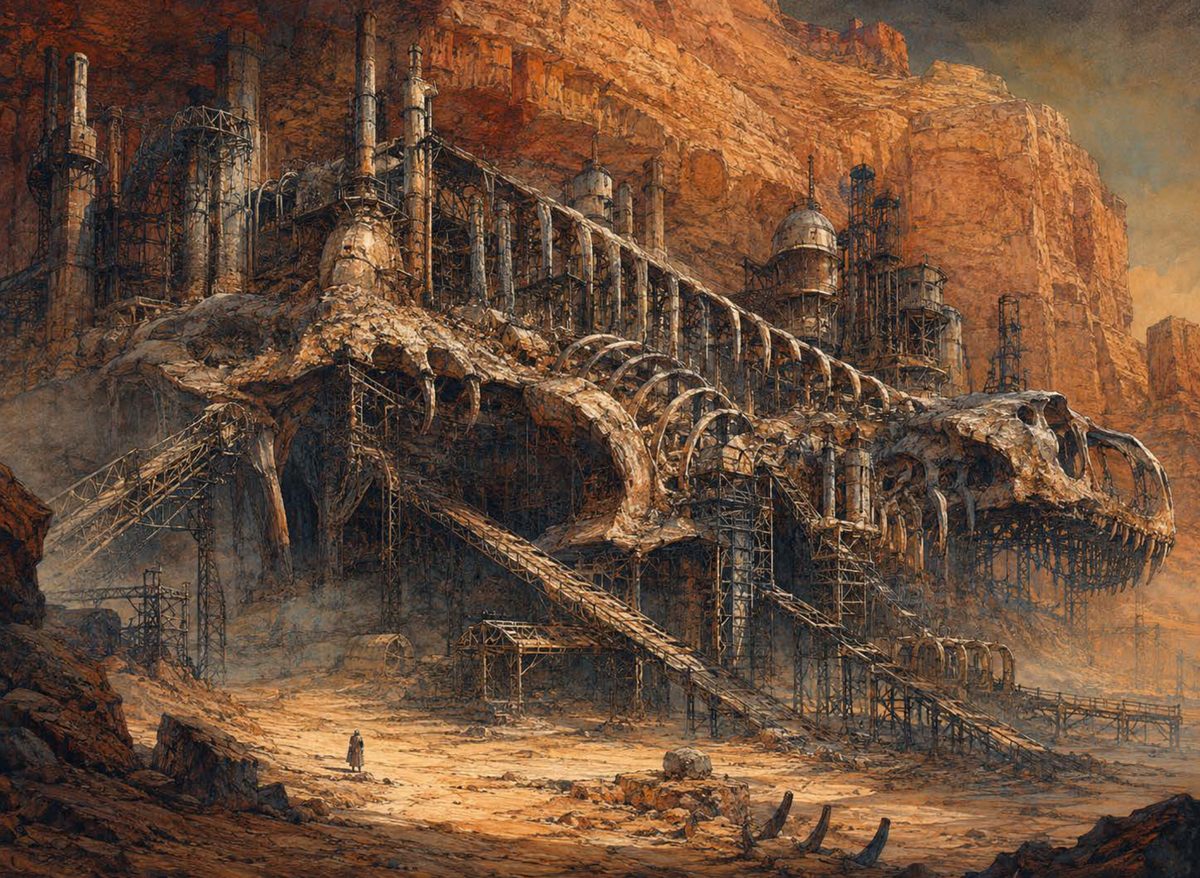
through petrification. It is something that appears half-discovered too, holding the seductive appeal of half-discovered bones, like that of the tyrannosaurus rex prior to a museumification.
All around, the appearance of the mining facility recalls the weathering processes that take place within an environment which is entirely without prejudice, the wind howling through a half-structure that disappears almost as quickly as it appeared, an outward form that nonetheless presents as a machinic oasis, an astral mirage waiting for its second wind. There is in the pseudo-essence offered by astrality, the air of something else waiting. This is a central quality of the simulation which exists (and persists) through the changeability of auras more than any fixed, intrinsic essence, which our realism ultimately lacks and therefore must reduce to something else entirely. To say our realism is also a simulation that must constantly avoid the topic of its own emergence through a paradoxical fascination with it. Even today, we avoid inspecting the genealogy of our morality, for example, as to not disrupt the simulation of its essence in reality. Inevitably, an aura of sanctimony fills the space left behind, a void that must be metastatically filled as it must simultaneously be left uninspected so as not to ruin the whole game of our liberal humanism whose moral absences are best revealed in the reading of its own history.
Gwen soon registers the absence of any miners in the facility, whilst Guy also registers this world’s Miyazakiian Desolation, the quietude that stands in direct opposition to the communicative and ecstatic realism that conditions this character to take silence as something profoundly undesirable. This is silence as a ‘negative’ condition that must be overcome through the act of having it overexposed to obstreperous reality. Of course, with an audience originating from that same obstreperousness — and therefore conditioned by those same processes — the desert’s silence becomes as uncomfortable for the viewer as it does for Guy, with that aura of silence raised to the level of the threateningly inauspicious. What is the exact experience of the too quiet, anyway? At its core, this scene breeds an atmosphere thick with mystery, coupled with the expectation that this silence will soon be punctured by some fast-paced event, an inevitable burst of sound and motion to fill the screen-hole that delivers spectators from that momentary silence. This is cinematic silence as opposed to that other thing once thought sacred. The silence here is not some sacred, meditative stillness, but a cinematic tool — a dramatic pause that heightens anticipation. It is the kind of silence that is burnt away by the overwhelming demands of reality, reduced to a means of facilitating the excitement.
“Will you relax?” Tommy asks in a close up that encompasses both his expression and Taggart’s act of reconnaissance, his looking out at the landscape through binoculars. Taggart’s vision lands on the intended target. The beryllium sphere in the distance. Soon enough, the crew approach, the scene transitioning to show something of the facility up-close, decay realised through the mise en scène of a construction yard without its labourers, of ladders ascending to nowhere, and equipment left out in the sun. There is an unnerving quality to all of this, of an absence which can reveal something of the world’s absurdity in isolation, as if a location that once held a productive purpose suddenly lost everything in the process of having been emptied out of its workforce. A similar absurdity can be found in the ‘dead mall’, an environment that has lost both its foot traffic and its semiotic confidence, a world replaced by a world collapsing, of ceiling tiles abandoned to rain and storefronts leading to nowhere. How easy it is for rain to liberate the world of its purpose. Yet there’s something profoundly unsettling about a fading world poised to return in astrality, as if taking incremental steps from the real is to pull reality in the right direction. What’s intriguing is how the crew’s mission has led them to this desert — that their reality required an injection of the real to preserve itself as something they could continue living within. Of course, the desert remains to be cemented over, existing only to remind us of that other world without air conditioning. If it wasn’t for this simple function, one could imagine the desert as a thing to be repurposed. Perhaps it is for this reason alone that the desert was left to those peoples whose imaginary could still put it to good use, and it is through this mythological relationship with the desert that may have saved them from that other mythology we call America.
As the crew continues their journey, moving through the shadows cast by the facility, the frame reveals a small, silvery figure emerging from the aperture of a dismantled flue section. Gwen gasps as it moves from the darkness, its movements reminding her of a small creature cautiously leaving its den in search of food. A second body follows, more tentative than the first, as the crew quickly retreats behind a column of desert rock. Gwen watches, mesmerised, as more of these child-like beings gather in the distance, their numbers growing rapidly since the first one appeared from its cavernous hideaway.
In their covert observation, the crew unknowingly projects their own child-like wonder onto these unfamiliar creatures, interpreting them based solely on their appearance. In the world of images and appearances, assumptions are made without question, just as the alien beings’ innocent, almost adorable exterior misleads the crew, who project meaning onto them as if they hold significance in relation to what is familiar and safe. These beings, charming and seemingly innocent — ‘like little children,’ as Gwen describes them — come to aid a weak (possibly wounded) member of their species to a watering hole.
“I don’t like this,” Guy whispers from behind Gwen. “I don’t like this at all.”
“They are so cute,” Gwen adds, before Guy counters her observation with his own, the growing tension felt towards this alien ‘Other’ rendered as a typical science fiction trope, heightened by satirical techniques: the slow movement of the frame into Guy’s expression, the non-diegetic insert, the interspersed images of the aliens moving as desert-dwelling piranhas. As Gwen spots the injured alien, she instinctively moves to approach, only for Guy to grab her by the shoulders and pull her back. The perspective shifts to reveal the wounded alien collecting a handful of water as the other grey bipeds whisper amongst themselves, demonstrating a communicative intelligence — only for their expressions to shift, their skin pulling back to reveal rows of incisors, teeth made for slicing through sinew and flesh. The moment of wonder is swiftly consumed by horror as the crew watches these creatures devour their own wounded.
“Let’s get out of here before one of those things kills Guy,” Gwen orders, rushing from the scene.
The gag here is once again the protracted witticism of seeing the cast subsumed into a narrative they now experience as hyperstitional reality. Galaxy Quest was once a television show — a fiction — that has now manifested as a world to be lived. Its mythological structures — its ‘historical documents’ — are no longer confined to fiction but have long since become, in the words of the CCRU, a ‘fiction that cannot be judged true or false because it makes itself real.’
The power of hyperstition here is not so much in the disintegration of truth itself, but in the erosion of its prioritisation in the world at large. The idea that truth has ever been prioritised in human history may be the final illusion left to us, and that illusion persists behind another manufactured crisis: the highly politicised and mediated spectacle of truth’s supposed disappearance. The post-truth world, then, is less a reality in which truth has vanished than one in which its disappearance must be continually staged in order to justify the systems that claim to preserve it. We must pretend to grieve its loss in order to sustain the structures built upon its existence.
In this way, reality — calcified, embalmed — persists through the suspension of the hyperreal, in that other world we call post-truth. No wonder, then, that virtual reality resembles an interment, a form of taphonomy in reverse, transitioning from the lithosphere to the biosphere to a fossilisation in digital utopia. What is astrality but the allure of this virtual space, refracted through a (hyper)eschatological lens? The thing that pulls us under, the thing that makes us go there.
Similarly, it is the astral quality of the graveyard that compels us to pause, to read names and dates, to pity the smallest graves, to enjoy the wincing of the gate as we come and go. It is in this ambient pull that we might even convince ourselves of a space beyond the present, just as we do when we reach for the tactile surface of a screen, drawn into the ritual of touch, searching for an existential intimacy with astral images that, in the words of Emil Cioran, ‘do not have substance but which simulate an illusion of life.’
“We’re not going anywhere without a Beryllium Sphere.” Nesmith orders, understanding the futility of retreat in the face of those piranha-like aliens on the desert planet’s surface. As Nesmith begins to delegate tasks to the crew before him, Gwen appears suspicious, asking the others why this all feels so familiar. There is a deep contradiction in Gwen’s countenance with an initial awe felt towards Nesmith’s sudden control over the situation levelled only by this gradual suspicion, the eyes that dart across her face.
“Assault on Voltrex III, Episode Eighty-One.” Tommy recalls from memory, nodding towards Gwen. Guy begins to panic, his voice trembling, the relevance of that particular episode lost on those around him. Both hands raised, he pleads with the commander for a straight answer. He cries out to the desert winds, revealing to the others that it was — in fact — Episode Eighty-One in which his character dies.
It is not long before Fred corrects Tommy’s earlier suggestion, putting Guy’s anxiety at rest. Alexander soon intervenes however, gesturing towards Nesmith, asking why they are listening to a man ‘wearing a costume, not a uniform.’ Once again, the irony of Alexander’s confrontational attitude lies precisely in its alignment with his character, Doctor Lazarus, who perceives the commander as an inferior tactician. Reflecting the Žižekian observation that ideology often manifests as its own opposition, Alexander’s belief that he has transcended the fiction only serves to entrench him further within it. This irony is only emphasised by his gradual inclusion into the cinematic frame from which he was earlier excluded, with his character now distanced from a pairing with Gwen, whose initial question — ‘Why does this sound so familiar?’ — once reflected a shared awareness of the situation. Whilst Gwen maintains a subtle familiarity with the source material — a self-awareness towards the events of the fiction — Alexander appears almost amnesic to the irony of his own actions. His attempts to distance himself only pull him deeper in, his confrontation with Nesmith not an act of rejection, but a perfect reenactment of the very fiction he seeks to deny. In other words, while calling out Nesmith for his superficiality — ‘He’s wearing a costume, not a uniform’ — Alexander unwittingly fulfils Doctor Lazarus’ function within the narrative.
That being said, the narrative of Galaxy Quest is not necessarily concerned with the simple ‘becoming’ of characters, but with the amalgamation of real entities and fictional ones, the blurring and disintegration that occurs in hyperreality to create a world produced in the interstitial. Astrality, it could be said, is the friction between the real and the fictional — the haemorrhagic space where collisions reveal the dichotomy for what it is: not an opposition, but a necessary confluence. Both auratic and ambiguous, the astral becomes forever surreptitious: not quite fiction, but never quite real enough. In many ways, astrality is the threshold through which hyperstition once passed, a processional space barely noticeable.
Gwen signals to the others, noting the disappearance of the cannibalistic aliens that had once been visible in the distance but are no longer present. Guy appears behind her to look for himself, followed by the rest of the group. As Tommy debates what kind of signal to perform in case the aliens return, the camera remains focused on Gwen and Guy’s brief moment of significance. It is within this moment that the soundtrack swells with a jaunty inflection, underscoring the subtle yet provocative glance Guy shoots toward Gwen’s cleavage, her zipper lowered by the desert heat. Noticing this, Gwen looks down at herself, as if to feel the added heat of his gaze. The desert wind isolates her hypersexualized appearance, the off-screen wind turbine blowing her hair in a way that accentuates the cinematic clichés of sexual objectification — all of which feed into the hyperfamiliarity of a sexual gaze. What’s striking here is that, while this moment could be read as a feminist critique of objectification, it is simultaneously reconstituted within the narrative as a continuation of the patriarchal crime. Perhaps this is the ultimate irony: the critique, like the gaze itself, is subsumed into the film’s logic. Alternatively, by outsourcing the perspective to Guy’s character, the film allows the audience to be absolved of complicity in the objectification — we are distanced from the salaciousness. As with all popcorn cinema, we are tasked only with enjoying the moment for what it is; its images are not meant to be parsed or analysed, but simply consumed. It is a space where the very act of enjoyment becomes an exercise in passivity. It is perhaps this disavowal of critical distance that makes popcorn cinema such a telling mirror of our cultural moment.
The specifics of how the crew obtains the beryllium sphere are scarcely worth mentioning; what matters is the drama of the mild peril that ensues. The real focus here is how each crisis is swiftly overcome, propelling the viewer from one predicament to the next. As the crew rolls the beryllium sphere from its location in the mining facility toward their landing craft, the piranha-like aliens begin to multiply, emerging from every hidden fissure and crevice. By the time Gwen turns to observe the aliens in pursuit, there are perhaps hundreds of them, kicking up dust with their speed as they move between the desert formations.
With the landing vessel in sight, Tommy is the first to board, initiating the power and preparing for a rapid departure. The others follow, manoeuvring the beryllium sphere into the back of the craft. Nesmith and Alexander are caught between the threshold of the ship’s entrance, and, in the midst of the tussle, Nesmith falls from the craft. Gwen pleads with Tommy to stop the ship, but the pilot turns to her, announcing that the ship is — in fact — on autopilot. The frame then transitions to show the aliens in the desert below, holding the commander hostage and parading him through the air. As they hold him captive, the aliens comment on Nesmith’s odd appearance before striking him over the head with a rock. The frame blacks out, mimicking the commander’s loss of consciousness.
This is not the first time the audience has shared in Nesmith’s loss of consciousness, but this time, the perspective aligns with the character’s, drawing the viewer closer to him. The action offers an immersive perspective, heightening the tension of what is to come. As a representation of Nesmith’s loss of consciousness, the audience is plunged into total darkness — a blackout that invites momentary speculation. By presenting the event in this way, the audience is prompted to ask, ‘What will happen to Jason Nesmith?’ — but also, ‘What will happen to me?’
From Alexander’s onboard protest — his looking down at Nesmith’s in the desert — it cannot be discerned whether or not he desires this empathetic pairing between protagonist and spectator. Perhaps Alexander actually desires the superficiality that Nesmith’s role as protagonist affords him, this desire manifesting through his barely concealed resentment. The appeal of being the main character of the universe lies not in the responsibilities it entails, but in the protagonist’s journey being the most transparent. It seems another Reversal has taken place in which the transparency of the hero’s journey has produced something in narrative theory that today considers this journey as the most superficial, the most banal. Why else did contemporary narrative so quickly enter the realm of the antihero, of passing the leading role over to villainy? It is perhaps the case that such techniques in narrative reversibility — of having sympathy for the devil — intended to simulate an alterity in a world without it. Yet these superficialities remain transparent, beyond even the ambiguity and complexity which they only play at. What’s important to understand about superficiality is how it renders reality so easy to understand –– and it is for this reason the mood of superficiality remains everywhere in the culture today.
It could be argued that artificial intelligence is merely intelligence made superficial — a reduction of complexity akin to those technologists who pursue a meta-reality in order to negate the complexities of the apparent one. Artificial intelligence, virtual reality, still unable to locate the referential position of either, a culture with neither intelligence nor reality remains endlessly fascinated with their codification, projecting them into some hyper-dimensional elsewhere. In the formulations produced by these pursuits, simulated doubles (re)create a reality rendered transparent to the instrumental reason of Silicon Valley. (Reading the history of Silicon Valley, one might wonder whether the place itself was manufactured as a form of counter-espionage — a covert means of shaping hostile entities with technologies always intended to be stolen.)
I am not asking for an end to anything here — not even to scientism or that instrumental reason, which, over a few hundred years, has become amnesic to its own fragility. Just watch. The fragility of science is destined to return, if it has not already. In replaying the same events of history, we will rediscover how fragility — vulnerability — has always been a benefit to knowledge. But this fragility does not resolve the deeper question of hyperreality. So much of this simulation obsesses over what is being communicated, yet never asks why. Hyperreality, yes — but why? To understand why the code was written in the first place is perhaps to wake from the dream, and yet when we wake, we emerge as Nesmith wakes from his unconsciousness to find himself upon the desert of the real itself.
‘In this postmodern world,’ writes Douglas Kellner in his piece Jean Baudrillard, taken from the Stanford Encyclopedia of Philosophy, ‘individuals flee from the ‘desert of the real’ for the ecstasies of hyperreality and the new realm of computer, media, and technological experience.’ It makes sense, then, that Nesmith, upon waking from unconsciousness, begins that very act of fleeing the desert — but not before he is exposed to its terrors. The monster that licks his face in this awakening scene becomes another harbinger of the real, its grotesque intimacy demanding confrontation. This ‘new realm’ finds expression in the ‘technological experience’ of the Thermian world, represented by the Protector orbiting the desert planet. Of course, the narrative hinges on the commander’s return to this hyperreal order but how much of this desert is purely simulated — a construct to make us believe the rest is real?
While acknowledging the technological experience and its power to create imitation, it becomes impossible to really distinguish between the Thermian world and the desert beneath. One might even imagine the Thermian intelligence generating everything presented before us — an entire planet — designed to sustain the continuation of a narrative to live by. To what lengths would anyone go to facilitate a meaningful existence? And to what extremes — especially in terms of what it is willing to sacrifice — would an entire culture go to sustain a sense of its own realism? What do we have to show for sacrificing the rainforests or the planet’s natural biodiversity? At the very least, the Aztecs believed they were upholding cosmic balance — offering human lives to ensure the sun’s rise. Similar to today’s ecological destruction, their sacrifices were rooted in a sacred economy, one in which human life was exchanged for divine sustenance. Through rituals, offerings, and sacrifices, the sacred was a means of reaching beyond oneself, to partake in a greater reality that governed the universe. Certainly, capitalism, in its hyperreal form, doesn’t merely represent something that pretends to transcend — it actively constructs a form of transcendence within the system itself. This ‘beyond’ that capitalism points to isn’t some external, higher reality but a space it has created — one that’s contained within the parameters of its own logic.
So, we might say that capitalism, unable to deliver true transcendence or an authentic escape from its structures, instead manufactures its own version of transcendence. This is where hyperreality functions: the simulated transcendence that is entirely internal to the system, like virtual worlds, digital ‘metaverses,’ and augmented realities, which, in a way, represent a beyond — but one that has been constructed from within capitalism itself. It’s a simulated ideal, not a real transcendence, but it’s presented in a way that feels as though it could offer release, progress, or fulfillment.
What is particularly interesting, then, is that this space is not only a simulation; it is a synthetic transcendence. A transcendence that is designed to keep us within the system, forever cycling through aspirations, desires, and consumption.
Unlike religious or spiritual transcendence that promises liberation beyond the system, this simulated transcendence never lets us truly escape because it only points us toward more of the same. We’re always promised access to the next, better ‘reality’ — whether it’s a virtual world, a digital experience, or a new form of escapism — but it’s still tethered to the original system.
To put it simply, capitalism creates its own sacred system where transcendence becomes not something that elevates us beyond the system but something the system can continuously offer. The sacred economy of capitalism, therefore, becomes a self-perpetuating loop where simulated transcendence takes the place of real escape.
No wonder then that Nesmith’s transmutation, his movement from the desert to the astral plane above, requires an unshakable belief — a faith — not just in the technological capabilities of this world, but in his own digital solubility. This faith is less about technology per se and more about Nesmith’s confidence in his integration with the simulated reality around him. The emphasis here shifts from survival in the desert (as one might expect from a modernist narrative) to submergence into a technological reality beyond it — a distinctly postmodern gesture. The fast-paced, action-oriented scene underscores this transition, showcasing Nesmith’s journey not as a triumph over nature but as an immersion into the hyperreal.
As the camera oscillates between the arid expanse of the desert and the sterile, artificial glow of the Thermian vessel, a striking visual contrast emerges. The ship’s interior is saturated with the synthetic hues emblematic of science fiction, while the desert appears both hypernatural and hyperfamiliar — the desert exactly as we would expect it to be. Yet, as with much of the realism we inhabit, this contrast is merely aesthetic — a distinction produced through the visual motifs rather than any fundamental difference in substance. More crucial than this superficial duality is the shared intensity that binds both spaces. Despite their apparent opposition, both settings pulse with the same manic energy, their realities collapsing into a single, ecstatic moment mediated through technology. To say, the intensity of the situation becomes as a unified ecstasy shared between these two parties via the technological devices they use to communicate. It is simply the case that communicative technologies have brought about a reality in which the ecstasy they generate can eclipse almost any event.
Gwen, now aboard the Protector, clutches the communicator as if trying to prevent Nesmith’s voice from slipping through her fingers, sighing with that deep sense of consolation that only technology can bring. Around her, the crew stands in collective relief at the sound of the commander’s voice returned to them. The Thermian — known as Teb — uses a terminal interface to display Nesmith’s current location on the desert’s surface. The crew watch as the commander fights off a grotesque, pig-like creature on the terminal screen before them.
“Jason — we’re going to use the digital conveyer to get you out of there.”
“The digital conveyer?” Nesmith asks Gwen in reply, keeping the beast at bay. Teb reveals that whilst the digital conveyer has never been ‘successfully tested’, there is renewed hope in Tech Sergeant Chen’s hands being at the controls this time around. Teb motions towards Fred, a smile emerging from the Thermian’s expression. It is in this moment where the camera performs a circular movement to position Fred at the centre of the frame, the onus placed upon him. The most revealing cinematography of our age can be seen in these moments of quiet sardonicism, those moments when the camera’s perspective is quietly aware of every ounce of action left to come. What to look for in any aesthetic is what’s captured as an essence inherent to reality. It is perhaps our realism that gives off a sardonic grin tending towards the surreptitious, and it is perhaps this Homeric sardonicism which is best reflected in a cinematography whose surreptitiousness is also transparent. Yet at the bottom of the sardonic well in aesthetics there is perhaps an interwoven hope, and it is this demonstrable sardonicism transparent to hyperreality that comes as perhaps the best evidence for a world beyond it, just as the idea of another world being possible begins in understanding how a realism is generated not through what it produces, but through what it disappears.
The Tech Sergeant hesitates — stuttering — motioning towards the door behind him, attempting to leave the room. The others gather around him, preventing his escape. Alexander rolls his eyes in response to Fred’s apprehension, informing Nesmith that they are, indeed, going to test the digital conveyer.
“On what?” Nesmith asks — fighting off the pig lizard.
“How about that pig lizard?” Tommy replies, forcing Fred to the control terminal. At some point in the scene, Fred leans into the device, manipulating the metallic prongs before him. A pained concentration runs through his expression. The tension is emphasised by the orchestral crescendo and those scenes of Nesmith in the desert, plummeting over the pig lizard, avoiding its clumsy attacks. Fred soon aims the device at the intended target. Before the pig lizard can lunge a second time, the beast is teleported from the desert surface, its anatomy disintegrated by the digital conveyer in a glow of lightening-blue radiance. The pig lizard materialises in the control room aboard the Protector. Clearly — the creature has not survived the teleportation process. In fact, the sudden act of teleportation has reproduced a creature with a twisted and discombobulated anatomy. What’s left of the pig lizard, following its digital ascension, is the slimy puppetry of something resembling the dog kennel scene from John Carpenter’s The Thing (1982). It appears as if a darker, far more cynical form of science fiction haunts this Galaxy Quest scene.
The pig lizard’s grotesque re-materialization aboard the Protector elicits a shared disgust — one tinged with a kernel of dark comedy. The failed reconstitution of the pig lizard — a brief eruption of grotesque horror — acts as a rupture in the otherwise sanitised, family-friendly simulation, revealing the cost of suppressing the real beneath layers of aesthetic smoothing. Its monstrous failure exposes the limits of techno-capitalist miscibility and subsequently the moment feels strange, almost misplaced, as if it belongs to a different version of the film. It lingers like the trace of a narrative before its sanitisation, a story reshaped to meet the consumer demands of popular cinema. In scrubbing one narrative of its darkness, another emerges — one suspended between sanitation and transgression, where the director’s initial vision bleeds through as something spectral. It’s said that Dean Parisot originally intended a darker film than the family-friendly version ultimately released. Likewise, if the world is shaped by aestheticized narratives, what can be said of the shadows that bleed through our hyperreality today?
Another reality haunts our presentation of images — a presentation drained of its substance, nuance, complexity and even grotesqueness. It was perhaps Georges Bataille who attempted to return something lost to our reality through an exploration of the grotesque. After all, it is the grotesqueness of the real that is disappeared in aestheticization today, disappeared in the ‘onibanality’, to borrow a term from Nick Land, whose teleology is seldom read in the context of its Bataillean foundationalism. It could be argued — as I claim so here — that the neo-reactionary strain of Landian thought can be read through a section taken from his The Thirst for Annihilation: Georges Bataille and Virulent Nihilism (page.77– 78), where Land once wrote: ‘I imagine myself old, still alive, somewhat fatter, and a Christian. Sickened, I push on. I see myself kneeling, drooling pieties… longing to be saved. What could more thoroughly demonstrate my unbelief than entertaining such obscenities…?’ This confession of unbelief is mirrored in the pieties Land now exhibits toward techno-fascism. In the same text, he notes, ‘Fascism is not so much a symptom of political desperation, as of libidino-religious numbness.’
Land’s numbness does not negate the validity of many of his insights into capitalism. In A Quick and Dirty Introduction to Accelerationism, he describes capitalism as an ‘actually installed […] positive feedback circuit’ which ‘appeals to nothing beyond itself,’ and ‘is inherently nihilistic.’ For Land, Capitalism = Nihilism. This equation underpins the sociopolitical hijacking of an outer-right political logic that defines his accelerationist project for those willing to see it. This hijacking is mirrored in the trajectory of deep ecologist John Zerzan, who transitioned from ultra-leftism to an outer-right contingency in his embrace of Future Primitivism. While Zerzan’s Primitivism lies in opposition to Land’s Futurism, the two share a structural similarity. Both projects represent radical responses to the delirium of techno-capital: one seeking liberation through total immersion in its logic, the other through its wholesale rejection.
In this sense, they are two sides of the same coin, each attempting to confront the nihilism at the heart of modernity from opposing extremes. Recognising the oppositional symmetry between Land’s Futurism and Zerzan’s Primitivism, I once asked Zerzan for his thoughts on Land. His response was unequivocal: ‘Land’s transhumanism disgusts me. Super unhealthy fantasies that support the worst of where the Machine is taking us and life on this planet. Techno-fascist nonsense.’ Nevertheless, theoretical elements of Land’s critique of techno-capitalism still resonate. His insights into the delirious logic of capital, forever seeking to escape terrestrial boundaries, remain salient. This ontological event horizon of capital — capital’s drive to transcend physical limitations — is perhaps best encapsulated in his essay Machinic Desire, where Land writes:
‘Capitalism is not a totalizable system defined by the commodity form as a specifiable mode of production, determinately negated by proletarian class-consciousness. It is a convergent unrealizable assault upon the social macropod, whose symptom is the collapse of productive mode or form in the direction of ever more incomprehensible experiments in commodification, enveloping, dismantling, and circulating every subjective space. It is always on the move towards a terminal nonspace, melting the earth onto the body without organs…’ (Emphasis added)
Capitalism’s drive towards this ‘terminal nonspace’ echoes both Mark Fisher’s reading of Baudrillard’s ‘terminal melancholy’ (Flatline Constructs: Gothic Materialism and Cybernetic Theory-Fiction) and Marc Augé’s reading of ‘the space of supermodernity’ with all ‘its power of attraction…’ (Non-places: Introduction to an Anthropology of Supermodernity). Whilst Fisher was correct in his assessment of Land’s ‘pulsional nihilism’ in his essay Terminator vs. Avatar, a problem lies in the demonstrable reality that whilst ‘Capitalism has abandoned the future because it can’t deliver it’ (Fisher, 2010) there remains the ‘actually installed […] positive feedback circuit’ (Land, 2017) now designed to hold humanity in the non-placed seduction of an astral ambedo — a trance-like absorption in sensory detail, a kind of affective stasis generated by immersive media that simulates transcendence while immobilising action.
Conceptually speaking, accelerationism was already in the water as early as 1990 when, in the very first chapter of The Transparency of Evil, Baudrillard considered ‘…an internal metastasis or fevered endogenic virulence,’ — sounding familiar yet? — ‘which creates a tendency for systems to explode beyond their own limits, to override their own logic — not in the sense of creating sheer redundancy, but in the sense of an increase in power, a fantastic potentialization whereby their own very existence is put at risk.’ Here, Baudrillard anticipates the very paradoxes that would define accelerationist thought. And yet there was always in Baudrillard an established metaphysics that posited an ontological ‘state of simulation’, implicating potentialization with that nonspace in which ‘We may pretend to carry on in the direction, accelerating, but in reality we are accelerating in a void…’ (Baudrillard, 1990, page.3–4)
Pushing on further still and we see how the pig lizard’s terrestrial grotesqueness could not be successfully melted into the aesthetic miscibility of the orbital non-space. The pig lizard is ultimately taken from its natural habitat within the desert and teleported elsewhere, its anatomy inverted beyond recognition, imploding under the weight of its incompatibility — the experiment of its reterritorialization in the hyperspace having proved fatal. In the event of the pig lizard’s implosion then, Gwen assures Nesmith that everything is fine whilst Teb reveals that it is — in fact — quite the opposite.
What’s left of the pig lizard then erupts, its gooey entrails unfurling across the control room. Nesmith nurses his head in frustration as Gwen appears from behind the safety of the control terminal, throwing blonde hair from her face.
Moments later, as Nesmith replies into his device, a stone monster materialises from the desert wall behind him. The aliens, noticing this, quickly scatter. Nesmith turns to face the threat, looking up at the monster’s tremendous height before fleeing at speed — running as debris scatters from his shoulders.
The general appearance of the monster, named ‘Gorignak’ by the aliens, clearly evokes the golem — a figure rooted in Jewish folklore. This appropriated golem, animated from desert rocks, has become a subtle yet well-established science fiction trope. As the golem is copied from one culture to another, from one narrative to another, its original cultural referent becomes obscured, absorbed into a hyperculture of relativity. This narrative flexibility aligns with Marilyn Cooper’s analysis in Moment, a magazine focusing on American Jewish life. In her article Jewish Word, Golem: A Mutable Monster, Cooper explains: ‘…a golem [in Jewish folklore] is a powerful but erratic humanoid formed from earth and brought to life through Kabbalistic magic; while the golem is often created with good intentions, or even to save the Jews, ultimately it runs amok and must be destroyed.’ She describes the golem as a ‘highly mutable metaphor with seemingly limitless symbolism,’ adding: ‘For Jews and non-Jews, the golem serves as a concept uniquely suited to expressing the fears and insecurities of the modern era. As Isaac Bashevis Singer wrote in 1984, ‘The golem story appears less obsolete today than it seemed one hundred years ago. After all, what are the computers and robots of our times if not golems?’’
This ‘limitless symbolism’ may seem to offer no fixed meaning, yet it is precisely this absence that makes the golem so adaptable. Its malleability facilitates a process of projection, allowing it to embody the fears, insecurities, or desires of the culture or narrative in which it is placed.
In Galaxy Quest, the desert represents a landscape of narrative dilemmas, where the golem materialises as the physical embodiment of a crisis the protagonist must overcome. Similarly, the nihilism transparent in today’s realism manifests through its monsters and demons — fictional entities that embody crises we must confront. This universal function of monsters is especially evident in cultural adaptations. A Western adaptation of an Eastern film — or vice versa — becomes dialectically revealing, forcing culturally specific anxieties to be reinterpreted as universally experienced. The monster, in such cases, transcends geographical and cultural barriers, becoming an emblem of shared fears. Byung-Chul Han explores this process in Hyperculture, particularly in his chapter on Appropriation, where he writes:
‘Appropriation is not per se violent. Colonial exploitation, which destroys the Other in favour of itself and of the Same, must be strictly distinguished from appropriation. Appropriation is an essential part of education and identity. Only an idiot or a god could live without appropriation. […] Hyperculture desires such appropriation; it enjoys the novel. It is a culture of intense appropriation. The one who appropriates the Other does not remain the same. Appropriation leads to a transformation of one’s own. Therein consists the dialectic of appropriation.’
Appropriation in this sense transforms the adapted work, creating what might be called a hypercultural monster. Take, for instance, Gore Verbinski’s The Ring (2002), an adaptation of Hideo Nakata’s Ringu (1998). The resulting monster emerges from a synthesis of Western and Eastern storytelling, producing something novel: a manifestation of globally pervasive techno-nihilism. This creeping fear, tied to technological alienation and existential dread, transcends cultural boundaries, making the hypercultural monster a potent emblem of our interconnected world.
Like Nakata’s original, the authentically haunting experience of Verbinski’s The Ring lies not in overcoming Samara’s curse (itself an act of retribution) but in the cursed individual’s process of proliferating the curse by copying the videotape within seven days. In both films, the monster — Samara’s Ghost —functions as a techno-nihilistic manifestation, where the only way to escape death is through subsumption into the curse itself. To survive, the cursed must ensure the curse’s survival, becoming agents of its proliferation. Likewise, capitalism does not simply produce commodities; it exudes an onto-electromagnetic logic that precedes and exceeds conscious deliberation, embedding itself within the hyperreal circuits of its own mediation. No longer merely an economic system, capitalism is a viral intelligence, a machinic unconscious that proliferates through the very infrastructures it appears to merely inhabit. It does not represent but operationalises, not mediates but inscribes. If Land’s accelerationist framework diagnoses capitalism as an autonomous cybernetic intelligence, and Anna Greenspan’s electromagnetic, ‘wireless’ capitalism (China and the Wireless Undertow: Media as Wave Philosophy) insists upon its diffusion through imperceptible wavelengths, then I posit a theoretical extension where capitalism, in its hypertrophic digital phase, is an apparatus of thoughtographic projection, a spectral economy of images whose mode of existence is inseparable from its compulsive self-propagation.
Here, the image does not illustrate — it haunts. Baudrillard’s concept of the simulacrum articulates the fundamental irreality of contemporary capitalist mediation, wherein signs refer only to other signs in an infinite, self-perpetuating loop. Yet within this closed system, images still act, still compel. They do not simply circulate but coerce circulation; they do not merely appear but demand engagement, enlisting spectators as unwitting vectors in their transmission. As with the cursed media of The Ring, where thought is externalised as a viral-image- event requiring continued reproduction for its very survival, hypercultural media operates through a compulsion toward dissemination. The subject is not merely exposed to this regime of thoughtographic capitalism but becomes its infrastructural necessity, a conduit for its continued metastasis.
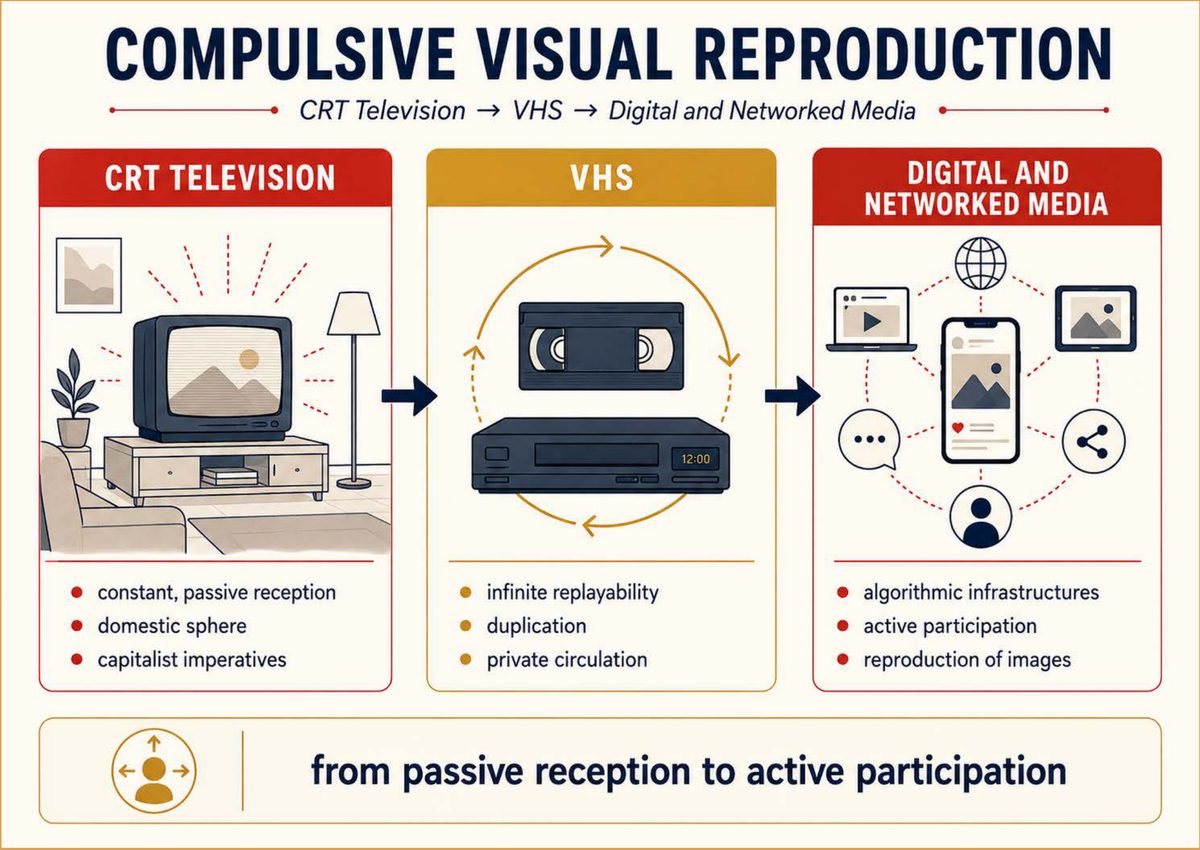
This logic of compulsive visual reproduction did not emerge fully formed in the digital age but finds its historical precursor in the cathode-ray tube (CRT) television, which inaugurated a fundamental shift in capitalism’s image-economy. The CRT television transformed media into a continuous, ambient presence, no longer confined to discrete acts of spectatorship but instead an omnipresent stream of transmission. Unlike cinema, which necessitated an event-based engagement, television instilled a regime of constant, passive reception, embedding capitalist imperatives directly into the domestic sphere. This was not simply an evolution of media but an ontological shift in capitalism’s mode of inscription — no longer reliant on human perception alone but instead operating through an electromagnetic infrastructure of broadcast ubiquity.
Greenspan’s theorisation of the wirelessness inherent to capitalism provides a crucial historical foundation for this shift. The CRT television functioned as an early node in capitalism’s transition from material production to electronic transmission, where economic power resided not just in commodities but in the control of frequencies, signals, and perceptual fields. As a broadcast apparatus, television synchronised entire populations to a unified visual temporality, effectively engineering attention economies long before the algorithmic feedback loops of digital media. More than a device, it was a spectral portal through which capitalism extended itself into lived space, embedding its visual language at the level of infrastructure.
This historical development also marks the moment when thoughtographic capitalism first takes hold. Television images did not merely inform; they functioned as visual contagions, demanding replication not just through direct transmission but through their incorporation into social behaviour, consumer desire, and ideological reproduction. Like thoughtography — where psychic energy inscribes itself onto photographic film — capitalist media imprints itself onto the subject through repetitive exposure, transforming human cognition into an extension of its circulatory logic.
The VHS added a crucial dimension to this process because it extended the continuous, ambient presence of broadcast television into a temporalized, user-controlled archive of spectral transmission. Unlike the CRT television, which dictated visual consumption through real-time programming, the VHS unlocked the potential for infinite replayability, duplication, and private circulation, deepening capitalism’s hauntological command over image reproduction. The VHS system marked a shift from passive reception (live TV) to active re-engagement, allowing consumers to replay, pause, and rewind images in the looping temporality that remains the basic design of algorithmic-intense, social media platforms today. The ability to record and copy tapes introduced a new phase in capitalism’s spectral economy. This hauntological infrastructure, made material in the VHS cassette, finds its most visceral expression in Gore Verbinski’s The Ring, where the spectral logic of reproduction becomes narrativised as horror. Just as The Ring’s cursed videotape requires duplication to perpetuate itself, capitalism’s thoughtographic imperatives found a material form in the VHS cassette — a physical medium for the viral expansion of media content beyond corporate-controlled distribution channels. While CRT television was a public-facing, domestic centrepiece, VHS brought capitalist media deeper into the individual psyche. It allowed for asynchronous consumption, meaning that images could haunt subjects at their own pace, embedding themselves more intimately into personal consciousness. Unlike broadcast television, which dictated a collective, synchronised temporality, VHS created a privatised spectral loop, where the same images could be replayed endlessly within isolated subjectivities, further integrating capitalist media into the viewer’s unconscious.
While the CRT television initiated the mass synchronisation of image-consumption, the advent of digital and networked media has exponentially intensified this dynamic. If television required a centralised broadcast model, contemporary digital capitalism disperses this power across those algorithmic infrastructures that no longer rely on passive reception but instead demand active participation in the reproduction of images. Social media, streaming platforms, and algorithmic feeds do not simply transmit capitalist imperatives — they optimise their reproduction, ensuring that the most memetically potent visual forms achieve the highest levels of circulation. In this transition, capitalism has moved beyond mere ideological interpellation to a fully automated process of self-replicating thoughtographic inscription.
If Baudrillard theorised the precession of simulacra as the death of the real, then thoughtographic capitalism radicalises this disappearance into a spectral materialism: a hyperstitional feedback loop where images do not simply replace reality but become its operational substrate.
Samara’s Ghost, emerging from the CRT TV as she does then, epitomises a techno-capital globalisation par excellence, where survival necessitates aligning with the ghost’s desire: to proliferate beyond terrestrial boundaries whereby the curse spreads not through physical destruction but through its images, creating a monstrous feedback loop of reproduction.
Following a tradition of Japanese monsters, Samara is said to be the human incarnation of a sea demon. However, in both The Ring and Ringu, the oceanic origins of the demon are displaced to the narrative periphery, if not lost entirely. The monster no longer represents a vengeful Gaia rising from the ocean depths to wreak havoc on land; instead, it becomes a psychologically damaging entity emerging from the interiority of a television screen, taking the form of a neglected and traumatised child.
Emblematic of its age, the monster reflects a profoundly nihilistic form of overcoming, where each viewer of the cursed videotape is forced into complicity with the curse, ensuring its endless proliferation. This shift from physical to psychological terror, from ocean to tele-screen, captures the anxieties of a world increasingly defined by media and its inescapable, self-perpetuating logic. In this way, The Ring allegorises a culture in which the image is not just a vehicle of fear but the very condition of existence. To resist the image is to die; to reproduce it is to live on — though in a spectral, mediated form. Galaxy Quest, though formally comedic, deepens this same anxiety: that reality itself has been displaced by a media ontology where the only escape from the real is to become an image oneself.
It is especially noteworthy that this particular golem — Gorignak —representing the desert of the real, cannot be destroyed either. The desert itself becomes a physical entity that Nesmith must escape. This again recalls Kellner’s definition of a Baudrillardian real, where individuals cannot escape — they can only flee. The space Nesmith seeks to escape is a hyperreal, defined not only by technological experience but by the play of hypercultural identities that Byung-Chul Han explores in Hyperculture.
“Digitize me!” Nesmith cries from the desert. “Come on, guys — digitize me!” What does it mean to digitise a person? Here, we see a cry to the astral world of images: in his demand for the physical dismantling of his body and transformation into a digital form, Nesmith’s desire to escape the desert of the real becomes inseparable from a deeper desire — the desire to escape death itself.
When we witness the trauma of death in life — be it through misadventure, suicide, the occasional murder of children by parents who didn’t want them anymore — it becomes all too easy for God to live again. As Emil Cioran writes in The New Gods: ‘A civilization is destroyed only when its gods are destroyed.’ And so, our gods lie dormant on our tongues, ready to slip from our mouths at a moment’s notice. In a culture that cannot quite move beyond sacrality and the dying Referentialism of gods it has rendered almost meaningless, everything is revealed. This is a culture that cannot let go of its gods, despite their absence, because the need to maintain their grasp remains. Likewise, everything is revealed in our attempts to negate death with platitudes: through memorial websites, endless efforts to digitise the dead, sending them beyond even the heaven they were once promised. Ours is a utopia whose ecstasy is so great it cannot let the dead rest in peace. It cannot bear the silence. Where the tomb once channeled the souls of the departed, the ritual of the grave now exists as a hyperspace, disconnected from any other purpose than the continuation of our sepulchral performances in life, a benefit for the still living.
At some point Gwen ushers the Tech Sergeant to the control terminal, urging him to digitise Nesmith from the desert floor. In this moment, Fred’s struggle with his dual identity becomes evident. As he’s subsumed into the narrative, Fred reveals his lack of faith in his existence — both as Tech Sergeant Chen and, perhaps more significantly, Fred Kwan. He hesitates, backing away from the terminal, visibly disoriented, resisting Gwen’s persistence. While the crew bickers, Gorignak corners Nesmith, capturing him by the leg and dragging him across the desert.
The frame transitions once again to show those events taking place aboard the Protector. As the crew turn to acknowledge Fred, the camera follows in their perspective to emphasise a sense of Fred’s sudden isolation from the group. Cowering in the corner of the room, Fred is experiencing a dissociation with his left hand shielding his face from the sudden responsibilities of an identity he now resists. Whereas Nesmith wishes to transcend the desert through this process of digitisation, through this leap of faith, Fred — on the other hand — already occupies that hyperspace as an anomaly of sorts. To say, the real digitisation that takes place within this scene then is the digitisation of Fred Kwan towards his actualisation as Tech Sergeant Chen.
Fred’s positioning within the frame is not insignificant either, with this character placed in the very corner of the room, with the ninety-degree angle of the corner acting as a divide between the visual emptiness on the wall to his right, (the metaphorical representation of Fred Kwan) and the terminal displays on the wall to his left, (the metaphorical representation of Tech Sergeant Chen). In short, this scene concerns Fred’s fluctuation between these two identities, with the emptiness of the real held to his right, and the simulation offered by the hyperreal held to his left. Walking the line between the two, Fred appears increasingly apprehensive in response to Nesmith’s growing expectation, with Fred’s anxiety emphasised in his movement, the incremental steps he takes towards the visual emptiness to his right.
The commander is persistent nonetheless, with Fred taking a few steps towards his left — the hyperspace of screens and images. As Nesmith pleads for his life, Gorignak tosses him aside effortlessly, stripping Nesmith of his shirt. In this moment, Fred succumbs to a state of immiscibility, turning toward the visual emptiness and rejecting the hyper-identity. Shirtless in the desert, Nesmith rises, his confidence swelling as the soundtrack crescendos.
The golem, now preparing to strike, looms over the commander as he stands, inspiring confidence in his crew aboard the Protector. Meanwhile, Fred considers Nesmith’s unwavering faith in his ability to materialise as Tech Sergeant Chen. As Fred hesitates once more, the automatic doors of the control room open, revealing Chen’s love interest, Laliari. Her smile, accompanied by a non-diegetic insert of angels’ chorus, mirrors Fred’s expression. Turning left, Fred finally steps forward to engage with the digital conveyor, his acceptance of the hyperreal now complete. Where Fred’s transformation marks an acceptance of hyperreality as identity, Nesmith’s resurrection reveals the ecstatic core of this condition: a utopia in which the digitised self, stripped of mortal dust, returns not as man but as image.
As Nesmith smiles, then grimaces, Gorignak collapses upon him. We are immediately transported back to the operation room, where the blue radiance of digitisation fills the frame. Nesmith’s body materialises with a bolt of lightning — a person successfully returned from the desert.
Notably, Teb calls out to the Tech Sergeant as though registering yet another reappearance in the room, while the rest of the crew eagerly surrounds the image of their commander returned to them, embracing him, touching him, testing something of his physicality. The commander celebrates as the Tech Sergeant turns to Laliari.
Meanwhile, Alexander remarks on Nesmith’s partial nudity with a facetious charm. They shake hands, smiling and sharing a moment of reconciliation. Nesmith’s partial nudity, here, functions as both a satirical intertextual reference to Captain Kirk’s tendency to lose his shirt and as a metaphorical rebirth in the hyperreal. Stripped of the clothing once contaminated by the dust of the real, Nesmith returns to this world with a visible nakedness, having undergone a digital baptism of sorts.
Nesmith turns to Fred, and one handshake follows another. Fred, pausing in his interaction with Laliari, addresses the Commander.
“Welcome back, Fred.” Taggart gestures, his words emphasising the return of both the commander and the Tech Sergeant in a scene where the crew have — in fact — all returned, bringing from the desert a sense of rejuvenation for that hyperreality into which they flee.
References
Articles
Cooper, Marilyn. (2017). Jewish Word | Golem A Mutable Monster. Available: https://momentmag.com/jewish-word-golem/. Last accessed 19th July 2022
Fisher, Mark. (2010). Terminator vs. Avatar: Notes on Accelerationism. Available: https://markfisherreblog.tumblr.com/ post/32522465887/terminator-vs-avatar-notes-on-accelerationism. Last accessed 19th July 2022
Kellner, Douglas. (First published Fri Apr 22, 2005; substantive revision Wed Dec 18, 2019). Jean Baudrillard. Available: https://plato.stanford.edu/entries/baudrillard/. Last accessed 19th July 2022
Land, Nick. (2017). A Quick and Dirty Introduction to Accelerationism. Available: https://jacobitemag.com/2017/05/25/ a-quick-and-dirty-introduction-to- accelerationism/. Last accessed 19th July 2022
• (2008). Machinic Desire. Available: http://xenopraxis.net/readings/land_ machinicdesire.pdf. Last accessed 19th July 2022
Books
Augé, Marc. (1995). Non-Places: Introduction to an Anthropology of Supermodernity, trans. J. Howe. London: VFatral ambedoerso
Baudrillard, Jean. (2010). America. New York: Verso
• (2002). Screened Out, trans. Chris Turner. London: Verso
• (1994). Simulacra and Simulation, trans. Sheila Faria Glaser. US: The University of Michigan Press
• (1993). The Transparency of Evil, trans. Benedict, J. London: Verso
• (1990). Fatal Strategies, trans. Philippe Beitchman & W. G. J. Niesluchowski. Los Angeles: Semiotext(e)
Cioran, E. M. (2013) The New Gods, trans. Richard Howard. US: University of Chicago Press
• (1992). On the Heights of Despair, trans. Ilinca Zarifopol-Johnston. Chicago: The University of Chicago Press
Cybernetic Culture Research Unit (CCRU), (2017), Writings 1997–2003. Falmouth: Urbanomic
Fisher, Mark. (2021). Post Capitalist Desire. London: Repeater
• (2018). K-Punk: The Collected and Unpublished Writings of Mark Fisher (2004–2016). London: Repeater Books
• (1999). Flatline constructs: Gothic materialism and cybernetic theory-fiction. PhD thesis, University of Warwick
Greenspan, Anna. (2023). China and the Wireless Undertow: Media as Wave Philosophy. Edinburgh: Edinburgh University Press
Han, Byung-Chul. (2022). Hyperculture, trans. Daniel Steuer. Cambridge: Polity Press
• (2021). Capitalism and the Death Drive, trans. Daniel Steuer. Cambridge: Polity Press
• (2015). The Burnout Society. California: Stanford University Press
• (2015). The Transparency Society. California: Stanford University Press
Kellner, Douglas. (1989). Jean Baudrillard: From Marxism to Postmodernism and Beyond. US: Stanford University Press
Land, Nick. (1992) The Thirst for Annihilation: Georges Bataille and Virulent Nihilism. London: Routledge
Zerzan, John. (1996). Future Primitive and Other Essays. Los Angeles: Semiotext(e)
Films
Galaxy Quest, 1999, DVD, Mark Johnson Productions, United States, distributed by DreamWorks Pictures, directed by Dean Parisot
The Pervert’s Guide to Ideology, 2012, DVD, UK, distributed by P Guide Productions, Zeitgeist Films, written by Slavoj Žižek, directed by Sophie Fiennes
The Ring, 2002, DVD, MacDonald/Parkes Productions, BenderSpink, Inc., Vertigo Entertainment, United States, distributed by DreamWorks Pictures (USA/International) and Asmik Ace (Japan), directed by Gore Verbinski
Ringu, 1998, Ringu/Rasen Production Committee, Japan, distributed by Toho, directed by Hideo Nakata
The Thing, 1982, DVD, The Turman-Foster Company, United States, distributed by Universal Pictures, directed by John Carpenter
Television Series
Star Trek The Original Series. 1969. [Video] Hollywood, California, United States: Gene Roddenberry
Video Games
Elden Ring (standard edition). 2022. Microsoft Windows, PlayStation 4, PlayStation 5, Xbox One, Xbox Series X/S. FromSoftware: Tokyo, Japan. Directed by Hidetaka Miyazaki and Yui Tanimura, written by Hidetaka Miyazaki and George R. R. Martin
Videos
Research Network for Philosophy and Technology. (n. d.). Anna Greenspan — China and the Wireless Undertow: Media as Wave Philosophy. Available: https://www. youtube.com/watch?v=0oogfN-Y4k8 Last accessed 12 February 2025
Discover more from BAUDRILLARD NOW
Subscribe to get the latest posts sent to your email.