Jean Baudrillard is much better known around the world than he is among French intellectuals
by Dr. Lucien Samir Oulahbib
Why? Because his work is much more important and profound than that of Michel Foucault or Pierre Bourdieu, the former merely imitating Sade by emphasizing the fascination with violence, the latter endlessly repeating Rousseau’s thoughts on the ultimate causes of inequality among men: the bad influences of “collective” moods, themselves produced by the defense of their status, as Max Weber had already said.
Baudrillard, for his part, attempted instead to unveil, for example, the unthinking but very famous “mystery of commodities” that had greatly intrigued Marx at the outset, considering, like him, that it is above all a fetish, and not simply an object of consumption.
This “talisman” therefore implies reconsidering the function of consumer choice as not only aimed at satisfying “basic needs,” but above all as the image or avatar of our place in the possession of signs expressing our ability (or inability) to have the strength, spirit, and beauty to shine within the “group,” all those things that were so detested by Rousseau, who fled from this seduction, particularly the products of the city, that deep and also dark side of the human soul that every tyranny seeks to control.
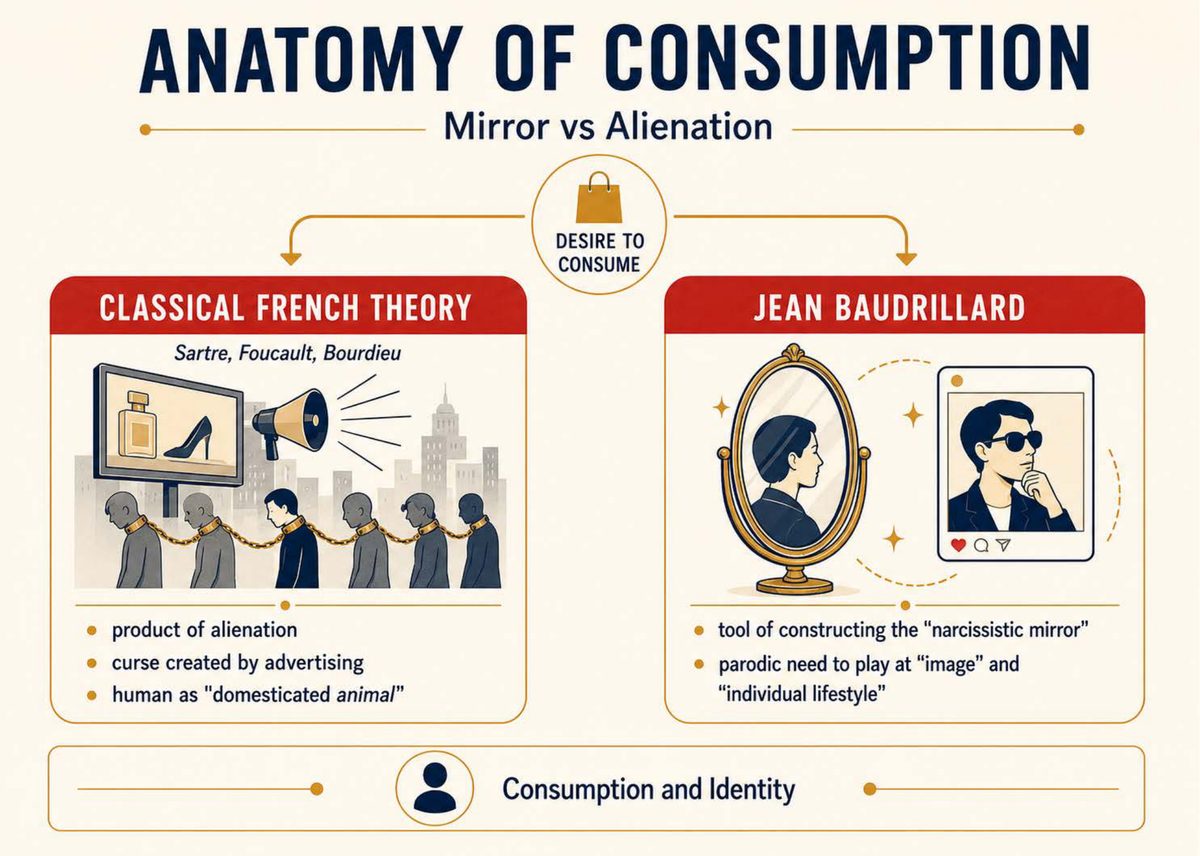
Thus, for Jean Baudrillard, and in stark contrast to Sartre, Foucault, Bourdieu (and all of so-called “French Theory”), the desire to consume is not the product of ‘alienation’
(like a curse) manufactured by “advertising” (that witchcraft), but a tool for constructing all of this as a narcissistic mirror; consumption as a permanent parade of attitudes feeding this parodic need to play seriously at always being someone, as if we embodied a kind of artificial but indispensable “lifestyle,” personified and constantly animated; as if we were a perpetual dream in search of the latest thrilling excitement, striving to be famous and believing that we are a true work of art, when in fact we are nothing more than those “precious ridiculous people” described by Molière, especially when we live in very large cities such as New York, London, or Paris. And regarding the former, Baudrillard expressed that his anxiety and frantic quest to constantly experience every sensation transforms him into a first and very paradoxical return to primitive life, in the sense that all the senses are constantly on aesthetic and erotic alert, not only as a human being, but also as a god capable of becoming a real image, much more so than any future humanoid; what Baudrillard calls the force of human seduction produced by all these vibrations transmitted by all these signs carried by humans and objects and connected to each other, so that everything unfolds in a permanent dream, like an endless film, like giant supermarkets where one has the feeling of being able not only to possess these things, but also to attain what they convey, that eternal dream of abundance that the state claims to offer, but which is of course only an illusion.
Thus, as we see in this Baudrillardian analysis, it seems appropriate to highlight another aspect that is more complicated than this simplistic division between certain consumer products that are imposed by “them” on “us,” we ‘poor’ alienated and domesticated animals, “human, all too human” … And yet, this latter binary vision still dominates all social research and literary fields, even today, in the 21st century. This is why, in the hierarchy of eminent intellectuals in France, all those who profess this kind of simplicity always have priority, like the Leninist generation; especially if, in a final burst of energy, they claim to discover that at the top of “capitalist” alienation are certain “Zionists” who have manipulated all of this…
So when we ask ourselves why Baudrillard’s very subtle thoughts have been set aside, we can understand this: there is a kind of objective and subjective alliance between the current supporters of this type of “sect” who dominate the global pyramid of integrated and initiated elites and the so-called “rebels” “ or ”opponents“ who in reality share the same framework and patterns based on the dissolution of all political and civilizational singularity, but concealed in a false opposition or simulation between ”progressives“ and ‘conservatives’ or ”reactionaries” rather than between sovereigntists and nihilists, which is the real divide.
And when Baudrillard criticized this alliance, for example in political spectacle or contemporary art, which is nothing more than a parade of decorative art, as the painter and sculptor Paul Rhoads also said (see Dogma magazine No. 24), we can see that these false opponents just want a bigger piece of the pie, without asking themselves how to make it grow in a healthier way.
Today, some of them, but in a suicidal manner, and because they are still unable to provide solutions to these ongoing problems (or as Leo Strauss put it: how to live together without constantly killing each other), some who had already failed with the idea of communism (and now jihadism and deep ecology) are becoming increasingly nihilistic (rather than “progressive”) and now want to make the ‘pie’ of growth disappear, at least for the “others “ (rich and poor), but not for themselves, comfortably ensconced in the state at the top of Himalayan debts, imploring ”Apocalypse Now” as a final spectacle.
But when Baudrillard denounced their sad strategy, he was immediately sidelined, for example when he edited the famous Beaubourg magazine “Traverses” and also when he wrote in the highly reputed Gallimard collection known as “white,” at the very moment when he was criticizing Foucault’s ideas, which are in reality very reactionary (just like Bourdieu’s), always considering that the real problem was “power” itself (“it must be broken, not used otherwise,” Foucault had said). They never ask themselves how power can be well organized to truly act for the people, and not just for the false elite (because it has done nothing but serve itself, as we see with growing corruption). In fact, all criticism has been recycled as a tool to diminish rather than protect citizens, to prevent the modern spirit, which runs through all eras, including our democratic era, from acting correctly with originality and innovation.
This is why, in France for example, all thinkers who attempt to analyze the complexity of our urban civilization, because it cannot be reduced to a simple binary opposition between good and evil, are sidelined. For example, in the French university and school system, students learn about Foucault and Bourdieu, who mainly imitated the young Marx and his thinking on “alienation,” rather than studying a true thinker like Baudrillard, who seeks to understand (perhaps as Georg Simmel did before him) not only “the object” as a “living symbol,” but also the mystery of property and money; and how to live in a reality fabricated both by us and by our increasingly effective tools for introducing, in a very intelligent way, the exciting confusion between the real and the simulacrum, as artificial intelligence and “cyborgs” show us every day.
Baudrillard once said that it is not “reality that overwhelms fiction,” for example when an exceptional situation arises, but rather that its simulation wants us to believe that it is the only reality (like the devil, said Baudelaire, who makes us believe that he does not exist), especially when it wants to impose that its products are simple objects among others.
We are living entirely in Orwell’s 1984, where it would suffice to produce ever more tons of anything, to win ever more wars, and to fight over sharing the spoils “fairly” in order to achieve the “good life,” even knowing that some are more equal than others (as in Animal Farm, Orwell’s other famous book).
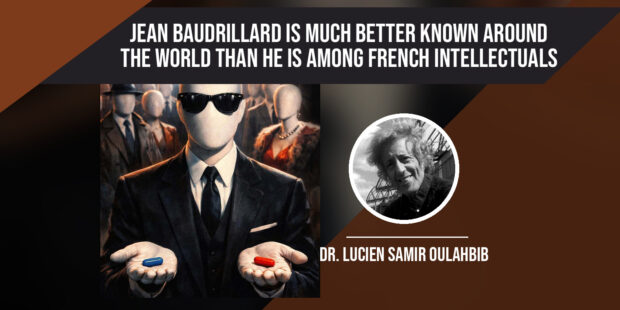
Thus, as we see every day, there will be an ever-widening gap between Reality (red pill) and Simulacrum (blue pill), with many Mr. Smith searching for deviants who claim to have left the “cave” to say that the simulacrum is not reality…
Discover more from BAUDRILLARD NOW
Subscribe to get the latest posts sent to your email.