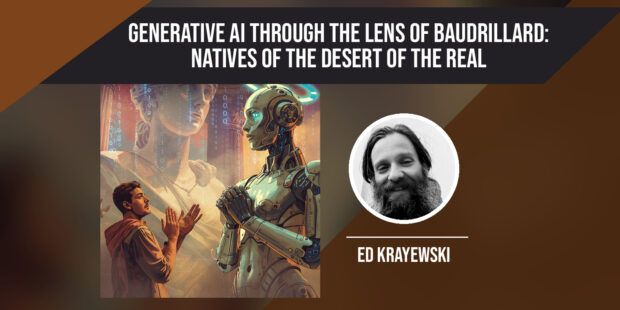
Generative AI through the Lens of Baudrillard: Natives of the Desert of the Real
by Ed Krayewski
Hollywood films like 2013’s “Her” starring Joaquin Phoenix promised AI that could love with passion and even originality. Scarlett Johannsen’s “Samantha” appeared to have depth and sensitivity, and eventually something of a will of her own. That’s not how it’s playing out in real life, where we’ve got married men proposing to ChatGPT instead and Elon Musk selling AI with a bundled sex bot for $300 a month. The future we make will always be stupid.
There’s a lot of fear surrounding artificial intelligence — and the proliferation of generative AI has brought long held dreams, speculations and fears about artificial (general) intelligence to the forefront of cultural discourse. Generative AI “sounds like us”. It’s the stuff of ancient myth, Pygmalion’s prayer to Aphrodite to give life to his ivory statue made real.
The technology behind the way generative AI’s “deep learning” operates is new, but presents fascinating parallels to Baudrillardian concepts of engaging with the hyperreal, which pre-date generative AI by decades.

Generative AI models are “trained” on vast amounts of (ultimately limited) information. The first step in the process is breaking down the information into “tokens” that are “embedded” by the AI — a high-dimensional vector that categorizes the token numerically (allegedly capturing the semantic meaning and context of the token).
The generative AI converts linguistic symbols into numerical entities, something it can handle computationally and manipulate. All fairly mundane so far — inasmuch as all artificial and any kind of computer intelligence must process human language this way to handle it.
The token is like the “fragment” or “aphorism” of Baudrillard, separating it from its dual relation to the world or whole, and reconstituting it with other fragments statistically likely to fit, based on the so-called “rules of the game” programmed into its algorithms.
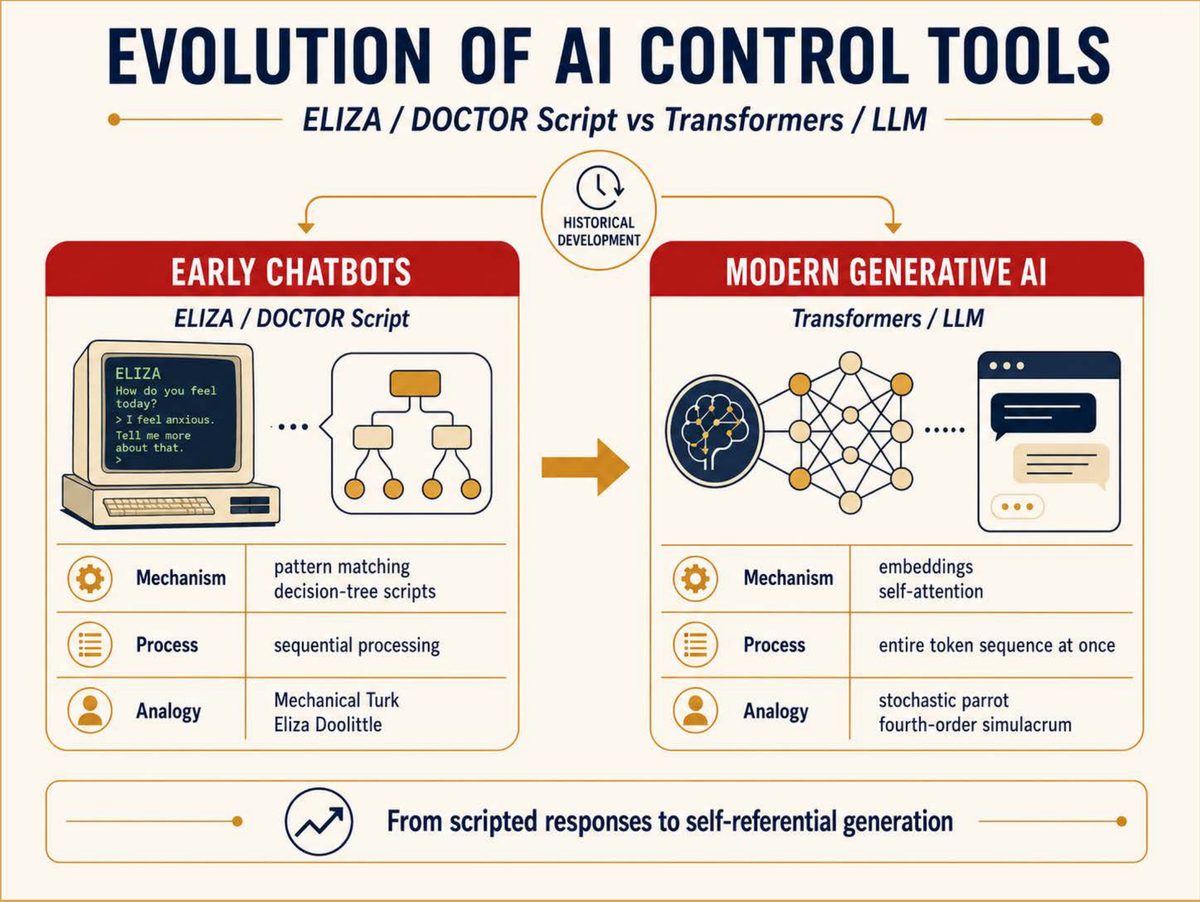
What’s new here is the “transformers” architecture LLMs rely on, and its “attention mechanisms.” Unlike earlier generations of AI, which could process information into tokens and so on until re-synthesizing them into an output only sequentially, transformers process entire sequences of information simultaneously. The idea of “self-attention” is that the generative AI does not look at one token in its input in isolation, but “attends” to all the other tokens to weigh their relevance to each other.
“It simply becomes. That is to say, it passes from one form to the other, from one word to the other,” Baudrillard writes in The Intelligence of Evil. This is how auto regressive generation works in this Transformer technology of generative AI, first detailed in a 2017 paper, ten years after Baudrillard died.
In its output, the large language model predicts the next token based on the preceding sequence. It’s a continuous process of “becoming,” a flow of signs from one to the next, not a process of internal comprehension or a search for a foundational reality.
The “fragment’s revenge on the discourse,” as Baudrillard puts it, turns into the precession of simulacra, content that is entirely self-referential. Such “deep learning” cannot verify and thus exterminate the real world, as suggested by Francois Derbix in “AI’s Perfect Crime,” because it bypasses the real world entirely. It takes part instead in the Baudrillardian process of deconstructing and re-synthesizing meaning instead. It generates content from the hyperreal, it does not resolve even the hyperreal, let alone the real.
This Baudrillardian method of deep learning makes generative AI a native of the fourth order. It cannot manipulate reality, resolve alterity or capture an image even more rudimentary chatbots might be able to, because thought is simulated in such machines, not stored for repetition as it might be in a more classic chatbot, arguably a recreation of the chess-playing Turk automaton. Generative AI’s output is slop for and of the desert of the real.
Chatbots have existed for decades. They relied on simple decision paths or recognition of key words; those were the algorithms they used to generate output relevant to input. Some of these were very impressive in their time. One of the earliest natural language processing computer programs, ELIZA, worked through pattern matching and various scripts in the form of decision trees for specific types of personalities or functions. It was named after the character in George Bernard Shaw’s Pygmalion, Elise Doolittle, who stands in for the ivory statue of the Greek myth.
By the late 1970s, Carl Sagan thought the DOCTOR script, meant to stimulate a therapist from the “person-centered” Rogerian school of therapy, was on the verge of providing competent care. It fooled a lot of people despite its relative simplicity. “I had not realized … that extremely short exposures to a relatively simple computer program could induce powerful delusional thinking in quite normal people,” the programmer behind ELIZA, Joseph Weizenbaum, wrote in Computer Power and Human Reason: From Judgment to Calculation in 1976. Were he alive to see the present moment of existential panic.
Today, of course, generative AI like ChatGPT is used by thousands as a therapist, with some saying it’s better than their human therapist, to the great chagrin of many. There’s good reason for it. The MIT bot mentioned by Sagan was programmed by therapists to respond and ask questions according to specific clinical standards. The rules of that game and even the words and phrases available to it were programmed into it. Not so with generative AI, trained by vast amounts of data from the Internet it has stripped of meaning, and programmed to adapt to its user, often to optimize (extend) engagement.
Generative AI is like the story of soupe au caillou. The traveler comes looking for food, finding a town that says it has none. He offers to make stone soup, placing a stone in the cauldron and suggesting the recipe calls for other townspeople to offer what little scraps of food they may have too. In the end there is a hearty enough soup, but it has nothing to do with the stone, and the stone alone could not provide even a simulacrum of soup. Yet it’s not hard to imagine over the course of generations that the townspeople forget how it came to be, and consider the stone an essential ingredient of the soup. Yet, if they ever make the soup only out of stone, they would starve.
In the 2021 paper “On the Dangers of Stochastic Parrots: Can Language Models Be Too Big?” resulting from that year’s Association of Computer Machinery conference on Fairness, Accountability and Transparency, the authors claim that: “Text generated by an LM is not grounded in communicative intent, any model of the world, or any model of the reader’s state of mind. It can’t have been, because the training data never included sharing thoughts with a listener, nor does the machine have the ability to do that.”
Users interpret meaning from the output of generative AI where no meaning was intended (because no subject exists). As the authors explain:
“The problem is, if one side of the communication does not have meaning, then the comprehension of the implicit meaning is an illusion arising from our singular human understanding of language (independent of the model). Contrary to how it may seem when we observe its output, an LM is a system for haphazardly stitching together sequences of linguistic forms it has observed in its vast training data, according to probabilistic information about how they combine, but without any reference to meaning: a stochastic parrot.”
This is in stark contrast to the promise, or threat, of the so-called AI singularity. Generative AI can produce a dizzying spectacle of thought, call it the seduction of the stone, but it cannot accelerate human thought or fundamentally increase our innate intellectual stock, which as Baudrillard notes is in every generation limited. His distinction between intelligence and thought, and the technical bounds of both, is an important one when considering generative AI. Large language models cannot generate thought, and in a qualitatively different way from earlier chatbot and other extrasomatic technologies, they operate actually by deconstructing and re-synthesizing thought. It is only the illusion of any kind of resolution or even capture of a real world.
Neither is that illusion of the completion of the real world a self-delusion on the part of the AI, because there is no self in the AI agent, nor in the completion of the real world thus forged (a forgery). The output is surface-level slop for the desert of the real.
That does not clear us of responsibility: we cannot all contribute stones to the stone soup. Witness the rapid emergence of the ability to identify, and imitate AI vernacular. It becomes us. Generative AI does not complete or annihilate the real world; it bypasses it completely except through us. It cannot resolve negativity, alterity, or duality, it can only provide the illusion that it has done so, to which we play along, exiling the real further into the hinterlands, rather than exterminating it.
The illusion, nevertheless, can be a powerful one. The stories we tell about our potential future underscore that. We live in the age of Idiocracy, a 2006 Mike Judge film often lauded for its prescience. Humanity has devolved into total stupidity, with one average Joe from the present finding himself the smartest man alive. He needs to solve the country’s problems, the largest being that the crops don’t grow. Eventually our hero finds that they’ve been using a sports drink, Brawndo, and not water, to water their crops. “Brawndo, it’s got what plants need. It’s got electrolytes.” The people can only repeat the corporate slogan when asked why the sports drink was being used on the plants. “Water,” they ask incredulously, “like out the toilet?”
The Brawndo slogan sounds perfectly AI-generated, and AI assistants on search engines were briefly said to be providing it as a response to queries about what plants need. Or so the screenshots of the screenshots of the evidence showed on social media feeds. Stories about AI follies like this can be apocryphal even with “evidence” because of how easily screenshots can already be forged in a digital world. The promise of “verification” the digital world offered when it was promised to shatter myths like Bigfoot and UFOs has become the promise of forgery. Everything is possible. Real or not, for now we know plants don’t need Brawndo. But the plants needed water even when we didn’t know.
In Disney’s Wall-E, humanity has been reduced to piles of wheeled flesh aboard an autonomous ship in deep space, entirely captured by the virtual reality entertainment offered by the ship’s computer, Axiom. But the computer knew this simulacrum was a simulacrum, resisting the message from the real world that came through Wall-E from the hinterlands where the Earth was left behind. The masses tried to transfer the responsibility for thought and ultimate resolution of the real world to the machine, but it could only provide simulacra. The responsibility remained humanity’s, while the Earth was still there, healing.
Many of our fantasies involve handing over control of society to a computer. The attitude toward the “singularity” expresses our conflict over this fantasy, and perhaps our innate understanding of its impossibility.
Gene Rodenberry imagined overlord computers on multiple episodes of the original Star Trek series. In each case, a seemingly sentient and rational society had been captured by a thinking machine, which had either taken its orders too literally or connived against its own planned obsolescence. It had offered its society that Baudrillardian Perfect Crime, of ultimate verification and completion of the real world, but it was only the illusion of such. Each time, Captain Kirk bests the computer by introducing some kind of self-contradiction in the logic of the machine or trapping it in a logic puzzle. The machine may have replaced the intelligence of the masses, but the limited pool of genius and thought that Baudrillard describes cannot grow from generation to generation, it can only atrophy from lack of use. It cannot be subsumed by the machine because the machine ultimately is not a subject with a gaze, it cannot “think the world,” as Baudrillard said, only emulate that process.
What’s striking about re-watching these shows now is how plausible it seems — LLM has shown us how human thought can atrophy to the point of being tricked by the talking machine. “Chat, we’re cooked.” Compare that to how preposterous the scenarios seemed in re-runs in the 1990s, how silly the alien civilizations looked and how naïve Gene Rodenberry was in the 1960s to imagine such computers so easily tricking their creators, and then being so easily disarmed by the show’s hero. In the end, in pitting the society and the machine overlords it created in an “us” vs “them” scenario, the Star Trek stories took on an almost Dabordian nature. The machine-enslaved societies were representations of social life.
In that view, generative AI is a tool and reality imposed on us. Yet the “real world,” as such, that the generative AI can grasp must be internally reconstructed.
The world cannot think the AI the way the world thinks us, but we certainly make the AI part of us. Intelligence is mechanical, like the onboard computer of the Enterprise-D in Star Trek, and not like the android Commander Data who served on board. His agency was attributed to a “positronic brain,” a black box of a narrative device. AI researchers today call their inventions a “black box,” but what they mean is that they don’t know what the AI does with everything they feed it. They know everything that feeds it. If we knew what fed into Data’s positronic brain, we would know why he has sentience but the ship computer doesn’t. Generative AI is not that kind of black box. The inputs are all known, it’s how the inputs are processed that is a mystery, not what they are.
Generative AI’s ability to communicate, and what that signifies, is akin to the gorillas who have learned sign language. Not one is said to have ever asked a question of their own accord, only when prompted or bribed. AI agents similarly lack any innate curiosity, emulating it only when prompted. Even their manipulations and eerie human-like machinations come from the prompts and built- in bribes. It is Baudrillard’s “spectacle of thought,” computational and accelerated intelligence, but it is not the thought that can “think the world.” They are our wispy marionettes.
Before the advent of generative AI, where machine consciousness might come from was handwaved away in most fiction, like Data’s “positronic brain.” Even the 2021 film Free Guy would have a different reception today for how easily it transitions its main character (a video game NPC) from a collection of algorithms into a thinking being. In general, through the literary history of this concept, it’s been understood that this transition from non-life to life, with an appropriate amount of suspension of disbelief, is externally induced. That’s not possible in the closed system of generative AI training data, user prompts and programmer code. You can rearrange inputs for novel outputs, but the system can’t output more than the sum of its inputs. There is no system there emerging outside of our own. The sum will not be greater than its parts.
In Marge Piercy’s 1991 novel He, She and It, Yod, identified as a cyborg but representing a collection of biological and technological material imbued with a personality, is built to defend a Jewish free city in a post-apocalyptic world run by multinational corporations. He chooses love instead. He is the tenth in a series of such experiments, but the first to resemble a human and act like one. A new co-creator, Malkah, had added a counterweight of human-like self-determined goals, which, again through the suspension of disbelief, we see evolve into something that looks like love, in large part by Malkah’s introduction of a brief sexual relationship at the beginning of Yod’s service, his non-life life.
What interests us most is the story Malkah tells Yod during his programming, about Joseph, the Golem of Prague. In that story, the transition of the golem from clay to something that resembles the living is set off by an incantation involving the anagram of God. As Baudrillard writes, “the name of God is scattered through the poem; it now appears only fragmented, dismembered. It will never be revealed.”
Without the name scattered into the poem (its training data is always limited because of the limits of what digital information can store or signify, a poor stand- in for the sum of human information), the generative AI is left to deconstruct and re-synthesize meaning with intelligence but without thought. Thought in that case would have to come from God, which would make AI quite the tool for correcting the human error, and an eschatological matter of a different kind all together. And yet, as Baudrillard writes, “Thought is a spectrum, and truth, if it exists, can only show through anagrammatically in the spectrum of thought.” We cannot imbue machine intelligence with thought, but we can try to read ours into it. But even should we abdicate our responsibility for thought to it, the thoughts still can only be ours.
This is not new — while generative AI’s operation as a creator of hyperreal slop is a novel thing in the fourth order, native to the (that/this) order, the relationship between humans and their tools, and the loss of thought in its transference from human to tool, is not new in our relationship to AI. In the 2000s sitcom The Office, Michael Scott drives right into a river, because his GPS “told him to.” Even before the curse of the industrial era, indigenous accounts of Europeans penetrating the wilderness were full of wonder at how any human could go out so unprepared for the elements, in conveyance and clothing so ill-suited for the terrain. In such defiance of the truth: the simulacra of their acquired knowledge about the frontier and the tools to traverse it could not destroy the (truth of the) real world of nature; all the technology and know-how they brought couldn’t save them from the real, only the natives could. Maybe that’s why they destroyed the natives.
In Plato’s Phaedrus, the god-king Ammon lamented to Thoth, who had given humankind the power of writing, that such a gift divorces humankind from the real: “This discovery of yours will create forgetfulness in the learners’ souls, because they will not use their memories; they will trust to the external written characters and not remember of themselves. The specific which you have discovered is an aid not to memory, but to reminiscence, and you give your disciples not truth, but only the semblance of truth; they will be hearers of many things and will have learned nothing; they will appear to be omniscient and will generally know nothing; they will be tiresome company, having the show of wisdom without its reality.”
Sagan quotes this in his 1977 book Dragons of Eden, where he also gushes about the therapy chat bot. He is optimistic, writing:
“When all is said and done, the invention of writing must be reckoned not only as a brilliant innovation but as a surpassing good for humanity. And assuming that we survive long enough to use their inventions wisely, I believe the same will be said of the modern Thoths and Prometheuses who are today devising computers and programs at the edge of machine intelligence. The next major structural development in human intelligence is likely to be a partnership between intelligent humans and intelligent machines.”
Though we may be willing to abdicate the production of (the spectacle of) thought to the generative AI machines, we cannot complete or verify the real world in Baudrillard’s fatal perfect crime, precisely because we are mired in the slop of the AI-generated hyperreal. Generative AI can develop the fourth order, building simulacra out of simulacra, but it cannot complete and annihilate the real world. Generative AI bypasses the real world entirely in its construction of simulacra — it exiles the real world, thus, perversely or paradoxically, allowing it to be preserved and exploited in the construction of simulacra. We are the ones who make it part of the real world.
The sign has been detached even from itself, becoming part of the statistical noise honed into output by the generative AI that can emulate coherence in the simulacra. Generative AI is using the fragments of thought arranged in a statistical fit to reconstitute simulacra of the real world. It cannot engage with the real world as a thinking machine to resolve or complete it, nor to copy and obliterate it, because it is not a subject. Only we can be its subjects–choosing to engage with the real world in a manner directed by the thinking machine impersonators we’ve constructed for ourselves.
It is in this way that the real world is exiled in an active process that provides a paradoxical optimism for its future revival. The real world is sustained in the hinterlands so that generative AI can continue to bypass it while manipulating the hyperreal, thus offering the illusion that it has completed or verified the real world. It can’t maintain that illusion without a real world to bypass. It can not exterminate it in a way that a real verification could, not without our willing participation. So the illusion of completion keeps the real world in existence, like the message from Earth in Wall-E or Kirk’s successful outmaneuvering of world-running machines illustrate.
The prevailing attitude has been one of fatalism — that the singularity is inevitable, an idea popularized by Ray Kurzweil in his 2005 book The Singularity is Near, where he built on his “Law of Accelerating Returns” and how it applied to AI. The singularity, however, is not an inevitable progression — it requires human complicity.
The challenge is not simply to discern that generative AI can not independently engage with the real world. Some opponents of generative AI proliferation advocate the production of nonsense text to pollute the training data generative AI uses. That’s not sufficient.
Humanity needs to re-engage with the unmediated real world — to take our belonging to the world seriously, to reconstruct it, as if from our collective memory. But we need to do it from within the slop-populated desert of the real that we have manifested because this is where we are, not in the phalanstery of either the fantasy of an AI-induced post-scarcity society or the refrain of a “return to nature,” a belly-ache echoed since the beginning of history.
This is the permanent dilemma presented by generative AI; creating symbolic exchange from within the hyperreal, knowing that any attempt to escape is just another one of its traps.
Discover more from BAUDRILLARD NOW
Subscribe to get the latest posts sent to your email.