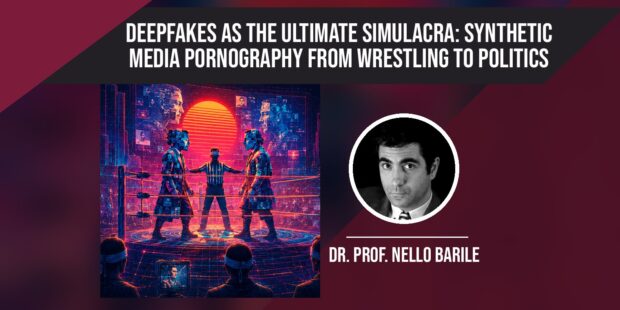
Deepfakes as the Ultimate Simulacra: Synthetic Media Pornography from Wrestling to Politics
by Dr. Prof. Nello Barile
A wrestling match between blind people. The referee is blind too. The spectators also. And the whole thing takes place in the dark (this last condition is superfluous).
— J. Baudrillard, Cool Memories
For years, the issue of deepfakes primarily revolved around alarming topics like the displacement of creative jobs, the visual proliferation of fake news, or face-swapping, where the faces of famous celebrities or ordinary people are superimposed onto pornographic content. After a long period of moral panic surrounding AI-mediated images, Black Mirror once again pushes the discourse into far more illuminating imaginative territories. The first episode of the new season, “Joan is Awful,” explores the interdependence between the physical and digital worlds, between daily reality and fiction. In a brief introduction, we glimpse Joan’s life as she’s forced to coldly fire a former friend and, even hypothetically, betray her partner with an ex. That evening, on the couch with her partner, Joan discovers key events from her day replayed in a TV series produced by the disconcerting Streamberry platform (a stand-in for Netflix itself).
The “Joan is Awful” series depicts the life of this unfortunate victim who, by “flagging” and not reading the informed consent agreement for data cession (much like a memorable South Park episode), has agreed to a very special treatment: her entire life can be reprocessed using quantum computers and AI to create a super deepfake series. In this series, everyone’s life is re-experienced by multiple characters, arranged on different ontological levels, in a continuous loop between the interpreter and the interpreted. The loop, of course, short-circuits when the object (Joan) meets the subject of the representation (Salma Hayek). The series highlights the potential consequences of a reckless integration of platform content, AI, deepfakes, the celebrity world, and the presumed centrality of the user, all justified by the need to extract and process data produced from “real” reality. As the narrative eminently shows, deepfakes populate this new “hybrid” communicative ecosystem (Barile 2022), characterized by:
- A “phygital” dimension that merges the real and virtual in various ways.
- A customer-centric regime that personalizes experiences for each user.
- An “empathic media” function that allows for interpreting the emotional dimension of data.
- Synthetic creativity capable of reinventing possible worlds from historical data series.
All the four dimensions are somehow predicted but not completely connected by Jean Baudrillard. In the popular description of the evolution of Simulacra, the French master states:
- simulacra that are natural, naturalist, founded on the image, on imitation and counterfeit, that are harmonious, optimistic, and that aim for the restitution or the ideal institution of nature made in God’s image;
- simulacra that are productive, productivist, founded on energy, force, its materialization by the machine and in the whole system of production — a Promethean aim of a continuous globalization and expansion, of an indefinite liberation of energy (desire belongs to the utopias related to this order of simulacra);
- simulacra of simulation, founded on information, the model, the cybernetic game — total operationality, hyperreality, aim of total control.
Ever since daily life became the central category in media representation, from classic storytelling to the story-living of current metaverse video games, artificial intelligence has proven particularly voracious in its ability to consume the experiential content of ordinary people, transforming it into data capable of training AI applications. Thus, the true pornography is increasingly that of everyday life.
Graham Meikle’s recent book Deepfakes (Polity, 2022), offers a perspective midway between media archaeology and the analysis of the imaginary. These “radical technologies” (Greenfield 2017) are comparable to older technologies, like electricity, which only after their massive diffusion truly transformed society. This is why it makes sense to study them now, at the dawn of their global assertion. The author uses remix culture as a principle to explain deepfakes, aligning them with the history of other creative practices, from Culture Jamming pranks to memetics. But deepfakes go far beyond what was once defined as convergent culture and/ or the participatory one (Jenkins 2009).
The unlimited dataset of images, videos, and texts we’ve shared through social media… is the raw material through which AI systems are trained to recognize, classify, and recreate images. With adequate density, these networks are capable of generating entirely new images: copies without an original (ibid, p. 6).
For fans of Jean Baudrillard (surprisingly not cited by Meikle), the definitions of simulacrum proposed in Simulacra and Simulation (1981) will resonate.
While at the time few understood the meaning of self-referential images generated by a numerical matrix without any external reference, today this idea, is easily observable in the evolution of deepfakes. In one of Baudrillard’s most popular tales, even promoted subliminally in the first Matrix, “The desert of the real” is connected to the allegory of the Empire. The equation suggests a correlation between the supreme form of imperial aims which is the one of the expansion of simulation everywhere, and the more traditional sovereignty which is the one described in Borges’ fairytale. In fact “it is with this same imperialism that present-day simulators attempt to make the real, all of the real, coincide with their models of simulation.” The overlapping of the model and the real is a profoundly violent process which emphasizes the key role of the model, of the codes and the matrix.
The real is produced from miniaturized cells, matrices, and memory banks, models of control — and it can be reproduced an indefinite number of times from these. It no longer needs to be rational, because it no longer measures itself against either an ideal or negative instance. It is no longer anything but operational. In fact, it is no longer really the real, because no imaginary envelops it anymore. It is a hyperreal, produced from a radiating synthesis of combinatory models in a hyperspace without atmosphere. By crossing into a space whose curvature is no longer that of the real, nor that of truth, the era of simulation is inaugurated by a liquidation of all referentials — worse (ivi, p. 1-2).
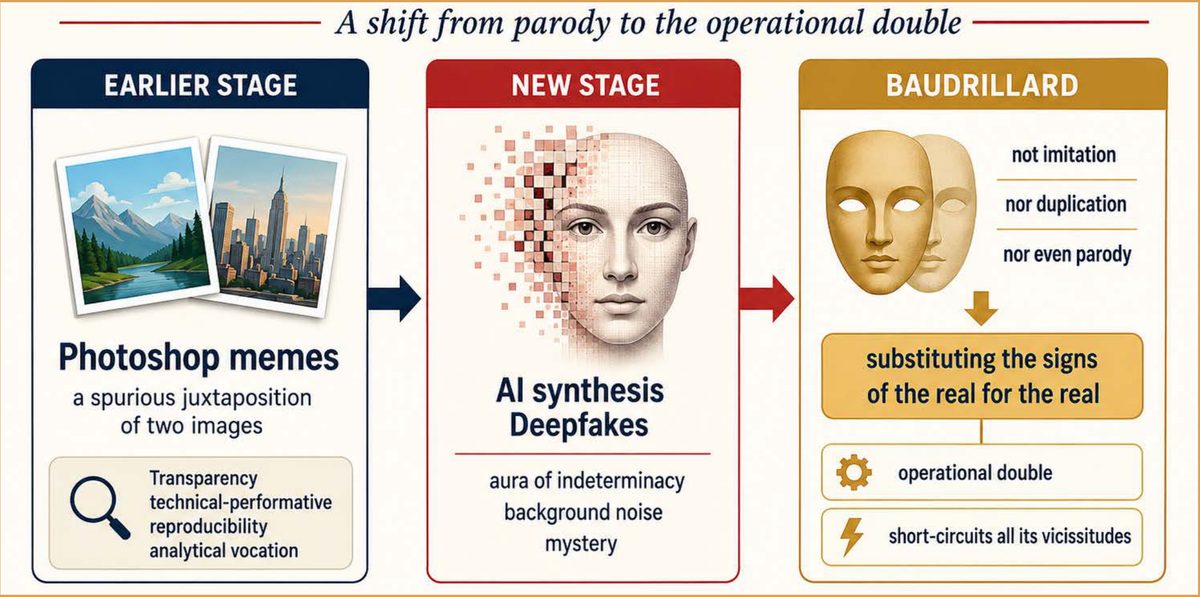
It is no longer a question of imitation, nor duplication, nor even parody. It is a question of substituting the signs of the real for the real, that is to say of an operation of deterring every real process via its operational double, a programmatic, metastable, perfectly descriptive machine that offers all the signs of the real and short-circuits all its vicissitudes (ivi, p. 2).
Never again will the real have the chance to produce itself — such is the vital function of the model in a system of death, or rather of anticipated resurrection, that no longer even gives the event of death a chance. A hyperreal henceforth sheltered from the imaginary, and from any distinction between the real and the imaginary, leaving room only for the orbital recurrence of models and for the simulated generation of differences (p. 3).
Meikle refers to the launch of the first iPhone and its facial recognition system as an example of the widespread diffusion of synthetic media (Meikle 2022, p. 22). With this term, we can refer to “images, audio, or videos that are generated by Artificial Intelligence processes” (ibid, p. 24).
The author engages in a long discussion on synthetic porn, produced by AI systems, which can take various forms. This includes non-consensual porn featuring The Avengers heroes (ibid, p. 44) placed in pornographic contexts, which garners incredible success in terms of searches and views on Pornhub. Or, in its everyday variant, revenge porn performs the same substitution, but this time with close, known, and/or intimate acquaintances. In both cases, the misogynistic nature of certain apps, like FakeApp and DeepNude, used for the creation and distribution of non-consensual sexual content, stands out (Gosse & Burkell 2020).
Although it may seem an “extreme” case, synthetic porn in reality adopts the same logic as official business, based on the exploitation of a celebrity’s image through multiple channels. This means the appropriation of their image, its editing in unconventional contexts, and its promotion in the public sphere (Meikle 2022, p. 45). A considerable number of platforms and applications operate in this sector: from Mrdeepfake, the most frequented community with the largest number of pornographic and nude versions related to famous stars like Emma Watson (around 478 contents), to CelebJihad, which aggregates authentic pornographic or nude content, associating it with “aggressive and illicit” commentary (ibid, p. 68).
Sexual performance is classically characterized by at least two predominant aspects: the immediate activation of desire and the technical efficiency of its staging (Breton 1995). A scientistic vocation that uses technique and video to make evident what is not real, thereby nullifying the captivating charm of illusion.
Pornography adds a dimension to the space of sex, makes it more real than real — in this lies its absence of seduction (…). One sees it too closely, one sees what one had never seen (…) by effect of the anatomical zoom, the dimension of the real is abolished, the distance of the gaze gives way to an instantaneous and exasperated representation: that of sex in its pure state, end of prospective space, which is also that of the imaginary and of fantasy, end of the scene, end of illusion (Baudrillard 1979, pp. 37-38).
If old pornography was primarily about transparency, technical-performative reproducibility, and analytical vocation, the game of masks introduced by deepfakes reintroduces an aura of indeterminacy, background noise, and mystery into the world of AI-dominated high-tech creativity.
We could list multiple nuances of deepfakes that also involve the world of memes. Politics is one of the fields where deepfakes proliferate regarding the most significant events of the moment. Images of Trump being captured by American police, or of the Pope transformed into a trapper, are significant examples of how AI can read certain elements of human emotionality to transform them into a specific image layout. In a much more “fake” than “deep” way, AI adds a touch of glam sensuality to American political figures, transforming them into performers somewhere between Elton John and drag queens in the memorable “Make America Glam Again.” Deepfakes emphasize and amplify the already established “horizontality” of the communicative-spectacular system and facilitate the democratization of images, both of celebrities and ordinary people. Both, after all, are susceptible to being simulated or recategorized into a story that is other than themselves. The difference between memes created with Photoshop, as a spurious juxtaposition of two images, and the synthesis performed by AI is increasingly evident (Vaccari & Chadwick 2020). Take the case of Evgeny Viktorovich Prigozhin’s great renunciation, metaphorically immortalized by superimposing his face onto Forrest Gump’s, when after miles of meaningless marathon, he invites everyone to go home. This is quite different from the prank cyberattack on Putin announcing the invasion by Ukrainian troops of the Kursk, Belgorod, and Bryansk territories, declaring martial law and urging residents to flee, in a War of the Worlds style read by Orson Welles. Prigozhin himself, a few months before the invasion, railed against audio deepfakes, accusing neural networks of performing miraculous mixes of true phrases with false ones he would never have uttered (Bershidsky 2023).
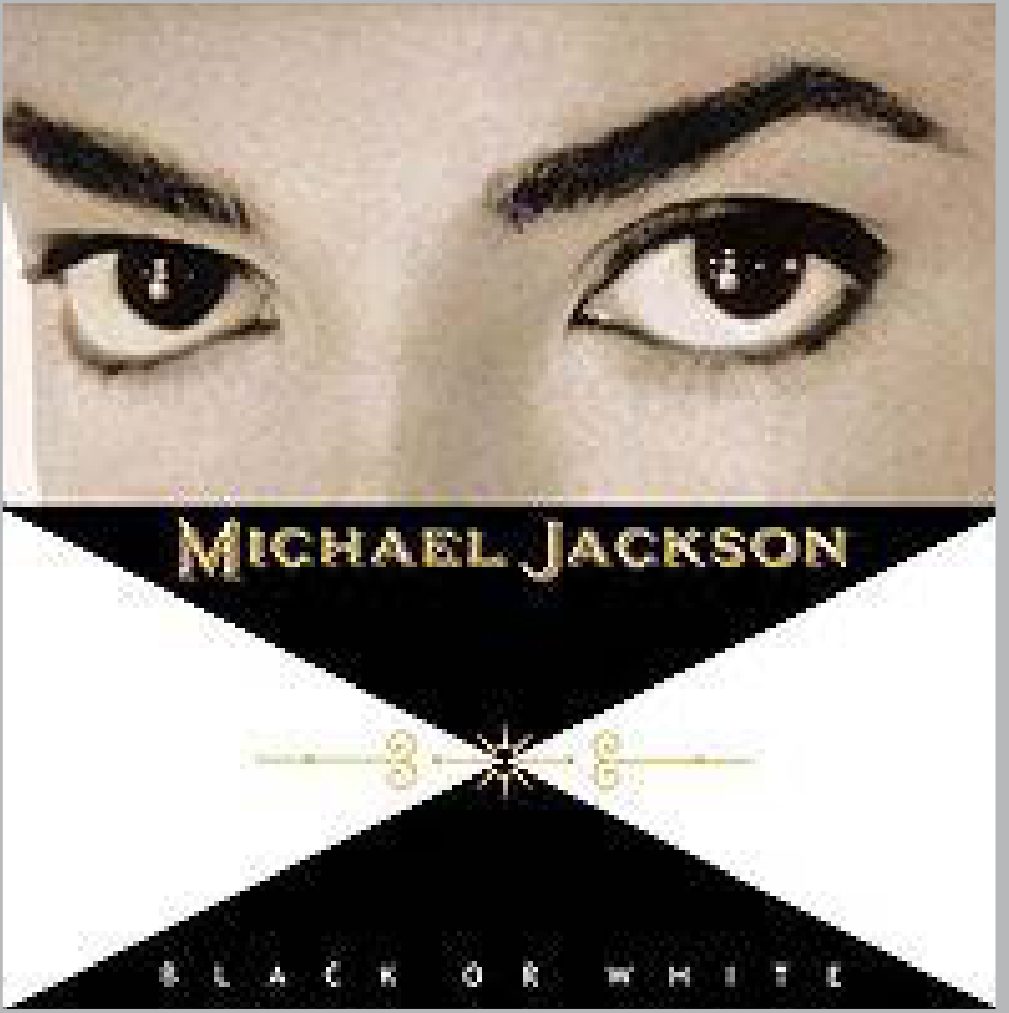
Until the 1990s the same disorienting effect was achieved through morphing, which allowed for the fluid superimposition of multiple identities. One of the most popular examples of morphing has been Michael Jackson’s music video “Black or White,” in which the king of pop shifts into different identities, ethnicities, genders, ages etc. to suggest a sense of fluidity and inclusivity, in some way forerunning the actual debate on woke culture. Before the video, Baudrillard already described the pop star in a very powerful and prophetic way.
“Michael Jackson is a solitary mutant, a precursor of a hybridization that is perfect because it is universal — the race to end all races. Today’s young people have no problem with a miscegenated society: they already inhabit such a universe, and Michael Jackson foreshadows what they see as an ideal future. Add to this the fact that Michael has had his face lifted, his hair straightened, his skin lightened — in short, he has been reconstructed with the greatest attention to detail… This is what makes him such an innocent and pure child — the artificial hermaphrodite of the fable, better able even than Christ to reign over the world and reconcile its contradictions; better than a child-god because he is child-prosthesis, an embryo of all those dreamt-of mutations that will deliver us from race and sex.” — (Baudrillard 1993, p. 21-22)
The current disorientation produced by deepfakes is even more radical than morphing, testifying to a kind of alien and/or primitive sensibility (consider videos, songs, and advertisements made with AI). The simultaneous feeling of familiarity and strangeness suggested by these images recalls the disorientation that robotics scholars call the “Uncanny Valley,” also applicable to virtual influencers (Berryman et al. 2021, Barile 2022) as well as deepfakes. There are lighter, more institutionalized variants, such as the rejuvenation effects on Harrison Ford who, in a kind of consensual deepfake, is brought back from his eighties to the glory of youth through AI-mediated de-aging. This image forces us to rethink Baudrillard’s famous aphorism: “The sad thing about artificial intelligence is that it lacks artifice and therefore intelligence.” If the idea of eternalizing youth or forcibly restoring it through technical devices, like Harari’s Homo Deus (2017), the idea of narratively cloaking such an intervention through the magic of the crystal skull is a way to restore the erotic dimension of artifice. Thus, the magical-seductive power of illusion, after being annihilated by technological pornography, is in its own way brought back into vogue precisely by the performance of artificial intelligence.
PORNOGRAPHY OF ELIMINATED SORROW: TRUMP’S GAZA
The deepfake video was generated in a critical and parodic manner, but was immediately reposted on the White House website. The global left, committed to Pro-Pal’s demands but uninterested in the Ukrainian situation, was unprepared for the traumatic turn of events. The devastation in Gaza, already underway under Biden’s assent/ dissent, has catastrophically intensified under the new presidency. Trump’s campaign promise likely contributed to his success in 2024. It combined two very distant situations: the Israeli-Palestinian crisis and the Russian-Ukrainian crisis, which the new president would resolve in a short time. Unfortunately, reality has proven more difficult than expected, and above all, the connection between the two crises, kept separate by international diplomacy and activists, could play out in the opposite way. The American president is doing everything, but not enough, to fracture the alliance between Russia and China, even humiliating Zelensky in a sort of wrestling fight, during his visit to Washington. The event defined by Trump as a “great TV show,” in no way halts the invasion of Ukraine, which continues to be ravaged, but it gives Benjamin Netanyahu carte blanche to pursue his plan to completely purge Gaza and remove its inhabitants. The AI-generated video, called Trump Gaza, is not just a colossal deepfake but a manifesto legitimizing the most extreme ambitions of the Israeli and global right. The kitsch setting, halfway between the Riviera and Dubai, enhances the central role of the American president, which reaches its peak in the iconic golden statue depicting him, reminiscent of the statues of the Middle Eastern personality cult (in the style of Saddam Hussein), but in a hyper-kitsch version. Even more notable in the video is the presence of Elon Musk, who appears in three key scenes: the first two in which he joyfully feeds himself, the third in which he walks under a shower of dollars. The video ridicules the absurdity of Trump’s Gaza proposal, but also celebrates the strengthening of the bond between the wealth-loving president and the South African tycoon.
WRESTLING AND THE POLITICS OF DEEPFAKES
Wrestling is a perfect case study to compare the pre-synthetic stage of simulacra with the post-synthetic one. At the time of electronic media in the Eighties, Wrestling became one of the most spectacular shows of the consumer society. A mix between simulation and dissimulation, which expands the aesthetic of violence to an exponential level that reaches, at the peak of the performance, its hilarious and parodic effect. If, according to Baudrillard, terrorism is the elevation of violence to the power of x, the ecstasy of violence, Wrestling is just the mimic representation of violence, a sort of commedia alla maschera, acted out by a certain number of odd characters, dressed up like lo-fi, glam, or androgynous macho superheroes.
The fetishism of their costumes stands both in the structure — short, tight, almost nude, with oil to exacerbate the body shapes etc. — and in the imagery resembling and implementing other social roles, or stereotypes from an undefined past, very similar to the concept idea of The Village People, such as: the cowboy, the glam style, the mummy, the giant etc. It would be better to avoid the common postmodern question about this scene: is it real violence or just simulated? Better focusing on: the fluidity of the social ties (in a loop of friends becoming enemies and then friends again); on the ambiguous masculinity which, exacerbated through violence and aggressivity, turns into its opposite; on the hyper-spectacle which blurs the borders between reality and fiction.
Wrestling is the spectacular epitome of the sculptured body through new sportive technologies: from bodybuilding machines to drugs. For this reason it expresses the profound axiological values of the Eighties (as Trump still does). In a brilliant quote from The Perfect Crime (1996), Baudrillard states:
This is how it is with bodybuilding: you get into your body as you would into a suit of nerve and muscle. The body is not muscular, but muscled. It is the same with the brain and with social relations or exchanges: bodybuilding, brainstorming, word-processing (…). Freud speaks of those people who live with a kind of inner mirror, in a fleshly, happy self-reference. That narcissistic ideal is past and gone; bodybuilding has wiped it out and replaced it with a gymnastic Ego-Ideal — cold, hard, stressed, artificial self-reference.
— pp. 125-126)
Bodybuilding replaces the obsolete ideal of the working-class hero with a totally individualized, operationalized, performative body which is not an active agent of industrial development, but is a passive agent of the spectacle. Think about Aronofsky’s scene of The Wrestler called “I quit,” an impressive example of a decadent, lo-fi, drug-addicted post-spectacular hero of a deconstructed and impossible working class.
As Disneyland, Wrestling is there to suggest that the rest outside is real, like for example politics, while it is not. For this reason at the time of deepfakes and generative AI, which is a powerful means to liquefy reality, wrestling becomes a paradigm of contemporary politics and geopolitics. Trump geopolitics is already a wrestling battle. If originally the tariffs were promoted as a way to limit the expanding power of China, after the commedia in maschera, the world figured out that the real enemy of the US administration was the closest friend EU, while the Chinese villain received a respectful treatment. Same with Russia, inducing a sense of awe in the new American President, who promised to solve in one day the war against Ukraine, and he’s still hanging from a wire, fighting, praying, threatening Russia with sanctions or even nuclear submarines, until they stop the war.
Wrestling is pornographic in the sense that it is obscene, it is not ironic in the sense of Avant-Garde dadaist performances, it is obvious, predictable and predetermined. It is also somehow uncanny, because we don’t understand if performers are characters, real fighters, dodgy crowds, superheroes or just clowns. This odd carnival of flashing bodies is somehow the prefiguration of what we see today in the generative AI productions, where in fact wrestling paradigm is somehow implemented in several ways. The Instagram profile ReallyNotAI collects a series of several images generated by AI.
The very name of the Instagram page ReallyNotAI plays on the ambiguity between something that could be real but isn’t. The clash between Trump and Musk, both wearing costumes cut out by Stars & Stripes, is among the most significant of this elevation to the power of x of simulation. In this exhibition of atrocities defined as the World’s weirdest wrestler, Trump faces off against unlikely wrestlers, monstrous giants, lions, bulls… but also with Biden dressed up as a fighter, and Putin. This strange page offers short clips that celebrate the consolidated bond between the American President and the imagery of wrestling, celebrating a hyper-visibility made of pure surface and fiction. This is perhaps why the fabulous aphorism I used as the opening quote imagines “A wrestling match between blind people” (Baudrillard 1990, p. 80). If wrestling is already a simulation or a dissimulation of the real, the AI remediation amplifies even more its ephemeral nature and function. The hyper-surface of a vacuum reality, which is real for many people (especially white trash working classes), but totally unreal for a huger public. This pure simulation completely detached from its core ontology (noumenon), could be turned into something more essential, assuming the clever idea of a fight between blind fighters. The only way to save this spectacle from its own obscenity is to transform it into an even more absurd performance, in which the artifice of the blindness of the performer, the referee, and above all the audience, upon whom darkness falls, ensures that there is finally something to see precisely because in reality we are no longer able to do so.
References
Barile, N. (2022), Communication in the new hybrid ontologies: from platform to the metaverse, Milan: Bocconi University Press.
Baudrillard, J. (1979). De la séduction. Paris: Galilée; trad. it. (1985). Della Seduzione. Milano: ES.
Baudrillard, J. (1981), Simulacra and Simulation. New York: Semiotext(e).
Baudrillard, J. (1990), Cool Memories, 1980-1985, trans. Chris Turner, Verso: London and New York.
Baudrillard, J. (1993), The Transparency of Evil: Essays in Extreme Phenomena, Verso: London and New York.
Bershidsky, L. (2023), “The Deepfake Revolution May Bring a Media Revival”, Bloomberg / The Washington Post, March 29.
Berryman, R., Abidin, C., Leaver, T., “A Topography of Virtual Influencers”, Paper presented at AoIR 2021: The 22nd Annual Conference of the Association of Internet Researchers.
Breton, P. (1995), L’utopia della comunicazione. Il mito del villaggio planetario, Torino, UTET.
Gosse, C. & Burkell, J. (2020), “Politics and porn: how news media characterizes problems presented by deepfakes”, Critical Studies in Media Communication.
Harari, Y. N. (2017), Homo Deus. Breve storia del futuro, Milano, Bompiani.
Jenkins, H. (2009), Confronting the Challenges of Participatory Culture: Media Education for the 21st Century, MIT Press, Jun 5.
Meikle, G. (2022). Deepfakes. Cambridge, UK: Polity.
Vaccari, C., Chadwick, A. (2020), “Deepfakes and Disinformation: Exploring the Impact of Synthetic, Political Video on Deception, Uncertainty, and Trust in News”, Social Media + Society, January-March: 1-13.
Discover more from BAUDRILLARD NOW
Subscribe to get the latest posts sent to your email.