Baudrillard and the Situationists
by Alan N. Shapiro
Editorial note
This article reproduces a chapter from Alan N. Shapiro’s book Decoding Digital Culture with Science Fiction: Hyper-Modernism, Hyperreality, and Posthumanism (transcript Verlag, 2024, pp. 161–185). The original text has been preserved, with footnotes renumbered for standalone publication.
INTRODUCTION
First, I will say something about the similarities and differences between the Situationist critical social theory of advanced or hyper-capitalism and consumerist media culture – the theory of “the society of the spectacle” – which is generally considered to be a “modernist” cultural theory, and Jean Baudrillard’s theory of image, media and consumer culture – the theory of simulation, simulacra, virtuality, hyperreality, Integral Reality, and “the models and codes precede the real” – which is considered to be a “postmodernist” cultural theory.
What additionally interests me about Baudrillard –perhaps more than his early critical theory of society – which is a variant of the sociological analysis of the questionable “reality” of “the social” which he himself self-critically distanced himself from in the 1978 text In the Shadow of the Silent Majorities… or the End of the Social)[1] – are the implications for how resistance and change and transformation can come about starting from his theory of objects, from his viewpoint of “taking the side of objects.”[2] How might this more advanced perspective – the vantage point of the root of the chestnut tree in Jean-Paul Sartre’s novel La nausée (an important reference for Baudrillard made in the first chapter on “Objects” of his book Passwords) – into strategies of resistance? How can the perspective of passionate, semi-living, active, wily, autonomous objects develop into a program for change? How can Baudrillard’s sense of the world as an enigmatic “radical illusion”[3] contribute to activist practices for transforming the dominant capitalist society and culture?
Terms like “advanced capitalism,” “dominant capitalist society,” and “critical theory of society” are my terms. They are commonly employed in post-Marxist cultural theory discourse (although I am mainly an anarchist!). They were not used by Baudrillard (he might have said “hyper-capitalism”). Baudrillard’s early books – like The System of Objects, The Consumer Society, and For a Critique of the Political Economy of the Sign – can be described as expressing a critical theory of society.[4] After 1978 – for example, in Fatal Strategies – he calls his own work a “fatal theory.”[5]
“TAKING THE SIDE OF OBJECTS” AND THE SITUATIONISTS
One could say that there are two main ideas in post-1978 Baudrillard. First, there is the idea of simulation, simulacra, and hyperreality, that the media-and-image-dominated culture of “late capitalism” (not Baudrillard’s term) is a very awful way of life, that so-called “reality” has disappeared under the weight of rhetorical images and rhetorical discourse, that the very idea of “reality” has generated “too much reality” and led intrinsically to the reign of the “self-referential signifiers.”
Many people know only this idea of Baudrillard. It was popularized by the Wachowski Brothers in the 1999 blockbuster science fiction film The Matrix. The theory of simulation and hyperreality was a sort of prophecy. It has “come true” – especially in the age of postfactual, televisual, and evil Trump as President. This would establish Baudrillard’s genius.[6]
The second main idea in late Baudrillard is that we might be able to do something about it.We might be able to changer le monde, “change the world,” in an act of “reversibility,” by “taking the side of objects.” This second idea is less well known –probably because it is expressed by Baudrillard abstractly and theoretically, and it is underdeveloped. My goal is to develop it further. This essay is a step in that direction.
As part of that project, I will demonstrate connections between Baudrillard’s idea of “taking the side of objects” and the work of another group of thinkers and activists called the Situationists, in the context of the intellectual history of the 1950s to 1970s. I will explore how the forms and strategies of “taking the side of objects” resistance are already present in Situationist practices. But first I will say something about the respective media theories of “the spectacle” (the Situationists) and “the simulacra” (Baudrillard).
At the end of the essay, I will connect Baudrillard’s idea of “taking the side of objects” to some ideas of the mid-twentieth century French existentialists Albert Camus (The Myth of Sisyphus), Jean-Paul Sartre (Nausea), and Simone de Beauvoir (The Ethics of Ambiguity).[7]
My main thesis is that there is an important area of intersection or convergence to be explored and further developed between Baudrillard’s idea about “the resistance of objects” and seven historical or contemporary Situationist activist practices: (1) Wandering (le dérive) (2) Psycho-geography (3) The diverting of technologies (le détournement) (4) The making or creating or construction of situations (5) A certain minority tendency within art which can be called “post-art” or “the radical illusion beyond art” (6) Neo-Situationism in the field of advanced digital technologies (7) Urban and street art activism
During the 1960s, Jean Baudrillard was close to the Situationists, both intellectually and politically. The Situationists were an artistic and political movement active and prominent in Paris, and in other French cities like Strasbourg, in major European cities like Amsterdam and London, and in many towns of Italy.[8] They were the inheritors of Dadaism and surrealism and Lettrism.[9] The Situationists advocated and strove towards le dépassement de l’art: the going beyond or realization or suppression of art, its generalized transference or blossoming into an active and transformative critique of everyday life in the advanced capitalist society.
Situationist ideas and practices were massively influential and inspiring during the student-worker near revolution in France in May-June 1968, on the Metropolitan Indians and Autonomist movement in Italy of the late 1970s, and in the San Francisco-Oakland-Berkeley Bay Area in the United States.[10] Situationism produced works of radical utopian architecture like Constant Nieuwenhuys’ New Babylon project, a science fictional worldwide city of the future.[11] The Situationists elaborated the idea of “unitary urbanism,” the dream and design of a city of endlessly enchanting and participatory nonfunctionalist situations, among which the creative and passionate post-capitalist citizens would experientially drift.[12]
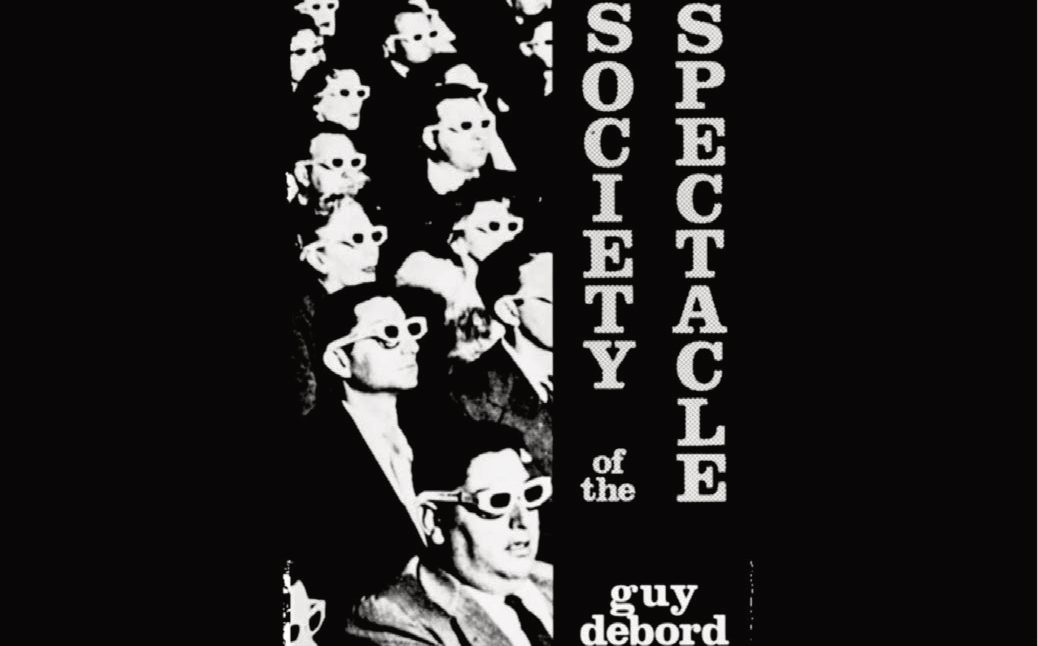
The Situationists produced two major theoretical texts,both of which were published in 1967, one year before the publication of Baudrillard’s first major work The System of Objects. These were The Revolution of Everyday Life by Raoul Vaneigemand The Society of the Spectacle by Guy Debord.[13]
Vaneigem’s work is a poetic, ludic, passionate, existentialist, and utopian text celebrating the potential qualitative richness of life which might become possible when the freedom of the individual gets expressed through the construction of situations: making of a “unitary ambience” and “the game of events.”
The Society of the Spectacle is a book which has had a widespread impact since the 1960s on critical social theory, media theory, new media art, video art, underground music, independent cinema, and social-political activism.[14] The book develops a major analysis of the advent of the post-World War II advanced capitalist society: the ubiquity of the mass media, high-tech, the culture of images, television, movies, advertising, computers, consumerism, marketing, organized leisure, shopping malls, cybernetics, the obsession of information, modern transportation, telecom networks. and the tourist industry. The book’s main thesis is that the citizen of the media culture is in a fundamental situation of spectatorship and passivity with respect to the power of the screen and the endless panoply of consumer objects.
The Society of the Spectacle is very close in spirit, style, terminology, and subject-matter to the first three published books of the young sociologist Jean Baudrillard: The System of Objects (1968), The Consumer Society (1970), and For a Critique of the Political Economy of the Sign (1972).The theory of the spectacle of Guy Debord and the semiotics of consumer culture of the early Baudrillard are twin theories. In the second volume of his notebooks or memoirs Cool Memories II, published in 1990, Baudrillard writes:
Pataphysician at twenty – Situationist at thirty – utopian at forty – transversal at fifty – viral and metaleptic at sixty – that is my whole history.[15]
“I was very, very attracted by Situationism,” he told interviewer Judith Williamson in 1989.[16] He seems to be stating that he was a Situationist in 1959 – already before the sixties. Two years after the founding of the Situationist International movement (sometimes called the SI), which happened in 1957. Nine years before The System of Objects.
BAUDRILLARD’S PARADIGM SHIFT
After Symbolic Exchange and Death (1976), there begins a paradigm shift in Baudrillard’s intellectual worldview or system of thought. The concept of simulation already appears briefly in The Consumer Society, but the deconstruction of “the social” as a legitimate epistemological concept, or object of knowledge-inquiry, for the social sciences first appears in 1978 with In the Shadow of the Silent Majorities. The iconic work Simulacra and Simulation, which literally appears as a hollowed-out book in the SF film The Matrix, comes in 1981. From this point on in his career, Baudrillard explicitly conceptualizes and draws attention to a highly significant distinction between his own position about contemporary media culture and what he summarizes as his view of what is the position of the Situationists, or Debord’s concept of the spectacle. In The Perfect Crime (1995), Baudrillard writes:
Virtuality is different from the spectacle, which still left room for a critical consciousness and demystification. The abstraction of the “spectacle” was never irrevocable, even for the Situationists. Whereas unconditional realization is irrevocable. We are no longer either alienated or dispossessed: we are in possession of all the information. We are no longer spectators, but actors in the performance, and actors increasingly integrated into the course of that performance. Whereas we could face up to the unreality of the world as a spectacle, we are defenseless before the extreme reality of this world – before this virtual perfection. We are, in fact, beyond all dis-alienation. This is the new form of terror, by comparison with which the horrors of alienation were very small beer.[17]
To summarize: the invocation of typical post-1968 neo-Marxist concepts around ideology, attributed to the Situationists: false consciousness/critical consciousness, mystification/demystification, alienation/ dis-alienation, unreality/redeemable reality, dispossession, hope, salvation. Allegedly “modernist” neo-Marxism superseded by Baudrillard’s“postmodernist”post-Marxism: the murder of reality through too much reality, the Virtual Reality unconditional realization of the world, which is its unconditional simulacrum, the new interactive performance of the integrated spectacle.
The later Guy Debord develops and utilizes the concept of “the integrated spectacle” in his 1988 book Comments on the Society of the Spectacle.[18] In his 2004 book, The Intelligence of Evil or the Lucidity Pact, Baudrillard elaborates the concept of Integral Reality: “the perpetrating on the world of an unlimited operational project whereby everything becomes real, everything becomes visible and transparent.”[19] It is the project of “realizing the world, of making it become technically, integrally real.”[20] This suppression of “the imaginary,”the loss of any imagination of the contingency of the real pushed aside by the realization of Integral Reality (or “the ecstasy of communication”), as characterized by Baudrillard, is very close to the definition that Debord gives in Comments on the Society of the Spectacle of “the final sense of the integrated spectacle,” which is “that it has integrated itself into reality to the same extent as it was describing it,” effacing the salutary gap between signifier and signified, the act of total integration steamrolling over aesthetic representation.[21]
In the citation above from The Perfect Crime, Baudrillard “reverse engineers,” or reconstructs logically, something like the concept of “the integrated spectacle” while elaborating his thought about how the early Debord’s theory of“media culture as spectacle”needs to be revised. “We are no longer spectators,” he writes, “but actors in the performance, and actors increasingly integrated into the course of that performance.”[22] We are performing actors, integrated into what was the spectacle, and which is now the integrated spectacle.
In his 1990 interview in Australia with Nicholas Zurbrugg, Baudrillard says:
Situationist modes of radicalism have passed into things and into situations. Indeed, there’s no need now for Situationism, Debord, and so on… All of that is out of date. The hyper-critical, radical, individual sensibility no longer exists. Events are the most radical things today. Everything which happens today is radical. There’s a great wealth of radical events, and all one needs to do is to enter its interplay. Nowadays, reality is radical. Reality is Situationist, not us![23]
“Radicalism has passed into events.” (Mike Gane makes that the title of one-fourth of his edited collection of Baudrillard interviews).[24] Reality is Situationist, not us. This would be a dimension of the later Baudrillard’s perspective of “taking the side of objects.”
IS BAUDRILLARD FAIR TO THE SITUATIONISTS?
On the surface of things, in one important way of looking at it, Baudrillard’s critique of the Situationists is unfair. For all intents and purposes,the Situationists stopped writing in the early 1970s. At least that is the official narrative or history. Baudrillard“capitalizes” on the formal event of their self-dissolution, and effectively forecloses in advance any possibility of them “catching up with” his post-1978 insights. The twelfth and last issue of the annually published journal Internationale Situationniste appeared in 1969. The organizational dissolution of the SI occurred in 1972. In the passages cited above from The Perfect Crime and the Zurbrugg interview, Baudrillard allows himself the freedom to have evolved and advanced in the 1970s and beyond, but he does not allow this to the Situationists. What happened to Situationist theory after 1980 is not well known. This is a subject in the history of ideas that is still open to scholarly research and investigation. My impression is that there was a great deal of Situationist theory developed after 1980 in Italy (Gianfranco Sanguinetti, Mario Perniola), in northern California (Bureau of Public Secrets, Processed World), and in Great Britain (Spectacular Times, Workshop for NonLinear Architecture).[25]
There is the post-anarchism of Hakim Bey (the Temporary Autonomous Zone).[26]
There is the French anti-surveillance journal Tiqqun (This Is Not a Program).[27]
There are the extensive writings of the British art historian and former member of the SI Timothy J. Clark.[28]
What did Raoul Vaneigem write after 1980? He wrote about 15 books.[29]
What did Guy Debord write after 1980? There are the Comments on the Society of the Spectacle and his autobiography Panegyric.[30] In Comments on the Society of the Spectacle (1988), Debord writes observations about contemporary media culture very similar to those of the later Baudrillard. Debord, like Baudrillard, questions if negation of the dominant capitalist society via “the critical consciousness of the human subject” is still possible, given the indistinguishability of rebellious gestures or so-called “authentic expressions and experiences” from their commodified and simulated versions. One can contemplate the “recuperation” of rebel style by the advertising industry starting in the 1970s, as documented by Thomas Frank in his book The Conquest of Cool: Business Culture, Counterculture, and the Rise of Hip Consumerism (1997).[31]
For Debord, the integrated spectacle is a new phase of capitalism corresponding to the spectacle’s extension since 1967. The integrated spectacle combines features of Western free-market big corporation capitalism and Eastern state capitalism-slash-communism. The integrated spectacle is the cumulative effect of five principal developments:
- Incessant technological renewal
- Integration of state and economy
- Generalized secrecy
- Unanswerable lies
- Ubiquitous new media to enact an eternal present Objective historical knowledge disappears, thus paving the way for unlimited falsifications. “Historical evidence which the spectacle does not need to know ceases to be evidence.” “Spectacular power,” writes Debord, “can deny whatever it likes… and change the subject; knowing full well there is no danger of any riposte, in its own space or any other.”[32]
“BAUDRILLARD AND THE SITUATIONISTS” COMMENTATORS DOUGLAS KELLNER AND SADIE PLANT, AND THE TENSION BETWEEN CRITICAL THEORY AND FATAL THEORY
There is an extensive secondary literature about the difference between the alleged modernism of Debord and the alleged postmodernism of Baudrillard. Or about the reputed social revolutionary stance of the SI and the supposed “sellout” to the late capitalist culture of simulation of Baudrillard.
Several books by Douglas Kellner and Steven Best, for example The Postmodern Turn, are lengthy and detailed elaborations contrasting Debord’s belief in modernist values like history, meaning, reality, interpretation, and social change against Baudrillard’s so-called nihilistic descent into an alleged postmodernist fatalistic pessimism. Kellner and Best offer informative descriptions of the many ways in which “the Situationist spectacle” has developed further in its newer stages of contemporary American media and political culture.[33] But with respect to Baudrillard, Kellner is an opponent who does not make the effort to understand the originality and specificity of Baudrillard’s positions.
Sadie Plant, in her book The Most Radical Gesture: The Situationist International in a Postmodern Age, is hostile to Baudrillard.[34] Plant is a passionate proponent of Situationism. Her belligerent understanding of Baudrillard is reductionist (see Exhibit C below).
Baudrillard’s stated critique of the Situationists is reductionist (see Exhibit B below).
Baudrillard, at times, presents his own view, which he contrasts to that of the Situationists, in a self-simplifying or reductionist way (see Exhibit A below).
On both sides of this debate, there is a self-expressed reductionist version of their conceptual differences.
Exhibit A (Baudrillard self-simplifies):
Baudrillard made the bold proclamation in 1983 in Fatal Strategies (a book focused in the first of its three parts on gambling, obesity, and hostages as objectively resisting “figures of the trans-political”) that he was leaving behind “critical theory” in favor of a “fatal theory” (the title of Mike Gane’s book is Baudrillard: Critical and Fatal Theory [35]). Yet major aspects of Baudrillard’s later position, as exemplified by the citations zeroing in on the Situationists referenced above, remain a “critical theory of society”: the conceptualization of the objects of the “critique” which are called virtuality, Integral Reality, and the implied “reverse-engineered” concept of the integrated spectacle.
In my view, we need both critical theory (media theory) and fatal theory (“taking the side of objects”) – and the fruitful tension between those two cultural theory concepts.
The articulation of this tension between the two currents of thought is the most interesting area of discourse of Baudrillard’s oeuvre. He often overstates the “death of critique”: for example, in the passage in The Perfect Crime which immediately follows his attempted takedown of the Situationists cited above:
In… the golden age of joyful disillusionment, we carried out the critique of all illusions – the metaphysical, the religious and the ideological. Only one remains: the illusion of criticism itself… the critical illusion has devoured itself.[36]
Immediately after this, attempting to provide an example, Baudrillard writes:
The critique of virtual technologies masks the fact that their concept is seeping everywhere into real life in homeopathic doses.[37]
This is not putting an end to all critique and to all media theory. It is rather seeking out a critical epistemology where the object of the critique is a historical totality, where the virtual is to be deconstructed in and due to its coupling with the myth of the real, not in and due to its alleged betrayal of a supposedly intact real (which would be a mere“liberal” and not a “radical” critique of virtual technologies).
Exhibit B (Baudrillard’s critique of the Situationists is reductionist):
The one-sidedness of the claim by Baudrillard to have left “critical theory” behind, and to have arrived on the new continent of “fatal theory,” is revealed not so much in his direct statements about the end of all critique, but rather in his pinning the label of “critical theorists who still believe in consciousness and the radical subject” onto the Situationists. He claims that their perspective on “the society of the spectacle” contrasts sharply with his own concepts of simulation and hyperreality,ignoring the fact that significant aspects of the Situationist historical project were radically performative – meaning that they were “ironic” and “fatal” and “taking the side of objects” in the senses in which Baudrillard uses these terms.
To find interesting “fatal strategies,” one must look no further than the seven Situationist activist principles which I have mentioned: (1) Wandering (2) Psycho-Geography (3) The Diverting of Technologies, (4) Making Situations, (5) The Radical Illusion Beyond Art (6) Neo-Situationism in Digital Media, and (7) Post-Public Urban Art.
Debord was a Marxist who, in many of his writings, clung to the myths of working class consciousness, the proletarian revolution, and the glorious future of “the generalized self-management of the workers’ councils.”[38] Many Situationist essays share this “theological” rhetoric. Baudrillard emphasizes this side, setting up the SI as the “straw dog.”
The German words Entfremdung and Verfremdung can help here. Baudrillard overemphasizes the Marxist side of the Situationists’ concept of alienation as Entfremdung: the debased historical condition of humanity under capitalism and its dreamt-of overcoming. He ignores the “radical theatre” and “radical performance” side of their concept of distantiation as Verfremdung – artistic techniques to incite change in the “consciousness of the audience”in the tradition of practitioners like Bertolt Brecht,Antonin Artaud, and the surrealists. Verfremdung is more rigorously the genuine historical context of the Situationists.[39]
Exhibit C (Sadie Plant’s critique of Baudrillard is reductionist):
Sadie Plant argues that Baudrillard was deeply influenced by the Situationists and effectively co-opted their ideas. According to Plant, the later Baudrillard gave up all prospects of criticism and political contestation. For Plant, “[Baudrillard is a] sold-out Situationist who wanders without purpose.”[40] Plant thinks that Baudrillard thinks that there is nothing to be done pour changer le monde. But this is, in fact, not the case.
Sadie Plant understands Baudrillard as believing that “the real and the meaningful have slipped away amidst a confusion of signs, images, simulations, and appearances.”[41] No, Baudrillard is saying that “reality” disappears through too much reality.He is not celebrating this. Virtual Reality is not the disappearance of a natural and awesome “reality” that was intact prior to the advent of digital and virtual technologies.
The Left’s longstanding emphasis on subjectivity is problematic because advanced capitalist-consumerist culture is a profoundly narcissistic culture, encouraging a “society” of narcissistic “subjects without others,” subjects without the capacity to recognize otherness. Communication, which saturates media culture, is destructive of other-ness. The field of subjectivity and so-called “authentic expression and experience” is ripe for recuperation, co-optation, or assimilation. Récuperation of radical assertions from the cultural margins by the power centers and by the spectacle is a key concept of the Situationists.The key historical event of the 1970s was the assimilation of“cool,”“creativity,” and “individual empowerment” by the advertising industry, consumerism, and personal computers.
After the setback for practical radicality which took place around 1970, Baudrillard made it the goal of his work to go as far and as deeply as possible into “theoretical radicality.”[42] He put his efforts into trying to figure out how to oppose a system which has already anticipated all opposition. This is, first and foremost, an epistemological question.
SITUATIONIST PRACTICES
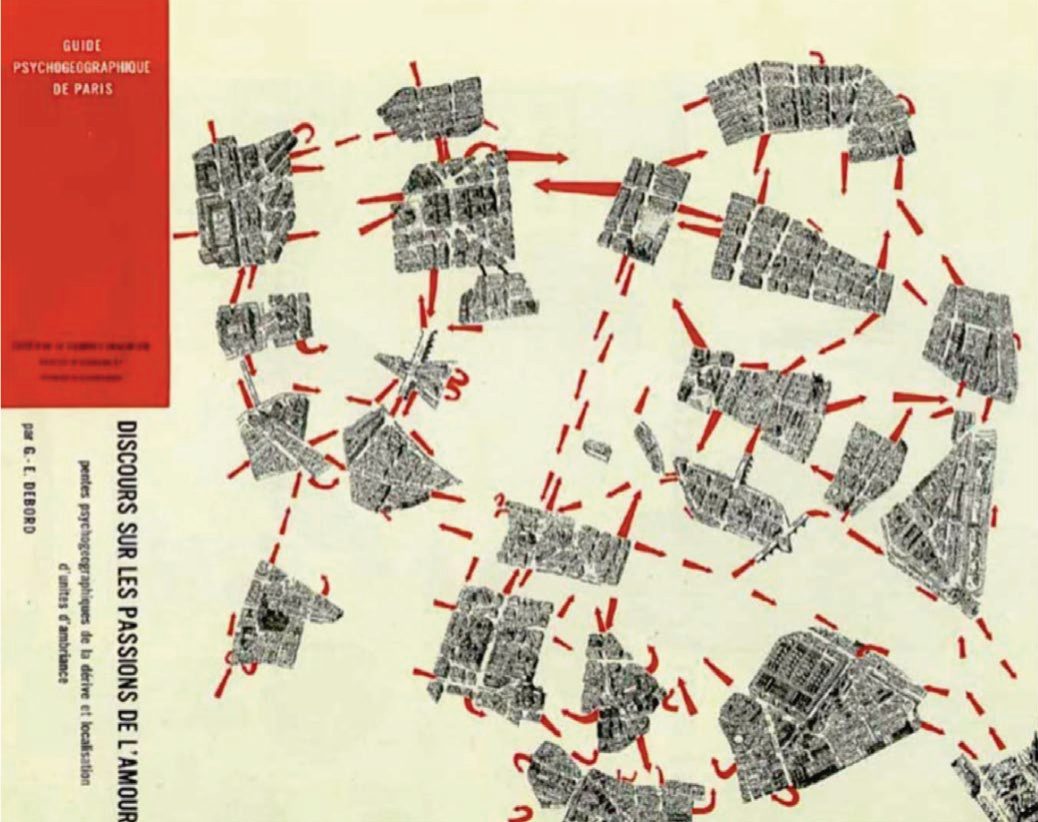
Wandering or the Drift – Le Dérive
In the essay “Theory of the Dérive,” Guy Debord wrote:
One of the basic situationist practices is the dérive, a technique of rapid passage through varied ambiences. Dérives involve playful-constructive behavior and awareness of psycho-geographical effects. They are thus quite different from the classic notions of journey or stroll. In a dérive one or more persons during a certain period drop their relations, their work and leisure activities, and all their other usual motives for movement and action and let themselves be drawn by the attractions of the terrain and the encounters they find there.[43]
The object-orientation here is that one is driven, doubled, and shadowed by the encounters –with both non-human and human “objects” – that one has in urban space. The Situationist view is that we live in an urban environment with so many possibilities for creativity and enjoyment, yet we constantly overlook these opportunities because we are focused in everyday life on the functional organization and layout of the city, the static places designated for work or sleep or shopping, and the physical transportation that we need to move among these locations. Drifting is a way of changing this, of discovering marvels and surprises in an intrepid playground of renewed urban spacetime.
In the dérive, one “takes the side of the object,” consistent with the system of object thought of the later Baudrillard, for example in his book Impossible Exchange (1999).[44] One follows the seduction,strange attractors,radical otherness,the non-human and the inhuman. One embraces “the world thinking me” of the cityscape as “psycho” and “geography” get rearranged playfully by the semiotic and physical signs encountered during the drift.
PSYCHO-GEOGRAPHY
In the essay “Introduction to a Critique of Urban Geography,” Guy Debord wrote:
Geography, for example, deals with the determinant action of general natural forces, such as soil composition or climatic conditions, on the economic structures of a society, and thus on the corresponding conception that such a society can have of the world. Psycho-geography could set for itself the study of the precise laws and specific effects of the geographical environment, whether consciously organized or not, on the emotions and behavior of individuals…[45]
There is a complex intricate psycho-geographical separation and interweaving between places in Venice (for example) where tourists go and those places where only Venetian natives go. Psycho-geography conjures up free association and fascination; the construction of stimulating “situations”; and adventurous playing with architecture and urban space. You discern the psycho-geographical contours, currents, fixed points, and vortexes which encourage or discourage entries, exits, and flows into and out of specific prescribed zones of the city.
The Diverting of Technologies – Le détournement
In the essay “A User’s Guide to Détournement,” Guy Debord wrote:
Any elements, no matter where they are taken from, can serve in making new combinations. The discoveries of modern poetry regarding the analogical structure of images demonstrate that when two objects are brought together, no matter how far apart their original contexts may be, a relationship is always formed… The mutual interference of two worlds of feeling, or the bringing together of two independent expressions, supersedes the original elements and produces a synthetic organization of greater efficacy. Anything can be used.[46]
The Situationists did not dream of a dis-alienation of man (eine Ent-Entfremdung des Menschens in German) as Baudrillard claims in his critique of them. Perhaps Erich Fromm or other “Marxist-humanist” thinkers would be more susceptible to such a criticism. Le détournement is usually translated into German as Zweckentfremdung, which is not wrong, yet it would perhaps be more correct to say Verfremdung, following the distinction between Entfremdung and Verfremdung originated by Bertolt Brecht.[47]
The Situationists advocated “beyond art” practices of “jamming the messages” and “turning the songs [of the dominant culture] inside out.”[48] This is the revenge of the object, the destiny of the object beyond the determining codes, beyond the meanings and definitions imposed on the object by the economics, politics, sociology, or advertising discourses.As Baudrillard writes in The Ecstasy of Communication: “the destiny of signs is to be torn from their destination, deviated, displaced, diverted, recuperated, and seduced.”[49]
THE MAKING OR CREATING OR CONSTRUCTION OF SITUATIONS
In the essay “Report on the Construction of Situations,” Guy Debord wrote:
We think the world must be changed. We want the most liberating change of the society and life in which we find ourselves confined. We know that such a change is possible through appropriate actions. Our specific concern is the use of certain means of action and the discovery of new ones, means which are more easily recognizable in the domain of culture and customs, but which must be applied in interrelation with all revolutionary changes…[50]
There is an alternative utopian-anarchist dimension to Baudrillard’s thought: direct speaking, seduction, symbolic exchanges, transgression, and meaningful non-virtual encounters with the other are possible. In Symbolic Exchange and Death (1976), Baudrillard writes incisively about graffiti in the subways and on the walls of New York City as the insurrection of pure signs against the ruling semiotic order of messages and meanings.
“Kool Killer: or the Insurrection of Signs” is a landmark cultural theory essay about graffiti and street art as symbolic rebellions against the dominant media society.[51] The creative graphics in the early 1970s were a new kind of urban intervention, an alternative to advertising, an outbreak against the sign-system.
Graffiti opposed the myths of the individual author and the identity of the human subject, being instead the invoking of ritual symbolic exchanges. Pseudonyms rather than proper names were asserted against the anonymity of postmodern bureaucratic existence. Urban space was reaffirmed against the system of well-behaved producers and consumers, of commuting subway riders, of the communicating senders and receivers of semiotic signs. The meaningless names like SUPERKOOL and KOOL KILLER (in Baudrillard’s example) left the confined designated fictional space of the underground comic books. It is a graffiti with no content, no message, no goal, and no ideology. This graffiti contests the very form of the media. The beautiful scrawls are the insurrection of “signs of nothing” against interpretation and denotation, and for an anti-urbanism against architecture.
The Radical Illusion Beyond Art
There is a minority tendency within art which can be called “post-art” or “the radical illusion beyond art.” Which artists does Baudrillard like? What does Baudrillard mean by “the radical illusion beyond art”? How do the realizations and processes of those artists whom he admires correlate to the “corresponding” Situationist practices?
In the era of the “integrated spectacle” (Debord) or “the conspiracy of art”[52] (Baudrillard),“art” persists and flourishes as a profitable hyper-industry, with its own inflated pretensions and its self-legitimating prestigious institutions. Baudrillard saw the contemporary art world as being complicit with–and metaphorical of– late semiotic hypercapitalism.
Baudrillard explicitly rejected the New York art scene’s attempted embrace of him as a critical cultural thinker in the 1980s. He was suspicious of any project of “applying” his ideas about simulation, hyperreality, Integral Reality, and the orders and precession of simulacra in a “transdisciplinary” or “crossover” way to either art – the New York “Simulationist” or “Appropriation” or Neo-Conceptualist or Neo-Geo artists such as Sherrie Levine, Jeff Koons, and Peter Halley, who claimed that their artworks were “simulacra” against “hyperreality” (for example, on the level of colors) – or film – as in the case of the Wachowski Brothers’ canonization of him as the supposed philosophical inspiration for The Matrix film series.[53]
It is not clear if Baudrillard disliked the New York “Simulationist artists” in the 1980s because he ruled out an artistic practice that referenced his philosophy as an inspiration in principle, or because he simply viewed them as being bad artists.
The list of “artists beyond art” on whose creations Baudrillard favorably commented, however, is surprisingly quite a bit longer than one would expect. By “artists beyond art,” I mean creators who are practicing something different from the mainstream currents of art,and whose works are to be interpreted differently from how the“art industry”sees them. Perhaps their creations should not be understood with the term “art.” Some of the principal figures are:
Edward Hopper (the use of light in his paintings)[54]
- Francis Bacon (whose paintings are “beyond aesthetics” and give form to “the illusion”)[55]
- Jackson Pollock (of equal stature with the revered Andy Warhol)[56]
- Mark Rothko (establishes unmediated contact with “the object” or “the fragment”)[57]
- Enrico Baj (a proto-Situationist and “pataphysician” about whose prints and collages Baudrillard wrote an essay and conducted an interview –they have a“mythical”quality and confront “the monstrous”)[58]
- Luc Delahaye (Baudrillard wrote about his “illegal” and hidden-camera photography of Paris Metro riders)[59]
- Mike Disfarmer (photographer of residents of rural Arkansas in the 1940s)[60]
- Christo and Jeanne-Claude (The “wrapping” in synthetic fabric and cloth of architectural structures such as the Berlin Reichstag and the Parisian Pont-Neuf bridge, and natural locations such as the New York City Central Park pathways or the coastline near Sydney, Australia “enoble(s) a form by covering it up”)[61]
- Charles Matton (Baudrillard and Virilio both wrote essays about his artworks which were miniature experimental spaces or “enclosures” which brought attention to “the illusion” and not to “the reality”)[62]
- Olivier Mosset (a painter of monochrome abstract works about which Baudrillard wrote a catalogue entry)[63]
- Sophie Calle (about whose photographic-conceptual-storytelling-performative art projects Baudrillard wrote the essay “Please Follow Me” – also known as “Pursuit in Venice”)[64]
- Marcel Duchamp (The master of the readymade, he made banality into art. His “found objects,” for Baudrillard, prefigure the media genre of Reality TV. He reduced everything to insignificance. His “fountain” is an emblem for our hyperreality yet is also the gesture of its possible reversibility)[65]
- Andy Warhol (Baudrillard wrote about Warhol in “Machinic Snobbery” in The Perfect Crime. Some of Warhol’s gestures were to embody the “death of the artist as subject” by “becoming a machine”; to work with the technologies of serial reproduction, and to historically mark the acceleration of hyperreality)[66]
Baudrillard’s many essays of appreciation of some art projects, on the one hand, and his critique in the essay “The Conspiracy of Art” of the “art industry” which is too close to the “creative industries” and the “technological fetishism” of capitalism (parallel to the critique offered by Andreas Reckwitz in Die Gesellschaft der Singularitäten[67]), on the other hand, provides guidelines for distinguishing the principles of symptomatic art versus art which radically challenges the media-capitalist simulacrum and hyperreality.
In his 1996 provocative essay “The Conspiracy of Art,” Baudrillard asserts that contemporary art has “lost the desire for illusion” and instead elevates everything in the world to “aesthetic banality.”[68] Like pornography, the logic of which replicates itself infinitely to all media and advertising images, art has become an obscenity of visibility, a relentless transparency of all things.What could art possibly still mean in a culture saturated by hyperreality and ubiquitous “cool” and marketable images? The aesthetic gesture of nullity or meaninglessness was inaugural when Duchamp or Warhol first thought it up, but it becomes endlessly banal in its endless recycling in countless exhibitions. It is the counterfeiting repetition in “signs,” or in the mode of irony, of previously initiatory gestures of art history. It is the commercial or sentimental-commodified form of nullity that sells well in the art market.
Neo-Situationism in the Field of Advanced Digital Technologies
Our activities in the space of digital and virtual media should avoid the two extremes of utopian and dystopian perspectives. Many theories of new media and new technologies have been euphoric in seeing great possibilities for creativity, self-expression, and democratic communication in online existence. Other discourses have been exclusively critical, observing in our networked immersion in “social media” and simulations the deepening of capitalist-consumerist conformism and control – now administered by a new set of large corporations.
The alternative to these two opposite positive and negative views of digitalization is to deal with the digital-virtual realm as an“ambivalent interspace.”We should conceptualize – and then act in – media from cyberspace to Augmented Reality as open contested arenas situated between commodification now re-inscribed through software code by economically powerful surveillance agencies and the potentialities of radical transformative creativity.
Urban and Street Art Activism
Space is both real-physical and simulated-virtual.We will need to invent new concepts to deal with this new situation. We need to extend creative and activist interventions in the province of urban space to the double-territory-and-imagination of material-and-informational space. We need an aesthetic movement of Interspace Art to comment prolifically on these physical-and-virtual and theory- and-practice boundaries. Physical spaces that we inhabit in the offline zones of the capitalist society are largely demarcated by “ownership.”We traditionally understand these spaces via the conceptual system of”public” and “private” – a still very influential instituting and interpretive framework belonging to modernist political-economic theory. In the concepts of digital codes and informational flows,the structural arrangement of clear physical demarcations between“public” and “private” recede into the past.
Street art and public art, although noble endeavors whose histories and politics still interest us greatly, largely operate based on the assumptions of these conventional categories. These genres founded themselves on the left-liberal idea that there is and should be a“shared cultural space”within modern society outside of and exempt from the nexus of cash values.
The work of Christos Voutichtis is at the intersection of art, architecture, and urbanism. His installation “All About Mistakes” was an urban intervention in Lisbon. The work consists of of screen prints, sculpture, and real-time audiovisual computational media. Fractalgeometric shapes projectedonto the frontfaçadeof a high-rise building.This is a computer-generated pattern influenced by the parameters of the shape of the building itself. Street art emerges as a pattern from the fractal unit. The fractal is the secret passageway beyond private and public to perception of the“radical illusion of the world.”
Voutichtis seeks an architecture without rules, without control or hierarchical order. A space is an anarchist space when it is not static, when it continuously changes, when it is influenced by its surroundings. See Christos’ work “Moving and Space-Forming Objects (The Performativity of the Space)” – a work of Interspace Art. Voutichtis’ installation piece uses large sheets of plastic wrapped around a selected physical structure to form a contained space that grows and expands as influenced by the outside breeze. Voutichtis is interested in fractal and breathing geometry, not a conventional Euclidean geometry with its three-dimensional axioms and classical dimensions. With fractal design patterns and parametric instantiation, there is relocation of the real-virtual body, inseparable from its immersion in hybrid space.

AUGMENTED REALITY VERSUS WALL STREET
There are huge possibilities for Situationist resistance practices that engage in a critical and transformative way with the dominant culture in the digital age. The aesthetics and technology of Augmented Reality enable the players of the game Pokémon Go to superimpose funny characters and monsters onto the familiar phenomenological environment of the physical world to re-enchant urban life. Other AR applications call up information from a database that is pertinent to a specific scene to add the enhancement of contextual information. Messages are digitally superimposed onto the real world. Augmented Reality played a major role in Occupy Wall Street of 2011 in New York City, a social movement which protested drastic income inequality and the political power of the wealthiest 1% of the global population (one Occupy slogan was We are the 99%). Political activism has been supported recently by AR.
More than 25 artists from around the globe took part in the collective action “Augmented Reality Occupy Wall Street,” covering the Wall Street and New York Stock Exchange geographical areas of downtown Manhattan with more than 400 augments. In this urban art installation of remote telepresence, the artist-activists created protest works that were seen in the desired target location even though their creators were not physically present there. At a certain stage of the unfolding of the Occupy events, the FBI and the NYPD police had occupied the Wall Street area with a massive presence of barricades, mounted horses, and the forces of order, blocking the thousands of protesters from entering that section of the city.The movement was primarily encamped in Zuccotti Park in the Financial District.
The ProtestAR smartphone app virtually projected images and sounds of protest movement members who were in Zuccotti Park into the space in front of the Stock Exchange. Using a smartphone or tablet (in the future, it would be done with AR glasses), people standing on street corners or assembled anywhere downtown could see artistic images-and-sounds of ironic commentary on the global financial system – casino slot machine bells- and-lights, a cage enclosing the iconic Stock Exchange bull, dollar bills, the Statue of Liberty, virtualized electronic money circulation, liquid data flows, green frogs – superimposed onto the physical reality in front of them. The ProtestAR app safely transported the demonstrators into the zones forbidden by the police. Enthusiasts with the app formed the AR Flash Mob, forming chains and circles of persons standing sideby-side and holding up their smartphones and tablets, enabling others standing around them to see and hear the augments.[69]
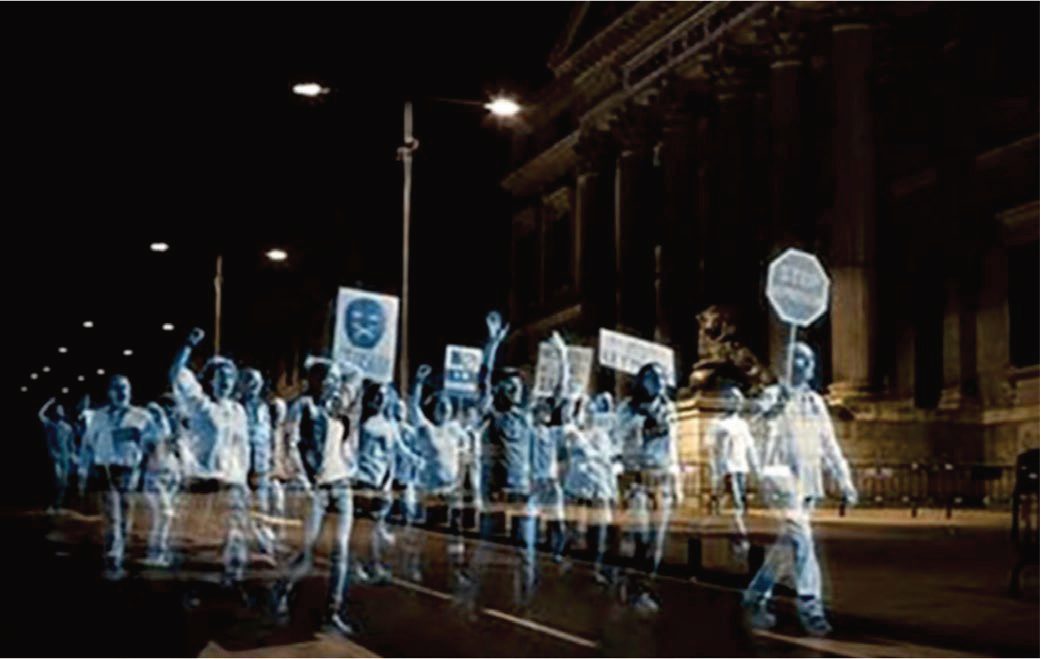
In 2015, the Spanish parliament passed laws restricting freedom of expression, freedom of assembly, rights of information access, and the right to protest. Any individual or group demonstrating in front of the Parliament building would be subject to a very large fine. The organization No Somos Delito (NSD) conceived of the hologram protest. The protest itself was filmed at a location outside Madrid and then projected with Augmented Reality in front of Parliament.It was shown in a loop to keep the rally in constant movement.[70]
CONCLUSION
The Situationists still have much to tell us.We are living in a society that still relies on the samechimericalsleightsofhandwhichtheSIdescribed.Thecultureofdigitalandvirtual technologies, and the advent of the Fourth Industrial Revolution, take the spectacle (and simulation) into new and unchartered galaxies. The Situationists are much closer to the later Baudrillard’s perspective of “taking the side of objects” than he himself chose to keep in mind or may even have been aware of. The Situationist practices offer a possible path for “applying Baudrillard” (even in an academic sense, if one considers the “activism of design” to be an academic discipline), making the relatively abstract philosophical and theoretical idea of “taking the side of objects” more concrete, practical and applied.
MCKENZIE WARK ON THE SITUATIONISTS
The media theorist and activist McKenzie Wark has published two books on the Situationists – The Beach Beneath the Street: The Everyday Life and Glorious Times of the Situationist International (2011) and The Spectacle of Disintegration: Situationist Passages Out of the 20th Century (2013) –where she demonstrates her passion for, and encyclopedic knowledge of, their history, ideas, practices, pre-history, and post-histories.[71] Wark read “Debord’s Society of the Spectacle at an impressionable age and decided thereafter to do something with it.”[72] She explains that many of her books are deeply imprinted by the Situationists.
Virtual Geography: Living With Global Media Events (1994) engages with Debord’s theory of a “lived time of experience” to glimpse, in the differentiated flows of information and vectoral trajectories of electronic transactions, gaps in simulation or the spectacle.[73] Dispositions (2002) is a dérive or wandering, written in the shadow of the worldwide integrated spectacle of global positioning and surveillance systems that want to fix our location and identity, defining us by our data profile.[74] It is a diary of aphoristic poetic musings.
Written in the style of Society of the Spectacle, A Hacker Manifesto (2004) is an updating of détournement (the diverting of technologies) for the digital age.[75] Echoing Marx and Engels’ CommunistManifesto, it calls for the “hacker class,” who work in the realm of intellectual “abstractions,” to rebel and actively question the necessity of private property.
Gamer Theory (2007) is a critical theory of games that rises to the anthropological level of Roger Caillois’ seminal Man, Play and Games, where the French ethnologist developed an “ideal typology” of games and festive rituals in different human societies across time.[76] Computer games and virtual worlds are the archetypal cultural form of contemporary society. Wark explores the complex intertwined relationship between the comforting perfection of the online game and the imperfections of the “compulsory creative” games we must play offline to survive in everyday life in the “disintegrating spectacle” of global capitalism.
The most succinct statement of Wark’s position with respect to the Situationists appears at the beginning of her pamphlet 50 Years of Recuperation of the Situationist International (2008).[77] From the 1950s to the 1970s, the Situationists were the heartbeat of a movement of neo-Marxist rebellion in Europe that was “beyond art and politics.” Their energy culminated in the student-worker near-revolution in France in 1968. The organization officially dissolved in 1972. According to almost all accounts,that was the end of it. It is precisely that assumption of closure with which Wark takes issue. She is primarily interested in what happened afterwards. Her books explicitly about the SI trace in detail the post-1972 activities of those who had been part of the group, or of others who sought to continue, or go beyond, the legacy of the Situationists.
This is almost a secret history. McKenzie Wark wanders with grace and verve through the ideas, creations, and activist practices of many figures in the social and intellectual history of the Situationists who were previously regarded as secondary to Guy Debord.
Starting about 1989, the Situationists were recuperated by “official international cultural exchange.”[78] They entered the museum and pantheon of culture. The Pompidou Center in Paris curated an official exhibition that went on tour. Greil Marcus published his book Lipstick Traces: A Secret History of the 20th Century, situating Situationism in “the history of oppositional popular culture”: the successor to Dada in art provocation and the forerunner of punk rock and the Sex Pistols in music.[79] Academics rushed in to claim the Situationists as part of art history, or of futuristic architecture, or of utopian urban planning and design. For literature professors, Debord’s writings came suddenly to have poetic and literary value. For film studies professors, Debord’s films became part of the avant-garde cinematic curriculum.
For McKenzie Wark, the dérive is only one instance of the more general ideas or practices of experimental behavior and permanent play. Situationist architecture is only one component of the more general idea of unitary urbanism. When experimental behavior is choreographed and enacted brilliantly in the context of unitary urbanism, then the possibility of the highest stage of “the construction of situations” appears.
The thesis of The Spectacle of Disintegration is that May-June 1968 and the self-dissolution of the SI in 1972 were not the end of the Situationist project. Wark writes at length about the works of the art historian and former Situationist Timothy J. Clark; the utopian writings of Raoul Vaneigem (and his relation to nineteenth century utopian socialist Charles Fourier); the détournement films of René Vienet such as Can Dialectics Break Bricks? (1973), The Girls of Kamare (1974), Mao by Mao (1977), and Peking Duck Soup (1977); and the later collaborations of Guy Debord, the film editor Martine Barraqué, and the poet and scholar of Western European slang Alice Becker- Ho in filmmaking and the devising of a board game called Game of War.
A great Situationist coup of the 1970s was when Gianfranco Sanguinetti, a colleague of Debord, writing under the pseudonym Censor, sent out his book-length text Truthful Report on the Last Chances to Save Capitalism in Italy (1975) to many political and financial power elite members of Italian society.[80] Pretending to be a Machiavellian sage of the Italian ruling class, Censor argued that bringing the pseudo-radical Communist Party into the government would be a brilliant strategic move to consolidate the system of the integrated spectacle.
Debord saw three versions of the spectacle: the concentrated spectacle (speaks the language of command), the diffused spectacle (invokes the imperative of shopping and consumerism), and the integrated spectacle. The integrated spectacle is characterized by the participatory interactive performance of “the user,” perpetual technological upgrades, merging of capitalism and the state, secrecy and lies, and the “eternal present” enforced by the media.
McKenzie Wark adds to these the concept of the disintegrating spectacle. It is concentrated and diffuse. Yet it is neither concentrated nor diffuse. The spectators are tasked with having now to themselves produce and distribute the images of the spectacle. But, for Wark, these images are no longer effective enough to mask the disappearance of “every real thing.”
Like Sanguinetti, and echoing Machiavelli, Dostoyevsky’s Grand Inquisitor (the secret of God is that God does not exist), Baudrillard, and Claude Lefort, Wark concludes that the power of capitalism and the state is not “real.” The secret of power is that power does not exist.It is a ruse perpetrated on the populace.It exists because people believe in that power. Power abides thanks to the spectacle of appearances.“The state renders spectacular the production of its own secrets,”writes Wark.[81] Appearances are exchangeable for other appearances. Secrets are exchangeable for other secrets. Secrets are complexly related to the spectacle. Wark concludes:
While the spectacle renders all that appears equivalent, the division between the secret and the spectacular implies a hierarchy – the main game of power. The division between the spectacle of appearances and the secrecy of non-appearances is itself an aspect of the falsification of the whole that the spectacle affects.[82]
PLAY DON’T WORK
The book that I have read about Marx that most inspired me was Marx’s Theory of Alienation by the Hungarian Marxist philosopher István Mészáros, published in 1970.[83] Mészáros argues that the first full-fledged elaboration of Marx’s philosophical system is in the theory of alienated labour of the Economic and Philosophical Manuscripts of 1844 (also known as The Paris Manuscripts), which were first released by Soviet Marxologists in 1932.[84] Marx writes of the estrangement or alienation of the work erunder capitalist conditions of production both from the process and from the product of his labour, as well as from social-psychological reality. It is the chain of overseers in the power hierarchy of the capitalist organization who dictate to the worker what he must do in his daily activity and how he must go about doing it. Not only is the product of his work an alien fetishized commodity, but “the worker sinks to the level of the most abject commodity.”[85] Forbidden to be active in freedom, the worker:
does not affirm himself in his work, but denies himself, feels miserable and not happy, does not develop free physical and mental energy, but instead disciplines his physical nature and ruins his mind… The more the worker works himself to the limit… the poorer he and his inner world become.[86]
Marx is not against work per se, which he regards as a healthy objectification of man. In a possible future non-alienated variation of work, man will come to be truly human for the first time. He will realize what Marx calls man’s species-being. Objectification is something like the creative and meaningful métier of the artist. But “in the sphere of political economy [capitalist organization under the prevailing paradigm], this realization of labour appears as a loss of reality for the worker.”[87] Man is estranged from his own body, from nature, from other human beings, and from his spiritual dimension.
In The German Ideology (1845), probably heavily influenced by Robert Owen, Marx writes of the utopian possibility of transcending the division of labor, and what this could mean for individual happiness. In positive freedom, man would:
do one thing today and another tomorrow, hunt in the morning, fish in the afternoon, rear cattle in the evening, criticize after dinner, do exactly what we feel like doing [wie ich gerade Lust habe], without ever becoming hunter, fisherman, herdsman or critic.[88]
In the capitalist mode of production as we know it:
Each man has a particular and exclusive sphere of activity, which is forced upon him and from which he cannot escape. He is a hunter, a fisherman, a herdsman, or a critical critic, and must remain so if he does not want to lose his means of livelihood.[89]
In a post-capitalist mode of production,which Marx in TheGermanIdeology calls communist society, “nobody has one exclusive sphere of activity, but each can become accomplished in any branch he wishes.”[90] The early Marx envisions a replacement of work by play, creativity, freedom, diversity of activities, and respect for scientific knowledge.
We are living in a society of self-imposed workaholism. As Erich Fromm wrote in The Fear of Freedom, published in 1942, modern man “has not gained freedom in the positive sense of the realization of his individual self; that is, the expression of his intellectual, emotional and sensuous potentialities.”[91] Everywhere one looks, people are working longer and longer hours to escape from themselves and the terrifying questions: what would they do with their lives if their day, week, and year were not structured by the routines and obligations of work? Who am I and what is the meaning of my life? The society of workaholism is “adverse to human happiness and self-realization.”[92] Workaholism is chiefly an inner compulsion.
The next stage of human freedom in post-capitalism would entail a synthesis of the accumulation of capital and the practice/realization of freedom by and for the free creative artistic worker. The great artist Joseph Beuys said that we are living under the oppression of an ideological version of Capital. In a democracy, Beuys said, everyone is an artist, everyone is creative, everyone – as a free being – has her own culture.[93] Humans are the co-creators of capital. We must deconstruct the ideological form of Capital and reconstruct a general economy of capital starting from art, popular culture, meaningful work, and self-determination.
EXISTENTIAL ENCOUNTER WITH THE OBJECT
It is summer and I go for walks in the botanical gardens. Past the rocky paths and the manicured lawns and the timed sprinkler fountain, I walk through the free-air and airconditioned greenhouses. I breathe in the aroma of the subtropical plants from Madagascar. I toss coins into the running stream for good wishes. I sit in solitude on a bench in front of a tranquil pond. There are swans and ducks and what I call waterbirds. I am in Germany, but this meditative scene reminds me of the duck pond of my childhood on Long Island. I gaze at the water and feel my inner peace. I stare intently at the fluttering leaves of an overhanging tree. What do these leaves want to tell me? What is the brute facticity of their existence? I see the roots of the tree in the ground. I see the tree inhabiting and breathing its ambience in the air. The tree calls to mind a tree-image on one of the screensavers of one of my computers. I hold the two trees – pond-tree and screentree – together in my mind’s eye as a magical pair.
This is a revisit to the chestnut tree which Roquentin encountered in Jean-Paul Sartre’s novel Nausea (“The chestnut tree pressed itself against my eyes.” [94]) This arboreal duo has a stealth connection to the Chestnut Tree Café in George Orwell’s novel 1984, where Winston Smith sought refuge from the future video-controlled totalitarian society, and where he later betrayed his lover Julia to the government (“Under the spreading chestnut tree, I sold you and you sold me…” [95]).
This is my existential encounter with the root of the chestnut tree. Objects are changing, taking on a life of their own. The bench on which I sit is manmade, yet the objectness of the root seeps into my space, undermines the taken-for-granted utility of cultural and natural objects, their design for use by humans. The underground part of the plant, buried in the soil,is a natural longevity that will outlive me.It invokes an emotion of both fear and of the heart. Roquentin: “I was the root of the chestnut tree. Or rather I was entirely conscious of its existence. Still detached from it—since I was conscious of it—yet lost in it, nothing but it.”[96]
I sit at my pond, living my Auseinandersetzung with the water, the chestnut tree root, and the leaves of the tree. If you tell me that your VR software will replace this elemental scene, then I will say that I am against that kind of software. But if you tell me that your software will enhance the Wirklichkeit (substantiality) of this scene, that it will lead to an advancement in what reality is, then my Vulcan Mister Spock ears will perk up.
What did you say? Spock ears? You mean the pointed ears of the half-human half Vulcan Science Officer Spock of the U.S.S.Enterprise on the Star Trek: The Original Series TV show, who is always pointing out the relative “primitiveness” of Earth science?
What kind of software would it be? Perhaps the software they have on Planet Vulcan, the home of an advanced humanoid civilization with a more advanced science than what we have. A planet which has overcome through collective spiritual growth its early instincts of violence. A planet that has eliminated war and poverty.
FROM THE SUBJECT TO THE OBJECT IN JEAN-PAUL SARTRE’S NAUSEA
Baudrillard writes at the beginning of his retrospective work Passwords:
For me, the object will have been the “password” par excellence. I chose that angle from the beginning because I wanted to break with the problematic of the subject. The question of the object represented the alternative to that problematic, and it has remained the horizon of my thinking… What really interested me, however, was not so much the manufactured object… but how objects spoke to each other – the system of signs and the syntax they developed… Behind this semiological formalism there was no doubt a memory of Sartre’s Nausea and that famous root… an obsessive object, a poisonous substance.[97]
The narrative of Sartre’s Nausea is told through the monological voice of the first-person protagonist Antoine Roquentin:
6:00 pm – I can’t say I feel relieved or satisfied; just the opposite, I am crushed. Only my goal is reached: I know what I wanted to know; I have understood all that has happened to me since January. The Nausea has not left me, and I don’t believe it will leave me so soon; but I no longer must bear it, it is no longer an illness or a passing fit: it is I.[98]
When the nausea or existential anxiety first came over Roquentin, it was something new to his being. He was frightened by it.The pain was doubled by trepidation about the pain. Roquentin had not known existence in this way before. Now the nausea is becoming a part of him, of his consciousness. He explores it like a scientist would. He accepts its familiarity and wherever it will take him. Contrary to the usual interpretation of Nausea that something bad has happened to him, something good has happened. It is the new normal of who he is.
THE MYTH OF SISYPHUS: ALBERT CAMUS ON THE SIDE OF OBJECTS
In his book The Myth of Sisyphus, published in 1942 during the Second World War, Albert Camus wrote the following sentences at the very beginning of the book:
There is but one truly serious philosophical problem, and that is suicide. Judging whether life is or is not worth living amounts to answering the fundamental question of philosophy. All the rest – if the world has three dimensions, whether the mind has nine or twelve categories – comes afterwards. These are games; one must first answer.[99]
Camus concludes logically that suicide is not a solution to the absurd. The absurd does not dictate death. The absurd emerges from the confrontation between the human striving for reasonableness and “the unreasonable silence of the world… This world… is not reasonable, that is all that can be said,” writes Camus. “But what is absurd is the confrontation of this irrational and the wild longing for clarity whose call echoes in the human heart. The absurd depends as much on man as on the world. For the moment it is all that links them together.”[100] From the moment that absurdity is recognized, it becomes a passion, the seed of a seduction.
Do you want to live? Camus answered in the affirmative. YES. The answer is that life indeed is worth living.The sense of absurdity that gave rise to the question,to the doubt, is not a static condition.
The absurd is a dynamic, a relationship, a gap, a cleft — between my aspirations for a good life and the frustrations of the existing social-existential order of things. And this dynamic is the groundswell of the most important human quality of all: creativity. The absurd is born of the desert. Absurdity arises from a comparison or tension. Absurdity is a water source, an oasis in the middle of the desert. It appears at first to be a negative, but it is really a double-positive of consciousness and rebellion, which are Camus’ two basic principles. How to live in the state of the absurd?
Sisyphus and his rock. The rock is the embodied metaphorical object parexcellence.To abide with the rock is to take the side of the object. The rock links the consideration of the world from the perspective of objects with Camus’ iconic existentialism:
The gods had condemned Sisyphus to ceaselessly rolling a rock to the top of a mountain, whence the stone would fall back of its own weight. They had thought with some reason that there is no more dreadful punishment than futile and hopeless labor… At the very end of his long effort measured by skyless space and time without depth, the purpose is achieved. Then Sisyphus watches the stone rush down in a few moments toward that lower world whence he will have to push it up again toward the summit. He goes back down to the plain. It is during that return, that pause, that Sisyphus interests me. That hour like a breathing-space which returns as surely as his suffering, that is the hour of consciousness.[101]
Sisyphus represents neither acceptance of the social-technological condition in which we find ourselves at the present historical conjuncture nor simplistic radical rejection of it.
One must abide in this condition, as in the human condition, with awareness, to transform this condition into something better, into creativity and, later, into a better society. The overall theory must emerge slowly and immanently from the experience, from deep familiarity with the condition, in a phenomenological and existentialist way. “The struggle itself toward the heights is enough to fill a man’s heart. One must imagine Sisyphus happy.”[102]
SIMONE DE BEAUVOIR, THE ETHICS OF AMBIGUITY
Like Baudrillard in Symbolic Exchange and Death, Simone de Beauvoir in The Ethics of Ambiguity defines what is specific to humans as being their conscious relationship to death.[103] The awareness of death that is uniquely human is the basis for developing a philosophy or ethics of ambiguity. For Baudrillard, this relation has been betrayed in the postmodern society which prefers to marginalize death, to institutionally push it to the edges of a non-awareness.
Simone de Beauvoir is nearly in complete agreement with the existentialist philosophy of her life partner Jean-Paul Sartre, as articulated in works such as Nausea and Being andNothingness.[104] For de Beauvoir, the relationship of humans to death infuses a fundamental ambivalence into the human condition, due to our awareness of death which is allegedly lacking among animals and plants. Man or woman is conscious of the world yet a part of it. He or she also experiences himself or herself as a thing potentially crushed by other things. He or she is an object for others. “As long as there have been men and they have lived,” writes de Beauvoir, “they have all felt this tragic ambiguity of their condition.”[105]
Other non-existentialist philosophies and ideologies have tried to eliminate this visceral ambiguity. “Hegel tried to reject none of the aspects of man’s condition and to reconcile them all.”[106] But Hegelianism is an idealism of Geist (spirit) recuperating all the negative moments of history into an “artificial paradise” of progress. Kierkegaard’s rebellion against Hegel stands as the starting point of existentialism in the history of philosophy. Kierkegaard opposed Hegel’s totalizing system through the Danish philosopher’s insistence on ambiguity.
In his 1979 book Seduction, Baudrillard writes extensively on Kierkegaard and his Diary of the Seducer (which is part of the two-volume Either/Or).[107] Baudrillard channels Kierkegaard’s story of Johannes the seducer and Cordelia the seduced into a theory of seduction as a critique of (Hegelian) dialectics. Baudrillard writes: “Suppose that all the major, diacritical oppositions with which we order our world were traversed by seduction, instead of being based on contrasts and oppositions.”[108] Relations of opposition, of Hegelian Aufhebung, fixed polarities, all challenged by the playfulness of seduction.
“Since we do not succeed in fleeing it,” writes Simone de Beauvoir in The Ethics of Ambiguity, “let us therefore try to look the truth in the face. Let us try to assume our fundamental ambiguity.”[109] Humans can seek solidarity with the object-ness of the world, to commune with the “radical illusion” of the world. De Beauvoir writes:
Man makes himself present to the world and makes the world present to him. I should like to be the landscape which I am contemplating. I should like this sky, this quiet and bone, and I remain at a distance. But it is also by this distance that the sky and the water exist before me.[110]
Embedded in the ambiguity of the human condition, human actions or freedoms are object-oriented. The term “object-oriented” updates the crucial notion of engagement in Sartrean existentialism. “Today must also exist before being confirmed in its existence,” writes de Beauvoir. “It exists only as an engagement and a commitment.”[111] Humans must first be situated in this world, living among objects. I seek alliance with technological and design objects which strive through defiance and wiliness to realize their objecthood. I must first disappear from myself, sojourn with “singularities” and recognize the “radical other,” to have some chance to ultimately reach an indirect “emancipatory” or “liberatory” opening onto subjecthood.
“Taking the side of objects”is a powerful and already present idea in one of the classic texts (de Beauvoir) of twentieth-century existentialist philosophy. De Beauvoir’s expression of solidarity with Kierkegaard’s concept of ambiguity connects with Baudrillard’s reading of Kierkegaard in the latter’s book Seduction.
[1] Jean Baudrillard, In the Shadow of the Silent Majorities… or the End of the Social.
[2] On “taking the side of objects,” see, for example: Jean Baudrillard, “The Object” in Passwords; Op. cit.; pp.1-6, and Jean Baudrillard, Impossible Exchange.
[3] On the world itself as an enigmatic, radical illusion, see, for example: Jean Baudrillard, The Perfect Crime, and Jean Baudrillard, The Vital Illusion.
[4] Jean Baudrillard, The System of Objects; Jean Baudrillard, The Consumer Society: Myths and Structures; Jean Baudrillard, For a Critique of the Political Economy of the Sign.
[5] Jean Baudrillard, Fatal Strategies (trans. Philip Beitchman and W.G.J. Niesluchowski) (Semiotext(e), 1983).
[6] Alan N. Shapiro, “Baudrillard and Trump: The Fifth Order of Simulacra” http://w ww.alan-shapiro.com/ more-on-baudrillard-and-trump-by-alan-n-shapiro/; Alan N. Shapiro, “Baudrillard and Trump: Simulation and Object-Orientation, Not True and False” http:// www.alan-shapiro.com/baudrillard-and-trump-simulation-and -object-orientation-not-true-and-false-by- alan-n-shapiro/
[7] Jean-Paul Sartre, Nausea; Albert Camus, The Myth of Sisyphus; Simone de Beauvoir, The Ethics of Ambiguity.
[8] Simon Ford, The Situationist International: A User’s Guide (London: Black Dog, 2006).
[9] Lettrismo e Situazionismo: incontri a Livorno (Livorno: Edizioni Peccolo Livorno, 2006).
[10] René Viénet, Enragés and Situationists in the Occupation Movement (trans. Richard Parry and Helene Potter) (Brooklyn, NY: Autonomedia, 1992); Nanni Balestrini and Primo Moroni, L’orda d’oro. 1968–1977: la grande ondata rivoluzionaria e creativa, politica ed esistenziale (Feltrinelli, 2015); Ken Knabb, Collected Skirmishes (Berkeley: Bureau of Public Secrets, 1997).
[11] Simon Sadler, The Situationist City (Cambridge, MA: The MIT Press, 1998).
[12] “Basic Program of the Bureau of Unitary Urbanism,” in Ken Knabb, editor and translator, Situationist International Anthology (Berkeley, CA, 2006); pp.86-89.
[13] Raoul Vaneigem, The Revolution of Everyday Life (trans. Donald Nicholson-Smith) (Rebel Press, 2001); Guy Debord, Society of the Spectacle.
[14] Jeremy Smith, “Society of the Spectacle,” in The Nation, 7 February 2002; Neil Nehring, “The Situationist International in American Hardcore Punk, 1982–2002,” in Popular Music & Society, December 2006; John Harris, “Guy Debord Predicted Our Distracted Society,” in The Guardian, 20 March 2012; Robert Zaretsky, “Trump and the ‘Society of the Spectacle’,” in The New York Times, 20 February 2017. The philosopher Jacques Derrida said: “Debord’s work is read now more than when he was alive… In France he’s read as presenting a precise critique and political analysis of the media, of the becoming-spectacle, the exploitation of the ‘show’ in politics and in the media, television.” Jacques Derrida, Kirby Dick, and Amy Ziering Kofman, Derrida: Screenplay and Essays on the Film (Manchester University Press, 2005).
[15] Jean Baudrillard, Cool Memories II: 1987–1990 (Paris: Galilée, 1990); p.131.
[16] Judith Williamson, “An Interview with Jean Baudrillard,” Block, 1989; p.18.
[17] Jean Baudrillard, The Perfect Crime; Op. cit.; p.27.
[18] Guy Debord, Comments on the Society of the Spectacle (trans. Malcolm Imrie) (London: Verso, 1998).
[19] Jean Baudrillard, “Integral Reality” in The Intelligence of Evil or the Lucidity Pact; Op. cit.; pp.17-24.
[20] Ibid.; p.17.
[21] Guy Debord, Comments on the Society of the Spectacle; Op. cit.; p.9.
[22] Jean Baudrillard, The Perfect Crime; Op. cit.; p.27.
[23] Mike Gane, ed., Baudrillard Live: Selected Interviews (Routledge, 1993); Op. cit.; p.170.
[24] Ibid.; pp.131-196.
[25] Gianfranco Sanguinetti, On Terrorism and the State: The Theory and Practice of Terrorism Divulged for the First Time (trans. Bill Brown) (Aldgate Press, 1982); Mario Perniola, I situazionisti. Il movimento che ha profetizzato la ‘Società dello spettacolo’ (Castelvecchi, 2005); Chris Carlsson, ed., Bad Attitude: The Processed World Anthology (Verso, 1990); Mind Invaders: A Reader in Psychic Warfare, Cultural Sabotage and Semiotic Terrorism (Serpent’s Tail, 1997).
[26] Hakim Bey, T.A.Z.: The Temporary Autonomous Zone, Ontological Anarchy, Poetic Terrorism (Autonomedia, 1985); Tiqqun, Organe de liaison au sein du Parti Imaginaire – Zone d’Opacité Offensive (Les Belles-Lettres, 2001).
[27] Tiqqun, Kybernetik und Revolte (trans. Ronald Voullié) (Diaphanes TransPositionen, 2007).
[28] Timothy J. Clark, Farewell to an Idea: Episodes from a History of Modernism (New Haven, CT: Yale University Press, 1999).
[29] Raoul Vaneigem, The Book of Pleasures (trans.John Fullerton) (Left Bank Books,1984); Raoul Vaneigem, A Letter to My Children and the Children of the World to Come (trans. DonaldNicholson-Smith)(PM Press,2018); RaoulVaneigem, The Movement of the Free Spirit (trans. Randall Cherry and Ian Patterson) (Zone Books, 1998).
[30] Guy Debord, Panegyric (trans. James Brook and John McHale) (London: Verso, 1991).
[31] Thomas Frank, The Conquest of Cool: Business Culture, Counterculture, and the Rise of Hip Consumerism (Chicago: University of Chicago Press, 1997).
[32] Guy Debord, Comments on the Society of the Spectacle; Op. cit.; pp.11-12,18-19.
[33] Douglas Kellner and Steven Best, The Postmodern Turn (The Guilford Press, 1997).
[34] Sadie Plant, The Most Radical Gesture: The Situationist International in a Postmodern Age.
[35] Mike Gane, Baudrillard: Critical and Fatal Theory.
[36] Jean Baudrillard, The Perfect Crime; Op. cit.; p.27.
[37] Ibid.
[38] Ratgeb (Raoul Vaneigem), De la grève sauvage à l’autogestion généralisée (Éditions 10–18, 1974).
[39] Baz Kershaw, The Radical in Performance: Between Brecht and Baudrillard (Routledge, 1999); David Caute, The Illusion: An Essay on Politics, Theatre and the Novel (Harper & Row, 1972).
[40] Sadie Plant, The Most Radical Gesture: The Situationist Internatonal in a Postmodern Age; Op. cit.; p.150. The exact quote is: “Postmodern philosophers are the sold-out situationists who wander without purpose.”
[41] Ibid.; p.154.
[42] Jean Baudrillard, Fragments: Conversations with François L’Yvonnet (trans. Chris Turner) (Routledge, 2004).
[43] Guy Debord,“Theory of the Dérive,” in Ken Knabb, editor and translator, Situationist International Anthology; Op. cit.; pp. 62–66; http://www.bopsecrets.org/ SI/2.derive. htm
[44] Jean Baudrillard, Impossible Exchange.
[45] Guy Debord,“Introduction to a Critique of Urban Geography,” in Ken Knabb, editor and translator, Situationist International Anthology; Op. cit.; pp.8-11. See also Merlin Coverley, Psychogeography (Oldcastle Books, 2018).
[46] Guy Debord and Gil J. Wolman,“A User’s Guide to Détournement,” in Ken Knabb, editor and translator, Situationist International Anthology; Op. cit.; pp.14- 20.
[47] Zweckentfremdung: for example, in the German translation 14–20 of the Simon Ford book: Simon Ford, Die Situationistische Internationale: Eine Gebrauchsanleitung (trans. Egon Günther) (Edition Nautilus, 2007); p.35. Attila Kotányi and Raoul Vaneigem, “Basic Program of the Bureau of Unitary Urbanism,” in Ken Knabb, editor and translator, Situationist International Anthology; Op. cit.; pp.86-89.
[48] “Basic Program of the Bureau of Unitary Urbanism,” in Ken Knabb, editor and translator, Situationist International Anthology; Op. cit.; pp.86-89.
[49] Jean Baudrillard, The Ecstasy of Communication; Op.cit.; p.80.
[50] Guy Debord, “Report on the Construction of Situations,” in Ken Knabb, editor and translator, Situationist International Anthology; Op. cit.; pp.25-43.
[51] Jean Baudrillard,“Kool Killer: or the Insurrection of Signs,”in Symbolic Exchange and Death; Op. cit.; pp.76-83.
[52] Jean Baudrillard, The Conspiracy of Art: Manifestos, Interviews, Essays (trans. Ames Hodges) (New York: Semiotext(e), 2005).
[53] Jean Baudrillard,“The End of the End: Interview with John Johnston,”in Mike Gane, ed., Baudrillard Live: Selected Interviews; Op. cit.; pp.156-164; “The Matrix Decoded: Le Nouvel Observateur Interview with Jean Baudrillard,” in International Journal of Baudrillard Studies (trans. Gary Genosko and Adam Bryx), July 2004; https://www2.ubis hops.ca/baudrillardstudies / vol1_2/genosko.htm
[54] Jean Baudrillard, Impossible Exchange; Op. cit.; p.141.
[55] Jean Baudrillard, The Conspiracy of Art: Manifestos, Interviews, Essays; Op.cit.; pp.57,77; Jean Baudrillard, Paroxysm: Interviews with Philippe Petit (trans. Chris Turner) (London: Verso, 1998); pp.91, 99, 103.
[56] Mike Gane, ed., Baudrillard Live: Selected Interviews; Op. cit.; p.147.
[57] Jean Baudrillard, Cool Memories IV: 1995–2000 (trans. Chris Turner) (London: Verso, 2003); pp.84, 104.
[58] Jean Baudrillard, “Enrico Baj, or Monstrosity Laid Bare by Paint Itself” and “The Transparency of Kitsch: A Conversation with Enrico Baj”; in Gary Genosko, ed., The Uncollected Baudrillard (SAGE, 2001); pp.141- 154; Enrico Bajand Jean Baudrillard, Enrico Baj: Transparence du kitsch (L’Autre musée) (Galerie Beaubourg, 1990).
[59] Jean Baudrillard, L’Autre: Luc Delahaye (Phaidon, 1999).
[60] Jean Baudrillard, Impossible Exchange; Op. cit.; p.146.
[61] Jean Baudrillard, Cool Memories (trans. Chris Turner) (London: Verso, 1990); pp.226227.
[62] Jean Baudrillard, “Charles Mattonou l’illusion objective,” in Charles Matton (Editions Hatier, 1991).
[63] Jean Baudrillard, “Olivier Mosset: The Object that is None” (trans. Hans Eberstark and Jon Avgikos), in Gary Genosko, ed., The Uncollected Baudrillard; Op. cit.; pp.138140; Olivier Mosset and Jean Baudrillard, Olivier Mosset (Distributed Art Publishers, 1999).
[64] Jean Baudrillard, “Please Follow Me” in Sophie Calle, Suite vénitienne, Jean Baudrillard, Please follow me (trans. Dany Barash and Danny Hatfield) (Seattle: Bay Press, 1988); Baudrillard, “Pursuit in Venice” in The Transparency of Evil: Essays on Extreme Phenomena; Op. cit.; pp.156-160.
[65] Jean Baudrillard, Paroxysm: Interviews with Philippe Petit; Op. cit.; p.108; The Perfect Crime; Op. cit.; p.28; The Conspiracy of Art; Op. cit.; pp.62, 78, 187; The Transparency of Evil: Essays on Extreme Phenomena; Op. cit.; p.11.
[66] Jean Baudrillard, “Machinic Snobbery” (on Andy Warhol), in The Perfect Crime; Op. cit.; pp.77-86.
[67] Andreas Reckwitz, Die Gesellschaft der Singularitäten: Zum Strukturwandel der Moderne (Suhrkamp, 2019).
[68] Jean Baudrillard, “The Conspiracy of Art,” in The Conspiracy of Art; Op. cit.; pp.25-29.
[69] https://protestars.wordpress.com/
[70] Lesley Wood and Cristina Flesher Fominaya, “World’s First Hologram Protest in Spain,” in Interface: A Journal for and about Social Movements (June 2015); pp.144-149.
[71] McKenzie Wark, The Beach Beneath the Street: The Everyday Life and Glorious Times of the Situationist International (Verso, 2011); McKenzie Wark, The Spectacle of Disintegration: Situationist Passages Out of the 20th Century (Verso, 2013).
[72] McKenzie Wark, 50 Years of Recuperation of the Situationist International (Princeton Architectural Press, 2008); p.9.
[73] McKenzie Wark, Virtual Geography: Living with Global Media Events (Indiana University Press, 1994).
[74] McKenzie Wark, Dispositions (SALT Publishing, 2002).
[75] McKenzie Wark, A Hacker Manifesto (Harvard University Press, 2004).
[76] McKenzie Wark, Gamer Theory (Harvard University Press, 2009); Roger Caillois, Man, Play and Games (trans. Meyer Barash) (New York: The Free Press, 1961).
[77] McKenzie Wark, 50 Years of Recuperation of the Situationist International.
[78] Ibid.; p.8.
[79] Greil Marcus, Lipstick Traces: A Secret History of the 20th Century (Faber & Faber, 2011).
[80] Gianfranco Sanguinetti, Truthful Report on the Last Chances to Save Capitalism in Italy (trans. Bill Brown) (Colossal Books, 2013).
[81] McKenzie Wark, The Spectacle of Disintegration: Situationist Passages Out of the 20th Century; p.113.
[82] Ibid.; p.110.
[83] István Mészáros, Marx’s Theory of Alienation (The Merlin Press, 2006).
[84] Karl Marx, Economic and Philosophic Manuscripts of 1844 (Progress Publishers, 1977).
[85] Ibid.; p.61.
[86] Ibid.; p.63.
[87] Ibid.; p.93.
[88] Karl Marx,“Private Property and Communism,”in The German Ideology (Prometheus Books, 1988).
[89] Ibid.
[90] Ibid.
[91] Erich Fromm, The Fear of Freedom (Egan Paul, Trench, Trubner & Co., 1943); p.15.
[92] Ibid.; p.120.
[93] Joseph Beuys, Everyone is an Artist: Cosmopolitical Exercises with Joseph Beuys (Hatje Cantz Verlag, 2021).
[94] Jean-Paul Sartre, Nausea; Op. cit.; p.127.
[95] George Orwell, 1984 (Penguin, 2016); Op. cit.; Part One, Chapter Seven.
[96] Jean-Paul Sartre, Nausea; Op. cit.; p.131.
[97] Jean Baudrillard, Mots de passe; Op. cit.; pp.11-12.
[98] Jean-Paul Sartre, Nausea; Op. cit.; p.126.
[99] Albert Camus, The Myth of Sisyphus; Op. cit.; p.3.
[100] Ibid.; p.21, p.16.
[101] Ibid.; p.88.
[102] Ibid.; p.91.
[103] Simone de Beauvoir, The Ethics of Ambiguity.
[104] Jean-Paul Sartre, Being and Nothingness (trans. Hazel E. Barnes) (New York: Washington Square Press, 1993).
[105] Simone de Beauvoir, The Ethics of Ambiguity; Op. cit.; p.7.
[106] Ibid.; p.8.
[107] Jean Baudrillard, Seduction (trans. Brian Singer) (Montreal: New World Perspectives, 1990).
[108] Ibid.; p.103.
[109] Simone de Beauvoir, The Ethics of Ambiguity; Op. cit.; p.9.
[110] Ibid.; p.12.
[111] Ibid.; Op. cit.; pp.77-78.
Discover more from BAUDRILLARD NOW
Subscribe to get the latest posts sent to your email.