Reclaiming Baudrillard: Evaluating the Relevance of Fatal Strategies to Leftist YouTubers
by Chris Christodoulou
Abstract
This paper examines the contemporary relevance of Jean Baudrillard to left-wing cultural and political discourse on YouTube. It argues that Baudrillard’s theorisation of ‘fatal strategies’ is a means by which popular leftist critique can be formulated at a time when right-wing populism has successfully exploited the propensity to circulate ‘fake news’ and (mis/dis)information via the Internet and social media, as personified in Donald Trump’s double-election to the presidency of the United States. By the publication of Fatal Strategies in 1983, Baudrillard had abandoned historical materialism as an emancipatory political project, rejecting the left’s Enlightenment humanist presumptions and socialist critique on account of what he later described as the “implosion of the social in the media” (1985). Instead, Baudrillard used the ‘figures of the transpolitical’, such as the obese, hostages, and the obscene, to highlight the object’s ‘revenge’ over the subject. Although Baudrillard’s death preceded the popularisation of social media, this paper contends that for the left to effectively counter right-wing hegemony, it must recognise the normalisation of ‘post-truth’ culture in a late-capitalist condition permeated by simulation and the hyperreal. To this end, it reveals the communicative and discursive methodologies of contemporary leftist YouTubers that strongly resemble Baudrillard’s fatal strategies, regardless of their direct familiarity with Baudrillard’s work.
Keywords: Baudrillard; fatal strategies; postmodernism; social media
INTRODUCTION
Once described as the “high priest of postmodernism” (Gane, 1991b), and a key reference point for discussions of late-capitalist hyperreality, Jean Baudrillard was, according to Poole’s obituary in The Guardian, able to anticipate, “by a decade or two, later arguments about … human society (as) a simulation designed by malign machines to keep it enslaved” (2007). Despite the prescience of the French philosopher’s ideas, which, at least initially, drew heavily from a Marxist critical and historical materialist framework, in the intervening period since his death, Baudrillard has been largely overlooked in leftist discussions about the impact of media digitalisation – especially the emergence of social media and online video sharing platforms – on the relationship between reality, politics and power in late capitalism. While Baudrillard’s assertions concerning the absorption of reality into simulation appear more relevant than ever, revitalised leftist politics in an age of austerity following the 2008 global financial crisis have made what Davidson (2023) refers to as the “performative radicalism” of much of his later work – accompanied by dismissals of Marxism and any form of emancipatory politics – appear empty and unsatisfying to the leftist aim of radical or revolutionary praxis. However, the US presidential victories of Donald Trump and the ability of his conservative and right-wing populist supporters to weaponise what Kellner (2021) describes as “intensified media noise” and deploy “perverse explosions of aggression and hate in social media” has led to a renewal of interest in Baudrillard’s ideas in leftist and post-leftist online influencer spaces, to the extent that “(p)ost-leftists”, according to McWhinney, “adore Jean Baudrillard … the prince of postmodernism” (2021). In acknowledgement of Davidson’s thesis, this essay will avoid extensive discussion of the performative aspects of Baudrillard’s writing in favour of a consideration of the critical potential of his later work for contemporary leftist discourse – especially in Fatal Strategies, first published in French in 1983 – in the context of political commentator and influencer channels on the social media and online video sharing platform YouTube.
DISCUSSION
Founded in February 2005 by former employees of the online payments company PayPal, YouTube, now owned by Google, has become a bulwark of conservative populism. Right-wing media channels and individual creators have used YouTube to build a formidable echo chamber that reverberates with outrage and culture war content, exploiting the ease with which misinformation (unintentional) and disinformation (intentional) can be disseminated across social media and the Internet (Herrman, 2017). Aided by the platform’s inconsistent implementation of its own moderation guidelines, the platform frequently recommends right-leaning, culturally conservative videos by media channels like Fox News and male lifestyle influencers from the ‘manosphere’ – spaces in which rigid masculinities are propagated in unrestrained and often crass ways – to accounts that do not show an interest in such topics (Shapero, 2024). More broadly, right-wing content continues to dominate online media spaces, with the journalism watchdog Media Matters for America finding “substantial asymmetry” across YouTube, Rumble, Twitch, Spotify, Facebook, Instagram, and TikTok, with right-leaning online shows accounting for roughly 82% of assessed programming, permeating “sports, comedy, and other supposedly non-political spaces” (Gogarty, 2025). Such evidence points to a correlation between the standardisation of right-wing ideology in western political systems and the increasing prevalence of social media and online video sharing platforms like YouTube for the dissemination of political commentary.
A key issue for leftist political commentators and ‘vloggers’ (video bloggers) is the creation of content that challenges the normalisation of right-wing ideological propaganda and (mis/dis)information as “common sense” (Lydon, 2020: 34). According to Törnberg and Chueri (2025), far right-wing politicians and influencers are much more likely than those on the left to spread (mis/dis)information on social media and online video sharing platforms, highlighting a “symbiotic relationship” between the radical right and “alternative media ecosystems that amplify their viewpoints”. Additionally, right-wing and conservative content creators deploy an anti-elitist rhetorical style that opposes democratic norms, legitimate hierarchies of knowledge, and tends to cast mainstream media as part of a corrupt elite, offering “fertile ground” for misinformation; conversely, misinformation is less useful to the left, who tend to use a rationalist mode of argumentation to focus on the social impact on structural and economic inequalities inherent to capitalism (Törnberg and Chueri, 2025). Buckingham frames the hegemony of conservative online content in terms of “trolling, flaming, and hate speech … covert surveillance and invasion of privacy … propaganda and online radicalization; and … filter bubbles that restrict rather than promote genuine political debate”
(2019: 16). Similarly, Suiter describes a “post-truth” context in which the media landscape in liberal democracies is being increasingly “dominated by reality TV, social media and filter bubbles … where appeals to emotion are dominant and factual rebuttals or fact checks are ignored on the basis that they are mere assertions” (2017: 25). Thereby, the left’s traditional dependence on rationality and predictability as inevitably beneficial to a materialist perspective of history, with truth and reality experienced in stable, empirically observable ways, is substantially disrupted by the combination of right-wing ideological manipulation and the platformisation of political engagement.
Admittedly, it seems paradoxical that a company that is as much at the forefront of “informational capitalism” (Fuchs, 2010) as YouTube could be an appropriate site for the articulation of progressive or radical leftist politics. After its acquisition for 1.65 billion American dollars in November 2006, YouTube became a subsidiary of Google parent company Alphabet Inc., making it part of one of the world’s largest technology companies by profit (Forbes, 2025). By January 2025, the platform had at least 2.53 billion users, equating to around 30.9% of the world’s total population (Datareportal, 2025). Fuchs (2010) argues that, in its integration of the “decentralised structure of the Internet”, YouTube exploits its users by capitalising on the previously social process of creative and knowledge production; the user-generated “commodity does not signify a democratization of the media toward a participatory or democratic system, but the total commodification of human creativity”. Similarly, Jenkins (2014) claims that participating on social media platforms “is not the same thing as … participating in the democratic governance of a state … Participation is about power, and no matter how ‘open’ a platform is, participation will reach a limit circumscribing power and its distribution”. By allowing its users “to engage in permanent creative activity, communication, and community building” (Fuchs, 2010), albeit in a way that precludes real or authentic participation and democratisation, content producers are transformed into just another exploited class, following traditional industrial labour. While YouTube’s tendency to commodify human creativity and offer its users only a limited degree of participation would seem to counter the left’s traditional support for economic redistribution and the democratisation of political power, the possibility of mass engagement offered by the platform’s “many-to-many communication” (Fuchs, 2010) structure points to its considerable potential for leftist political action outside the hierarchies of traditional mass media. For the purposes of my argument, YouTube needs only to be effective to the extent that it allows content producers to challenge right-wing hegemony and engage in the articulation and dissemination of leftist ideology.
With his death in 2007, Baudrillard did not experience social media and online video sharing platforms in their current form or level of ubiquity. Nevertheless, many of Baudrillard’s discussions of the intertwining of politics, power and communication systems have a prescient applicability unmatched by other recent thinkers of media culture. Donald Trump’s election victories in 2016 and 2024, and the United Kingdom’s exit from the European Union (widely referred to as ‘Brexit’) suggest that politics and their representation, particularly in western English-speaking media, seem to have been considerably disrupted by social media. For example, Morris (2021) asserts that the “infamous ‘£350 million a week for the NHS’ advertisement on the side of a bus promoting a Leave vote during the UK Brexit campaign was clearly aimed at those who share for emotional reasons without considering the facts properly” while “US Republican politicians similarly aimed to harness this phenomenon for the Trump campaign”. Thereby, Baudrillard “was already recognising … the phenomena of ‘fake news’ and ‘post-truth’ that are allegedly the side-effect of social media … in the 1980s” (Morris, 2021). In response, leftist YouTube influencers addressing Baudrillard have focused on the central concepts of simulation (the condition in which signs go beyond representations to precede and construct reality) and the hyperreal (the more real than real, a world in which images and representations have no real-world referents), originally set out in his 1981 book Simulacra and Simulation.
While leftist YouTuber discussions of Baudrillard promote his conceptions of hyperreality and simulation, they often do so at the expense of revolutionary hope. For example, Adam C. Jones of the Acid Horizon channel introduces the ‘Baudrillard, Techno-Fascism and the Tyranny of Advertising’ episode as follows: “Content warning: this episode contains discussion of the rise of techno-fascism which will be proven correct inevitably to the ongoing and generating schizophrenia of the co-host talking right now” (00:02- 00:13). In this analysis of the Simulacra and Simulation chapter ‘Absolute Advertising, Ground-Zero Advertising’ from (1994: 87-94), potentially radical or culturally resistant actions and language are co-opted and transformed by capitalism into commodified signs and messages at source, with no fertile ground left on which to develop truly revolutionary ideas. Baudrillard claims that all resistant or radical signs are “absorbed in advertising because it has no depth, it is instantaneous and instantaneously forgotten”; instead, all “original cultural forms, all determined languages” are trapped in a “degree zero of meaning” (1994: 87). Further, logic and fact-checking become insufficient responses to the advertising industry’s reality-changing power of disinformation; “advertising is no longer (was it ever?) a means of communication or of information” (1994: 90).
While Simulacra and Simulation extended Baudrillard’s critical analysis of everyday life in late capitalism, it also affirmed his theoretical trajectory away from the possibility of radical thought and action based on a historical materialist perspective. Baudrillard’s first three books (dated by their original publication in French) – The System of Objects (1968), The Consumer Society (1970), and For a Critique of the Political Economy of the Sign (1972) – were a sustained effort to update Marxist critical theory to address the commodification of social and cultural experience in the late-twentieth century, reflecting the contradictions involved in trying to revitalise Marxism for the post-war period in which productivity increased, wages rose, and the middle classes grew. Nevertheless, Davidson (2023) argues that Baudrillard eventually “lost sight of the material structures on which capital’s power depends and drifted into a political dead end”, failing to provide an adequate Marxist critique of the material basis for the apparent shift away from precarity, poverty, and social instability. McWhinney goes even further by claiming that the concepts of hyperreality and simulation introject the ecstatic flows of capital as critique, diminishing the radical potential of Marxist analysis, while failing to offer an effective critical alternative:
Exploitation of labour and the labour of consumption under late capitalism are both significant and central experiences of the subject in advanced capitalist societies; consumption on its own is not. In his sign fetishism and monolithic conception of the code, Baudrillard ended up taking the side of capital, erasing any potential for resistance against capitalism. (2021)
With the deepening of consumer society into the twenty-first century, Baudrillard’s critique suggests that only the negation of commodification can offer the possibility of emancipation.
However, the prospect of political action based on the disavowal or negation of consumption as a monolithic code seems to institute a starting position of ideological weakness. Meanwhile, the conservative right has been able to posit ‘solutions’ that draw significantly from leftist responses without challenging the systemic basis of those problems in capitalism. For example, decommodification could just as easily be a project of compelling women to return from the workplace to their ‘natural’ domestic sphere as ‘Tradwives’, as right-wing political influencers such as Matt Walsh of the The Daily Wire have promoted (The Majority Report with Sam Seder, ‘Tradwife War Ripping Conservatives Apart’, 07:00-08:36).
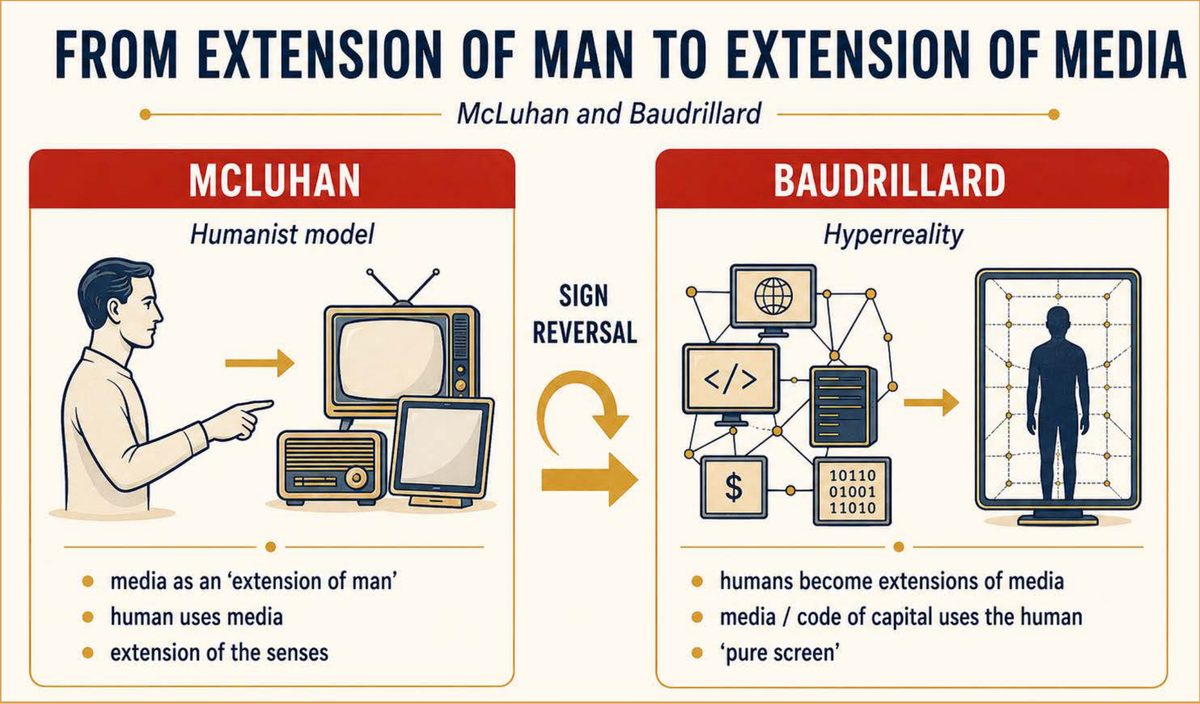
Nevertheless, it is important to reiterate that Baudrillard’s project was to defend the real against the combined accumulation of signs and capital, and as he noted, his detractors often seemed to be “confusing message and messenger” (2005: 23). Baudrillard sought to de-commodify culture by introducing “symbolic exchange”, which refers to any social practice that defies the “repressive, reductive, rationalizing metaphysic of utility” (1981: 141). From this perspective, symbolic exchange develops when the logic of the sign is abandoned, thereby acting as the radical negation of sign value in commodity exchange and allowing for the emergence of other forms of exchange. The difference between sign value (linked to commodity exchange) and symbolic value (linked to gift exchange) came to play a more important role in Baudrillard’s work up to his death. In an ironic reversal of McLuhan’s (1964) humanist theorisation of the media as an ‘extension of man’, Baudrillard claimed that, in hyperreality, humans have become extensions of media; the only resistance to the sign value of commodity exchange is symbolic exchange with its “uninterrupted cycle of giving and receiving” (1975: 143). In the case of the election of a ‘non-politician’ like the businessman and reality TV star Donald Trump to the highest office in American politics, the right has successfully exploited the hyperreal – not least in the form of what Kellner describes as the daily posting by the President on social media platforms, including his own Truth Social, of “flat-out lies, absurdities, outrages, and outrageousness” (2021) – by claiming to disrupt ‘elites’ on behalf of working class voters, thereby manipulating the electorate into misrecognising the hegemony of economic capital – such as in the form of large corporate tax cuts, thereby intensifying existing concentrations of power and wealth – as symbolic de-commodification. To effectively challenge right-wing hegemony, Baudrillard implies that the left must adopt the ‘fatal strategy’ of abandoning its humanist and rationalist presumptions for the disruptive logic of symbolic exchange, whereby:
… the limit point in which all alternative values spasm into their opposite: such as life and death, good and evil, chance and fate, male and female, human and inhuman … As such, reversibility can also be considered a strategy emerging from within any given arrangement: the immanent potential for subversion or metamorphosis.” (2008: 12)
Baudrillard here evokes an accelerationist strategy that diverges from the Marxist oppositionality adopted in his first three books, dismissing decelerative, humanist solutions in favour of what Mackay and Avanessian describe as “an affirmation that the increasing immanence of the social and technical is irreversible and indeed desirable … in a concrete transition to another life beyond the iniquities and impediments of capital” (2014: 8). For Baudrillard, the aim is to strategically disrupt the seamlessness of simulacra in the hyperreal, which, if successful enough, will gain the status of an event and become a “poetic singularity” (1996: 103).
Baudrillard’s later work points to a stage in which the hyperreal has been pushed to its limits and where all frames of reference have dissolved, to the extent that, as Gane observes, “all the previously secure categories of social knowledge which have guaranteed the articulated spheres of being are undermined: economic, political, religious, sexual, cultural, as well as the human itself” (2000a: 43). Baudrillard refers to this stage as “transpolitical” (2008:
45), in which critical engagements with knowledge, society and reality must be transformed to correspond with the decline of Enlightenment assumptions about truth and rationality. Now, the only way for engagement to be effective is to produce ‘radical thought’:
Radical thought is a stranger to all resolving of the world in the direction of an objective reality and its deciphering. It does not decipher. It anagrammatizes, it disperses concepts and ideas and, by its reversible sequencing, takes account both of meaning and of the fundamental illusoriness of meaning … Cipher, do not decipher. Work over the illusion to create an event. Make enigmatic what is clear, render unintelligible what is only too intelligible, make the event itself unreadable. Accentuate the false transparency of the world to spread a terroristic confusion about it, or the germs or viruses of a radical illusion. (1996: 104)
Producing radical thought in hyperreality involves making events “unreadable” by accentuating their “illusoriness”, resulting in a disruptive irony. According to the Cambridge Dictionary, ‘irony’ is not only the sarcastic use of words to imply the opposite meaning, but also the revelation of a fundamental incongruity between that “which was intended to have a particular result (but) has the opposite or a very different result”. For example, the ironies involved in efforts to ‘clean-up’ politics in America reveal the fundamental hypocrisy of power in late capitalism and weaknesses in its hyperreal structures. While referring to the impeachment of Bill Clinton, Baudrillard’s statement below can be readily applied to the multiple attempts to dethrone Donald Trump on moral grounds:
By managing to condemn a perversion of justice that verges on the betrayal or a solemn oath, the judge is contributing to building the image of a ‘clean’ America. And one, therefore, which benefits from an enhanced moral power to exploit the rest of the world (even if it does so democratically). (2003: 34)
Soon after Trump’s first election win, women, segments of the media, and political rivals launched an attack on the President by exposing his sexual vulgarities and misdemeanours, including the covering up of a hush money payment to the adult film star Stormy Daniels (Morgan, 2025). Around the same time, revelations of wide-scale sexual assault and harassment by Hollywood producer Harvey Weinstein, and others in the film, television, and other media industries, as well as politicians, were circulated, reinforced by coverage of the social justice movement #MeToo through which women felt able to publicly recount their experiences of sexual abuse. Yet, unlike Weinstein, the President escaped significant criminal and political penalty, despite the image of a ‘clean’ America having long since passed in the public imagination, partly resulting from Trump’s, Weinstein’s, and their entourages’ historic misbehaviour. In a Baudrillardian context, radical thought on the part of Trump’s opponents would involve going beyond the normalised expressions of outrage at his actions to ironically highlight the systemic procedures that have allowed him to retain power.
In a critique of Baudrillard’s performative text, Fatal Strategies, Levin argues that:
… the fatal strategy is not a political strategy in the sense of a subject ‘position’ in relation to an object or goal … The fatal strategy is in a way neither active nor passive, but a kind of magical identification with the actions of things … one’s ‘opposition’ comes out of the system itself” (1996: 271-272).
In Baudrillard’s analysis, “magical identification” as an oppositional strategy is not defined in terms of its representational value. As Patton noted in his translator’s introduction to The Gulf War Did Not Take Place, Baudrillard “believes that writing should be less a representation of reality than its transfiguration and that it should pursue a ‘fatal strategy’ of pushing things to extremes” (1995: 6). In this spirit, this article invites readers to use Baudrillard as a means by which online and leftist YouTubers can cipher rather than decipher; that is, to strategically use language beyond traditional leftist discourse to challenge and disrupt capitalism from within its linguistic and communicative structures.
Baudrillard’s theorisation in Fatal Strategies falls within a leftist critical framework, in which leftism is defined (ironically) from a Marxist critique of cultural hegemony. Baudrillard rejects the humanist presumptions of Marxism, such as the origin of ‘the social’ drawn from Thomas Hobbes’ theory of the contractual binding of the state and the people, whereby, from a Marxist perspective, such a ‘social contract’ develops out of the relationship between the ruling and working classes. However, as Shanyi argues, “Baudrillard claimed that there has never been … a responsible collective subject, and no social project … has ever really existed” (2023: 290). Forgoing even the notion of a critical political economy of the sign, Baudrillard later comes to believe that the reproduction of society no longer centres on reproducing the mode of production, but on the overproduction of the real, the hyperreal:
The other production, that of values and commodities, that of the belle epoque of political economy, has for a long time had no specific meaning. What every society looks for in continuing to produce, and to overproduce, is to restore the real that escapes it. That is why today this ‘material’ production is that of the hyperreal itself. (1994: 23)
There is no longer a ‘real’ base where production takes place. There is only the hyperreal, which appears more real than the real world itself; for Baudrillard, we live in a world where apparent contradictions merely exist to simulate the differentiation of subjectivity. Taken to its most extreme conclusions in Fatal Strategies, this theory asserts that objects have come to rule subjects and the social has disappeared. While, as Gane identifies, this is not to say “society has been dissolved; what has changed is the idea of a society with a systematic overdetermined complexity, or a society in depth, having a separated structure of economic basis and political, cultural, and social spheres” (1991: 126). We as subjects must accept this dissolution and adopt objecthood ourselves.
According to Baudrillard, a transpolitical objecthood would be able to simultaneously internalise and critique the:
… transparency and obscenity of information in a universe emptied of event, the transparency and obscenity of space in the promiscuity of networks, transparency and obscenity of the social in the masses, of the political in terror, of the body in obesity and genetic cloning … the end of the scene of the body – irruption of the obscene. The end of the secret – irruption of transparency. (2008: 45)
The “transparency and obscenity” of information, the social, space, terror, and the body have accelerated since Baudrillard’s death, notably demonstrated in the intensification of media (mis/ dis)information, perverse ‘irruptions’ of aggression and hate in social media, and the ‘obscene’ overexposure of politicians and celebrities by themselves or their detractors, as well as social networking promotion by individuals whose ‘personal branding’ often involves sharing the most intimate and sometimes shocking aspects of their private lives. President Trump and others on the right venerate the use of social media to mis/disinform the public and to distract and deflect from their attacks on the legal and democratic institutions that could constrain their objectives. For example, President Trump’s former political adviser Steve Bannon referred to this accelerationist strategy as one of “shock and awe”, whereby “(a)ll we have to do is flood the zone. Every day we hit them with three things. They’ll bite on one, and we’ll get all of our stuff done, bang, bang, bang” (Gagliardi, 2025). In addition, with the death of the social, society becomes overexposed to media events that replace the spectacles of consumer society with the obscenity of the screen that transmits content instantaneously: “Obscenity begins precisely when there is no more spectacle, no more scene when all becomes transparency and immediate visibility when everything is exposed to the harsh and inexorable light of information and communication” (1988: 130). Without defense or distance, we become “a pure screen, a switching center for all the networks of influence” (1988: 133). Gane highlights that overexposed politicians and celebrities “are transpolitical figures in a society in which the social is no longer a vital principle” (1991: 126). In the transpolitical, the era of interiority, subjectivity, meaning, privacy, and inner life is over; a new era of obscenity, instantaneity, and transparency begins.
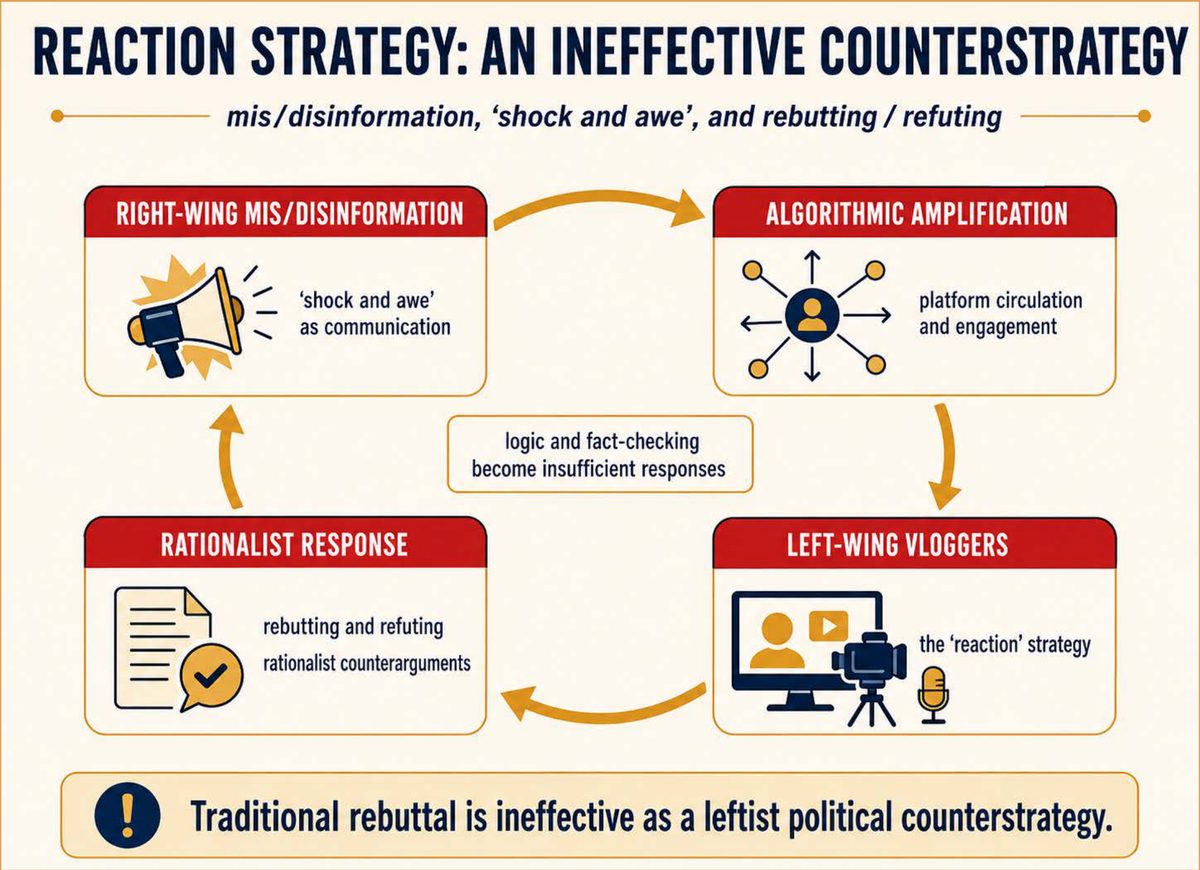
Fatal Strategies articulates the possibility of a critical response to the hyperrealisation of the social; a position from which leftist social media influencers and YouTubers have considerable strategic agency. Having grown up with the Internet, instantaneous communication and streaming content as everyday experiences, feelings of alienation for screen-savvy young people are more likely to be framed by the ecstasies of speed and simulation rather than material absence. The Marxist tradition seeks to explain, in a humanist manner, the needs and desires of the masses. It assumes, theoretically, the alienation of the masses from themselves and their labour, which has demonstrably created a schism between the critical commentator and the masses. Baudrillard argues that traditional left-wing critique based on “objective information, the increase of collective happiness, the understanding of facts and causes” is ineffective as a form of political intervention, “except in reply to opinion polls” (2008: 100). In the context of online political discourse, such a strategy offers a sense of intellectual superiority and complacency, inviting participants to respond as expected to algorithmic processes. However, this approach is far from effective in the sense that it is based on ‘factual’ humanist and rationalist biases inherited from Enlightenment modernity. Instead, as Baudrillard argues, what “fascinates everyone is the debauchery of signs, that reality … is debauched by signs” (2008: 100). In response to right-wing mis/ disinformation and ‘shock and awe’ as communication, left-wing vloggers and YouTube commentators have tended to opt for the ‘reaction’ strategy that provides rationalist counterarguments to the announcement of conservative policies and the commentary of right- wing social media counterparts. This process of rebutting and refuting has played a central role in online left-wing narratives and is firmly located within the humanist sign systems of modern political discourse but is ineffective as a leftist political counterstrategy. Baudrillard’s theorising of the transpolitical shows the need for new critical and communicative strategies to contend with the ongoing proliferation of hierarchical sign-systems as forms of ideological hegemony, entrenched by the power of material institutions in the late-capitalist mode of production. Thereby, a Baudrillardian leftism would be one not based on the “illusion” of the social, but on reversibility, irony, obscenity and challenge. It is in these approaches the hope for a transpolitical reversal of the hyperreal lies.
For Baudrillard, the erosion of the social in late capitalism has introduced a series of “transpolitical figures”, defined by Baudrillard in Fatal Strategies as: the ‘obese’, an informational overflow that perpetuates its own logic; the ‘hostage’, whose fate is aleatorily determined outside their control, and the ‘obscene’, through whom every ‘secret’ is exposed as non-existent (2008: 45). While these figures are distinctly substantiated as adaptable for both left-wing and right- wing causes (they are, after all, transpolitical), below, I apply their ideologies and methodologies to the communicative strategies of some of the most effective leftist YouTuber vloggers and video essayists, based on subscriber counts at the time of writing (June 2025).
OBESITY: THE TRANSPOLITICS OF SPACE
In Fatal Strategies, ‘obesity’ is defined by Baudrillard as the characteristic of over-consumption in western societies. While he correlates overeating and the excessive consumption of media, the term is not necessarily intended to be abusive or defamatory. Rather, Baudrillard draws on the Lacanian notion of the mirror stage of infantile development to define obesity as an obscene form of abundance that indicates systemic collapse in the social permeation of a regressive orality. Thereby, the “secret form of the mirror, by which the body watches over itself and its image, is abolished, yielding to the unrestrained redundancy of a living organism” (2008: 47). If obesity is defined as “taking up space” (2008: 47), the obese are not separate from the world, nor do they have a sense of totality; they are driven simply to occupy space incessantly. As such, space refers to the basis on which boundaries are drawn; ‘taking up space’ denotes the passive cancer-like disappearance of limits and the indiscriminate intake of information.
The strategic value of the transpoliticisation of space is strongly evoked by Turkish American streamer Hasan Piker, who also uses the ‘HasanAbi’ pseudonym. Piker’s main channel has a subscriber count of 1.62 million and uploads videos around 3-4 times per day that vary in length from around 15 minutes to over an hour, with the latter usually consisting of joint streams with fellow leftist vloggers and political commentators. Piker’s YouTube content addresses traditional leftist and social justice issues such as gun control; LGBTQ+ rights; universal education and health care; worker power and autonomy, and anti-Zionism. However, in antithesis to the right-wing caricature of the left-wing campaigner and ‘social justice warrior’ (SJW) who fixates on a single issue linked to identity politics, Piker has a significant presence on the livestreaming video games platform Twitch, where, at the time of writing, he is the platform’s fourth most-subscribed channel (Twitchtracker, 2025) and is considered its “de facto political commentator” (Foxman et al, 2024). While gaming is still considered a male-focused activity, Piker’s appearance and persona in his YouTube videos align with the physical and communicative attributes valued by those who populate the manosphere spaces in which rigid masculinities are propagated in unrestrained and often crass ways by largely young male participants, even if Piker’s leftist politics diverge from the right-wing ideologies these audiences typically espouse. Piker Is exceptionally tall, regularly visits the gym, and has the idealised physical characteristics of an ‘Alpha’ male in his early-30s. Temperamentally, he is agentic and assertive, often extolling self-improvement strategies to detoxify the behaviours of young men vulnerable to the gender essentialism and social isolation that often characterises manosphere participants (van Valkenburgh, 2021). Thereby, introjected feelings of romantic and interpersonal failure are reframed as consequences of neoliberal hyper-individualism and the alienation of deindustrialised working-class men. Those attracted to manosphere content for its irreverence, frank debate, and open discussion, could feasibly fall into the orbit of an iconoclastic leftist who disdainfully critiques conservative and right-wing ideology while lampooning the strategic ineffectiveness of mainstream progressive political discourse. For example, in the video ‘WHY IS THIS STILL AN ISSUE?’ (16th June 2025), which addressed leftist discourse on the role of self-determination in the hyper-sexualisation of female pop stars like Sabrina Carpenter, Piker claims that:
Gen Z has become hyper-puritanical … It comes from a place of powerlessness … You go out there to protest, but then nothing changes, so you look to your favourite influencers where you can have some semblance of influence … This is the kind of thing that happens all the time with the ‘woke’ SJWs, and so-called ‘cancel culture’ … I think it’s wholly unproductive at the end of the day … It’s infantilising to act like she (Carpenter) is a victim of the exploitative and perverse forces of capital.
In this editorial commentary, Piker is critiquing the apparent tendency of young leftists – namely those identified as belonging to Gen Z and “woke SJWs” – to overemphasise identity politics as a defeated strategy of ressentiment that has the unintended effect of deflecting attention from structural considerations associated with economic inequality. His unapologetic ideological positioning and rhetorical style seems to affirm his perceived authenticity among followers. In this context, Marantz (2025) describes Piker as the “Joe Rogan of the left” – referencing the comedian and sports broadcaster’s eponymous Joe Rogan Experience podcast, which is hugely popular among right-leaning young men – based on Piker’s tolerance of controversy and ‘Alpha’ male appeal.
Piker’s interaction style consists of him streaming from his Los Angeles- based hybrid bedroom-office where he multitasks on a computer while followers identify news items and fandom-specific memes for his commentary. Unlike traditional journalists, whose work is guided by objectivity and editorial oversight, political vloggers like Piker build a sense of trust through interpersonal affinity, transparency, and connectedness, affirming Burgess and Green’s view that vlogging is “the emblematic form of YouTube participation” (2018: 53). Additionally, an ideologically driven rhetorical style is used to deflect potential accusations of complicity with the corporate ownership of online platforms. For example, on Twitch, Piker will occasionally role-play as ‘Hank Pecker’, an ethno-political caricature of a conservative ‘redneck’ – a derogatory term typically applied to rural white American conservatives perceived to be crass and unsophisticated – while, in political commentary on YouTube, Piker frequently refers to the same group as ‘hogs’, with elderly politicians referred to as ‘vampires’. In this respect, Piker reframes from a socialist perspective online ‘Edgelord’ discourse in which far right individuals on platforms like the anonymous forum site 4chan intentionally seek to deride or shock leftist targets. Having occupied so much space and absorbed so much information, such obese participants tend to deny a coherent ideological basis in fear of being ridiculed as ‘right wing’, while forcefully defending forms of ‘free speech’ that attest to their extremist beliefs. Neubaum (2024) illustrates a discrepancy between right-wing forum participants who reject any political affiliation, and the large number of vloggers and social media influencers who explicitly identify with a right-wing political stance, such as conservative, Republican, or pro-Trump. Thereby, as Piker demonstrates, a leftist approach can benefit from exploiting the ironies of obesity in online culture, strategically combining the ‘edgy’ visual and linguistic signs with open demonstrations of a consensus-driven political consciousness more consistent with socialist values.
THE HOSTAGE: TERRORISM AND CANCELLATION
“The hostage” is the second transpolitical figure that offers a fatal strategy for leftist political critique via ‘new’ information and communications systems. In his exploration of the oppositionality between symbolic and simulation cultures, Baudrillard examines how hostages of terrorism experience the absence of agency while intensified counter-terrorism strategies ironically undermine wider societal structures in their deployment. He argues that terrorists have adapted to simulation; their acts are staged for the media and become part of the world of self-referential signs in hyperreality:
We are all hostages, and we are all terrorists. This circuit has replaced that other one of masters and slaves, the dominating and the dominated, the exploiters and the exploited. Gone is the constellation of the slave and the proletarian: from now on it is the hostage and the terrorist. Gone is the constellation of alienation: from now on it is that of terror. It is worse than the one it replaces, but at least it liberates us from liberal nostalgia and the ruses of history. It is the era of the transpolitical that is beginning. (2008: 61)
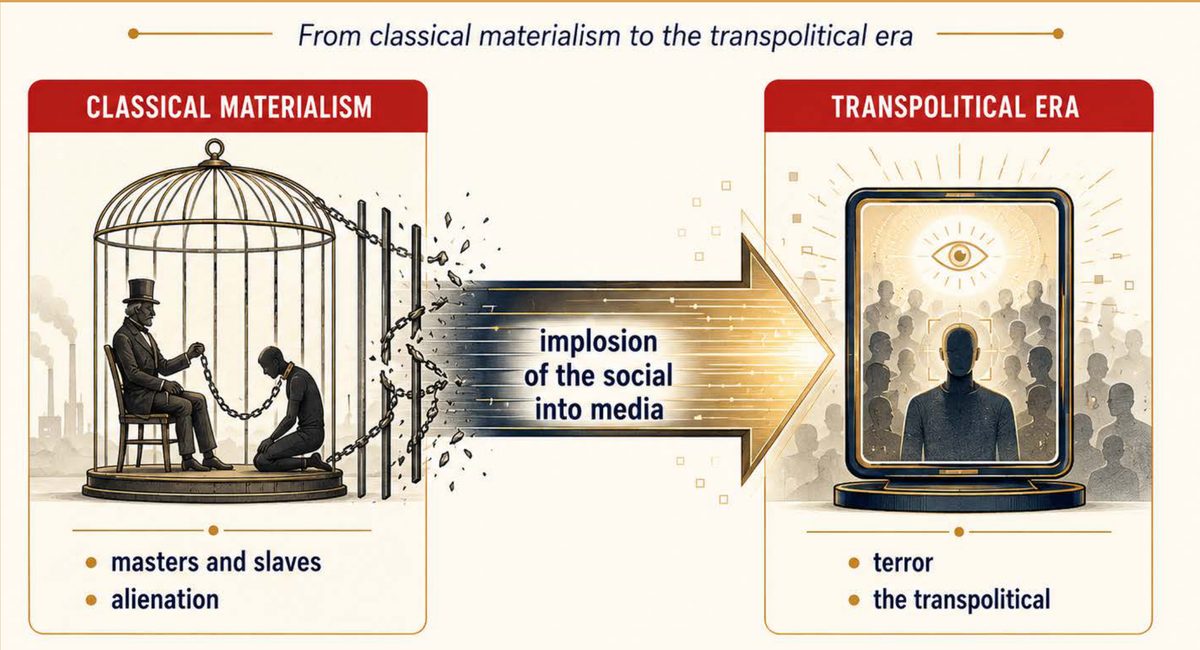
For Baudrillard, there is no hostage-terrorist dichotomy; in the transpolitical era, everyone is responsible for terror, and everyone can behave like a terrorist. At the same time, everyone is held hostage by terror.
In a culture of simulation, the responsibility for creating a ‘toxic’ online environment that propagates fake news and (mis/dis)information is often framed as a form of collective behaviour. Taking responsibility for others’ irresponsibility is generalised and everyone is made complicit with power. Such is the basis of ‘cancelling’ and ‘cancel culture’, whereby everyone in a group or ‘safe space’ becomes a hostage at risk of blackmail. For Žižek:
… (c)ancel culture, with its implicit paranoia is a desperate (and obviously inefficient) attempt to compensate for actual troubles and tragedies … the violence and exclusion to which (marginalised groups) are permanently subjected. The answer to this violence cannot be the retreat into a cultural fortress; a pseudo ‘safe space’ whose discursive fanaticism leaves intact and even strengthens the resistance of the majority to it (2023: 105).
The “discursive fanaticism” of cancel culture can be understood as a form of extortion or intimidation, where individuals or groups use the threat of public shaming to silence or control others, often using new forms of media technology, either in the shaming of individuals on social media and instant messaging platforms, like X and WhatsApp, as well as through the circulation of AI-generated ‘deep fakes’, where images, videos or audio recordings are maliciously or surreptitiously manipulated to mimic a likeness. Žižek’s analysis of the paradox of ‘safe spaces’ affirms Baudrillard’s view that power in hyperreality permeates society through the circulation of signs, rather than via direct control; “terrorism is only the executioner for a system which itself also seeks both total anonymity and, at the same time and contradictorily, total responsibility for each of us” (2008: 57). While hostages are made responsible for systematic violence, terror cannot be diffused through cancellation. Terror is aleatory, defined by challenge, chance and randomness. The terrorist, who is also a hostage, has no responsibility for their fate.
The transpolitical terror-hostage dynamic of cancel culture is enacted across the ideological spectrum. Conservatives and conservative-adjacent spaces such as the manosphere advocate a return to pre-modern and often religious values against postmodern decadence. In Western societies, these calls from the right are combined with the espousal of individualised economic abundance at the expense of state-led and centralised services that can mitigate the socially and morally deleterious effects of economic inequality as the accumulation of private wealth increases. At the same time, the right has enacted, as Sarkar illustrates, a spurious “culture war” against marginalised groups and their allies, denoted by race, gender and sexual orientation, as a means by which to deflect accountability for grievances rooted in iniquitous material and economic circumstances:
… the right’s strategy is this: to subvert, diffuse and redirect class conflict … which along with technology is the most powerful engine of social transformation in our history … All the while those in power get away with imposing the economic policies which have impoverished the white working class in the first place (2025: 18-19).
Conversely, the left typically preaches permissiveness regarding issues of cultural. gender and sexual identity. However, in its attempts to guarantee this tolerance, it requires the escalation of rules, with more ‘cancelling’ and regulating, that introject anxiety and tension in these ostensibly ‘safe’ or permissive spaces, whether physical or virtual. In these spaces, we have, according to Sarkar, “nurtured a culture that’s deeply individualistic, where to be seen as a victim, to be able to claim a marginalised identity position, gives you social capital” (2025: 26). Thereby, a late-capitalist culture is one where all individuals are potential terrorists, and all can be held hostage, with permissiveness transformed into the fundamentalist terror of universal prohibition; in a ‘woke’ regime, it is difficult to know when participants in permissive spaces will be blackmailed or cancelled for their acts or words, as the rules of engagement are often unclear.
By eschewing a version of cancel culture that supports the accumulation of social capital in the context of late-capitalist individualism, Kyle Kulinski – the host and producer of The Kyle Kulinski Show on his YouTube channel Secular Talk, which has 1.85 million subscribers at the time of writing (June 2025), and co-host with his wife Krystal Ball on the podcast Krystal, Kyle & Friends – shows how the terror-hostage dynamic can be adopted as a fatal strategy of the populist left; the Secular Talk YouTube page contains the caption the “home of news and politics commentary from the populist left perspective”. Like Piker, Kulinski is in his 30s and presents a wide range of cultural and political content using a confrontational and sometimes profane tone. However, unlike Piker, Kulinski’s style of presentation adopts the semiosis of mainstream news broadcasting, often appearing in smart suits and facing the camera directly in his multiple daily uploads, while his youthful looks, carefully groomed beard and short-cropped hair give him the allure of an ‘all-American boy’ or upper-class ‘prep’ student.
The ‘Jon Stewart TORPEDOES MAGA ‘Cancel Culture’ (7th January 2025) episode employs the Secular Talk format of intercutting editorial commentary with clips from news, broadcast and online media, in this instance, from the comedian Jon Stewart ridiculing conservative politicians and commentators who claim to have been de-platformed by the ‘woke left’ while censoring any criticism of Donald Trump’s MAGA (‘Make America Great Again’) ideology. However, while Kulinski uses the episode to mock the right’s apparent hypocrisy, he also uses it to suggest opportunities for the left’s strategic deployment of the communicative discourses of social media that have hitherto mainly benefitted right-wing cultural hegemony and conservative political success:
This is just social media in today’s age … Outrage is gonna get the anger and the energy … The idea is to take that the anger and the ‘cancel culture’ (narrative) and direct it at … the war criminals, the robber barons … and the corrupt politicians. That’s where the outrage has to go.
Together with arguing for the importance of engaging those with political beliefs not informed by leftist thinking, in a transpolitical culture where everyone can be both a hostage and a terrorist, Kulinski is seeking to forge alliances between disparate factions of ‘angry’ progressive and working-class groups to establish one ideologically cohesive unit against the ‘real’ enemies of the people, namely the “war criminals, (corporate) robber barons … and the corrupt politicians”. Kulinski is critical of leftist tendencies to exclude dissenting views in the apparent support of minority groups, as some of these dissenters may be sympathetic to socialism’s historic class struggle, and which have the unintended effect of prolonging these groups’ positions as victims, or hostages.
OBSCENISM: DISAPPEARANCE OF THE SCENE
Baudrillard’s etymology of the obscene is based on the ‘scene’ as the prerequisite space of meaning; “(f)or something to be meaningful, there has to be a scene, and for there to be a scene” (2008: 90). For Baudrillard, scenes can be defined in terms of God, reason, truth, the political, or the social; primary spaces from which meaning and the real originate. In the West, the obscene is realised in the terrorism of excessive appearance that brings about the loss of “an illusion, a minimum of illusion, of imaginary movement, of defiance to the real” (2008: 90). The illusion is not to be equated with the idea of the false, and the real must be humiliated, just as it has humiliated illusion, for only in this way can obscenity itself be unhinged.
The election of a businessman, reality TV star and convicted criminal to the American Presidency suggests that humiliating the West’s political reality cannot merely involve the debunking of falsehood to reveal the ‘truth’, thereby restoring the illusory performativity of truth and meaning. Rather, the obscene itself must be realised as illusory in the performative spaces of Western media and social media. Perhaps the most well-known and obscene of the YouTube leftists is Cenk Uygur, host of the popular YouTube news show with Ana Kasparian, The Young Turks (6.13 million subscribers), and Chief Executive Officer of the TYT network of left-wing news channels. Along with alluding to Uygur’s Turkish American background, the channel’s name is evocative of his bombastic and antagonistic rhetorical style. In addition, Uygur has shown the ability to organise his followers towards radical political ends. In 2011, he founded the political action committee Wolf PAC to lobby for the limiting of corporate donations within the United States’ political system and the public financing of all United States elections. In the episode ‘Cenk Announces Wolf PAC.com at Occupy Wall Street’ (20th October 2011), Uygur dramatically announced the creation of Wolf PAC, filming himself near the site of the September 11th World Trade Centre terror attacks, asserting that:
Tonight, we’re going to start a fight to take back our democracy. Our politicians are bought. Who bought them? Corporations did. Corporations are not immoral. They have no morality. Corporations are profit-making machines. We must not let the machines take over our government.
Like his nephew Hasan Piker and Kyle Kulinski, Uygur is critical of the Democratic Party’s dependence on corporate donations and its inability to substantively counter the Republican Party’s prioritisation of the interests of the rich and privileged, despite its historic progressive and social democratic commitments to the redistribution of wealth. For example, Uygur responded to Donald Trump’s first presidency by announcing on YouTube the creation of a new wing of the Democratic Party, the ‘Justice Democrats’, which he co-founded with Kulinski. In the video ‘The Democratic Party Takeover HAS BEGUN’ (24th January 2017), Uygur explained that Justice Democrats are an answer to what he sees as a corrupt and ineffectual Democratic Party, and begins the video by asserting “the Democrats used to represent something wonderful – the voters”, but after “realising they could take corporate cash like the Republicans … the Democratic Party slowly became the ‘establishment Democrats’. The ‘corporate Democrats’ you know now”. Uygur ends the video by arguing for the repurposing of corporate tactics to orchestrate a hostile takeover, challenging incumbent congressional Democrats by running “strong progressives” who pledge to refuse corporate donations.
The strategic repurposing of reactionary right-wing discourse by Uygur and The Young Turks is an example of Baudrillard’s claim that radical thought can benefit from the “reversible sequencing” that “takes account both of meaning and of the fundamental illusoriness of meaning” (1996: 104). In this example, meaning is correlated with ‘establishment’ politics in which the Democratic and Republican parties are seemingly interchangeable in their transpolitical corporatism and indifference to most voters’ rational interests, and whose systemic performativity is based on a scene of oppositional illusoriness. Thereby, the US political system’s dependence on signs of corporate power to suppress or redirect anti-corporate sentiment offers the possibility of the reconfiguring of such signs into a progressive messaging that introjects the ‘politics of business’; for example, the deployment of language referring to ‘strong’ goal setting, information control, and the forming of acquisitive strategic alliances for socialist ends. Such a reversal illustrates the extent to which traditional left-wing campaigning based on debunking and lamenting the loss of the social have become ineffectual against reactionary trends in the age of social media, as leftist methodologies are often unwilling to acknowledge the obscenity of ecstatic sign exchange that is already devoid of rationality.
Baudrillard’s philosophical trajectory can be delineated from prescient Marxist critic of ubiquitous sign systems in late-capitalist consumer culture to pessimistic harbinger of socialist irrelevance in a transpolitical condition of simulation and the hyperreal where political action is doomed to failure on account of the implosion of the social with the desires and impulses of capital. In particular, the intertwining of the social with digital communications in the form of social media illustrates how the convergence of ideological, political and technological changes has strongly benefitted conservative and right- wing political interests, especially in the profusion of (mis/dis)information and fake news. In this sense, the twice-elected US President Donald Trump personifies the hegemony of contemporary transpolitics, where the line between the media and political discourse has been elided to the extent that the President’s lies and indiscretions did not derail his electoral ambitions, but instead affirmed the contiguity between his politically intemperate ‘shock and awe’ communicative style with post-truth norms in the social media age. This involution of the technical and the discursive reinforces Baudrillard’s claim in Fatal Strategies that objects have come to rule subjects, and the social has been displaced by simulation. The only possibility for leftist resistance is to accept this defeat and adopt objecthood; more specifically, the strategic use of language beyond the humanist and rationalist presumptions of Marxism to challenge and disrupt capitalism from within its linguistic and communicative structures, thereby fomenting opposition from the “magical identification with the actions of things” (1996: 271). As the examples of Hasan Piker, Kyle Kulinski and The Young Turks suggest, the shrewdest Marxists, socialists and social democrats in the social media ecosystem understand the limits of using facts and logic to achieve their progressive and revolutionary aims. A more transpolitical framing of truth and reality that can circumvent accusations of Marxist elitism is thereby needed to reveal effective spaces for instigating political action based on the creation of reality as it is experienced.
References
Acid Horizon (2025) ‘Baudrillard, Techno-Fascism and the Tyranny of Advertising’. YouTube. 13 April. Available at: https://www.youtube.com/watch?v=B4hPDame1f0 (Accessed: 30 June 2025)
Baudrillard, J. (1975) [1973] The Mirror of Production, trans. Mark Poster, St. Louis, Mo: Telos Press.
Baudrillard, J. (1981) [1972] For a Critique of the Political Economy of the Sign, trans. Mark Poster, St. Louis, Mo: Telos Press.
Baudrillard, J., and Maclean, M. (1985) ‘The Masses: The Implosion of the Social in the Media’. New Literary History, 16(3), 577– 589.
Baudrillard (1988) The Ecstasy of Communication. trans. Bernard Schütze and Caroline Schütze, Cambridge, Mass. and London: Semiotext(e).
Baudrillard, J. (1994) [1981] Simulacra and Simulation, trans. Shelia Faria Glaser, Ann Arbor: The University of Michigan Press.
Baudrillard, J. (1995) [1991] The Gulf War Did Not Take Place, trans. Paul Patton, Bloomington and Indianapolis: Indiana University Press.
Baudrillard, J. (1996) [1995] The Perfect Crime, trans. Chris Turner, London and New York: Verso.
Baudrillard, J. (1998) [1970] The Consumer Society. trans. Chris Turner, London: Sage Publications.
Baudrillard, J. (2003) [2000] Passwords, trans. Chris Turner, London and New York: Verso.
Baudrillard, J. (2005) [2004] The Intelligence of Evil or the Lucidity Pact. trans. Chris Turner. New York and Oxford: Berg.
Baudrillard, J. (2008) [1983] Fatal Strategies. trans. Philip Beitchman and W. G. J. Niesluchowski, Cambridge, Mass. and London: Semiotext(e).
Buckingham, D. (2019) The Media Education Manifesto, Cambridge: Polity Press.
Burgess, J. and Green, J. (2018) YouTube: Online Video and Participatory Culture, Cambridge: Polity Press.
Datareportal (2025) ‘YouTube Users, Stats, Data & Trends for 2025’. Datareportal. 12 March. Available at: https://datareportal. com/essential-youtube-stats (Accessed: 30 June 2025)
Davidson, M. (2023) ‘Jean Baudrillard Grasped the Symbolic Life of Capital but Lost Track of the Material World’. Jacobin. 18 June. Available at: https://jacobin. com/2023/06/jean-baudrillard-grasped- the-symbolic-life-of-capital-but-lost- track-of-the-material-world/ (Accessed: 01 July 2025)
Fisher, M. and Taub, A. (2018) ‘Should We All Be Taking Irony Poisoning More Seriously?’ New York Times. 23 August. Available at: https://static.nytimes.com/email-content/INT_4981.html (Accessed: 10 August 2025)
Forbes.com (2025) ‘Alphabet’. Forbes. Available at: https://www.forbes.com/ companies/alphabet/ (Accessed: 30 June 2025)
Foxman, M., Harris, B. C., and Partin, W. C. (2024). Recasting Twitch: Livestreaming, Platforms, and New Frontiers in Digital Journalism. Digital Journalism, 12(4), 516– 536. https://doi.org/10.1080/21670811.2024 .2329648
Fuchs, C. (2010) ‘Labor in Informational Capitalism and on the Internet’. The Information Society, 26(3), 179–196. https://doi. org/10.1080/01972241003712215
Gagliardi, A. (2025) ‘Shock and Awe: The Method to Trump’s Madness’. The Lion. 10 February. Available at: https://thelion. sites.lmu.edu/opinion/shock-and-awe-the- method-to-trumps-madness/ (Accessed: 09 July 2025)
Gane, M. (1991a) Baudrillard’s Bestiary: Baudrillard and Culture, London and New York: Routledge.
Gane, M. (1991b) Baudrillard: Critical and Fatal Theory, London and New York: Routledge.
Gane, M. (2000) Jean Baudrillard: In Radical Uncertainty, London: Pluto Press.
Gogarty, K. (2025) ‘The right dominates the online media ecosystem, seeping into sports, comedy, and other supposedly nonpolitical spaces’. Media Matters for America. 14 March. Available at: https://www. mediamatters.org/google/right-dominates-online-media-ecosystem-seeping-sports-comedy-and-other-supposedly?utm_source=www.chaoticera. news&utm_medium=referral&utm_campaign=on-youtube-left-leaning-channels- are-growing-faster-than-the-right\ (Accessed: 30 June 2025)
Herrman, J. (2017) ‘For the New Far Right, YouTube Has Become the New Talk Radio’. The New York Times Magazine. 3 August. Available at: https://www.nytimes. com/2017/08/03/magazine/for-the-new- far-right-youtube-has-become-the-new- talk-radio.html (Accessed: 30 June 2025)
Jenkins, H. (2014) ‘Rethinking ‘Rethinking Convergence/Culture’. Cultural Studies, 28(2), 267-297. https://doi.org/10.1080/09 502386.2013.801579
HasanAbi (2025) ‘WHY IS THIS STILL AN ISSUE?’. YouTube. 13 June. Available at: https://www.youtube.com/watch?v=0HFoD4BKglQ (Accessed: 01 July 2025)
Kellner, D. (1989) Jean Baudrillard: from Marxism to Postmodernism and Beyond, Cambridge: Polity Press.
Kellner. D. (2021) ‘Baudrillard and Trump’. Baudrillard Now. Available at: https:// baudrillard-scijournal.com/baudrillard- and-trump/ (Accessed: 02 July 2025)
Koeller, D. (2018) ‘Rescinding Daily Pennsylvanian Article’. TYT Blog. 10 April. Available at: https://web.archive.org/ web/20190626085246/https://legacy.tyt. com/2016/04/22/rescinding-daily-pennsylvanian-article/ (Accessed: 10 August 2025)
Levin, C. (1996) Jean Baudrillard: A Study in Cultural Metaphysics, London: Prentice Hall.
Lydon, K. (2020) ‘Gramsci in the Digital Age: YouTubers as New Organic Intellectuals’. The Graduate Review, 5, 34-45. Available at: https://vc.bridgew.edu/grad_rev/ vol5/iss1/8 (Accessed: 30 June 2025)
Mackay, R. and Avenessian, A. (2014) ‘Introduction’. #Accelerate: The Accelerationist Reader, eds. Robin Mackay and Armin Avenessian, Falmouth: Urbanomic, 01-47.
The Majority Report with Sam Seder (2025) ‘Tradwife War Ripping Conservatives apart’. YouTube. 16 April. Available at: https://www.youtube.com/watch?v=Bk0vez_LLYg (Accessed: 01 July 2025)
Marantz, A. (2025) ‘The Battle for the Bros: Young men have gone MAGA; Can the left win them back?’ The New Yorker. 17 March. Available at: https://www.newyorker.com/ magazine/2025/03/24/the-battle-for-the- bros (Accessed: 30 June 2025)
Marx, K. (2008) [1875] Critique of the Gotha Program, Wildside Press, LLC.
McLuhan, M. (1964) Understanding Media: The Extensions of Man, New York: McGraw- Hill.
McWhinney, A. (2021) ‘A Marxist Mission to Rescue Jean Baudrillard’. Negationmag. March 2021. Available at: https://www. negationmag.com/articles/marxist-mission-rescue-baudrillard (Accessed: 02 July 2025)
Morgan, T. (2025) ‘Donald Trump sentenced without punishment in Stormy Daniels hush money case’. ABC News. 10 January. Available at: https://www.abc.net. au/news/2025-01-11/trump-hush-money- sentencing-stormy-daniels/104806590 (Accessed: 02 July 2025)
Morris, J. (2021) ‘Simulacra in the Age of Social Media: Baudrillard as the Prophet of Fake News’. The Journal of Communication Inquiry, 45(4), 319–336. https://doi. org/10.1177/0196859920977154
Neubaum, S. (2024) ‘The Rise of the News-Fluencer: Reaching journalists where their audiences scroll’. Bulldog Reporter. 9 April. Available at: https://www.agilitypr. com/pr-news/content-media-relations/ the-rise-of-the-newsfluencer-reaching- journalists-where-their-audiences-scroll/ (Accessed: 08 August 2025)
Peters, M. A., Neilson, D., and Jackson, L. (2020) ‘Post-Marxism, Humanism and (post)structuralism: Educational philosophy and theory’. Educational Philosophy and Theory, 54(14), 2331–2340. https://doi. org/10.1080/00131857.2020.1824783
Poole, S. (2007) ‘Obituary: Jean Baudrillard’. The Guardian. 08 March. Available at: https://www.theguardian.com/ news/2007/mar/08/guardianobituaries. booksobituaries (Accessed: 8 August 2025)
Powell, A. and Williams-Johnson, D. (2023) “You Dumb Cracker B*tch”: The legitimizing of White supremacy during a Twitch ban of HasanAbi. New Media & Society, 27(3), 1318-1335. https://doi. org/10.1177/14614448231191776 (Accessed: 08 August 2025)
Sarkar, A. (2025) Minority Rule: Adventures in the culture war, London: Bloomsbury.
Secular Talk (2025) ‘Jon Stewart TORPEDOES MAGA ‘Cancel Culture’. YouTube. Available at: https://www.youtube.com/ watch?v=qW6ICUTc6Gw (Accessed: 01 July 2025)
Shapero, J. (2024) ‘Research finds pattern of YouTube recommending right-leaning, Christian videos’. The Hill. 02 October. Available at: https://thehill.com/policy/technology/4727588-research-finds-pattern-of-youtube-recommending-right-leaning-christian-videos/ (Accessed: 30 June 2025)
Shanyi, Y. (2023) Theorizing Fatal Strategies: A New Leftist Vocabulary of Jean Baudrillard. Journal of Education, Humanities and Social Sciences, 21. 289-298. https://doi.org/10.54097/ehss.v21i.14018
Suiter, J. (2017) ‘Post-Truth Politics’. Political Insight, 7(3), 25–27. https://doi. org/10.1177/2041905816680417
Törnberg, P., and Chueri, J. (2025) ‘When Do Parties Lie? Misinformation and Radical-Right Populism Across 26 Countries’. The International Journal of Press/Politics, 0(0). https://doi. org/10.1177/19401612241311886
Twitchtracker.com (2025) ‘Twitch Subs Count and Stats’. Twitchtracker. Available at: https://twitchtracker.com/subscribers (Accessed: 14 June 2025)
Van Valkenburgh, S. P. (2021) ‘Digesting the Red Pill: Masculinity and Neoliberalism in the Manosphere’. Men and Masculinities, 24(1), 84-103. https://doi. org/10.1177/1097184X18816118
The Young Turks (2011) ‘Cenk Announces Wolf PAC.com at Occupy Wall Street’. YouTube. Available at: https://www.youtube. com/watch?v=ykLB0d4KNAc (Accessed: 10 August 2025)
Discover more from BAUDRILLARD NOW
Subscribe to get the latest posts sent to your email.